
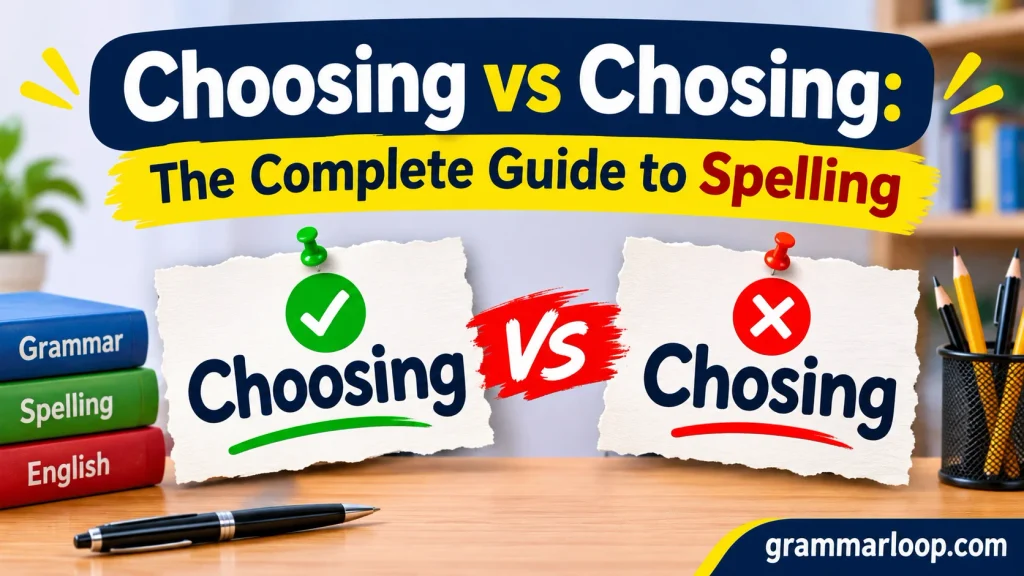
Choosing and chosing may look similar, but only one is the correct spelling in standard English. Many people get confused between these two forms because they sound almost identical when spoken. However, understanding the difference is important for improving your writing, spelling, and grammar skills. The correct word is “choosing,” which is the present participle of the verb “choose.” It describes the action of selecting or making a decision between different options. On the other hand, “chosing” is a common spelling mistake that should be avoided in formal and informal writing. Learning this simple distinction can help you write with more confidence and accuracy.
The word “choosing” follows a straightforward spelling rule that makes it easier to remember. When a verb ends in a silent -e, you usually remove that final letter before adding -ing. For example, “choose” becomes “choosing,” not “chosing” or “chooseing.” This spelling pattern also appears in other common English words, such as “write” becoming “writing” and “make” becoming “making.” Understanding this rule can help you recognize similar spelling patterns and avoid mistakes in everyday communication. Whether you are writing a school assignment, preparing a professional email, or creating online content, using the correct word form makes your writing clearer and more polished.
In this complete guide, we will explore the difference between choosing and chosing, including their meanings, spelling rules, and practical examples. You will learn why “choosing” is correct, how to use it properly in sentences, and which common mistakes to avoid. We will also look at related words, useful examples, and simple tricks to help you remember the correct spelling. Whether you are an English learner, student, blogger, or professional writer, this guide will make the topic easy to understand. By the end, you will feel more confident using choosing in everyday writing and avoid the incorrect spelling “chosing” in your future communication.
Choosing vs Chosing: The Core Difference Explained
At first glance, “choosing” and “chosing” look almost identical. The only difference is one extra “o.” That tiny detail changes everything.
The correct word: Choosing
- Comes from the verb choose
- Used in present continuous tense
- Also works as a gerund (a verb acting like a noun)
Examples:
- I am choosing a new phone today.
- She is choosing between two universities.
- Choosing wisely saves time later.
The incorrect form: Chosing
- Not recognized in standard English
- Appears due to spelling confusion, not grammar rules
- Often created when people drop a vowel by mistake
Example (incorrect):
- ❌ I am chosing my outfit.
Correct version:
- ✔ I am choosing my outfit.
The mistake is common, but English spelling rules don’t support it.
Why “Choosing” Is the Only Correct Form
To understand why “choosing” wins, you need to look at the base verb: choose.
English verbs don’t randomly lose letters when they change form. Instead, they follow predictable patterns.
When we form the present participle (the “-ing” form), we usually:
- Keep the base spelling intact
- Add “-ing” directly
So:
- choose → choosing
Not: chosing
That second “o” is part of the root structure. Removing it breaks both spelling consistency and pronunciation cues.
A simple rule to remember:
If the base verb has a double vowel like “oo,” you usually keep it when adding “-ing.”
Breaking Down the Verb: Choose in All Its Forms
Understanding the full verb system makes this spelling crystal clear.
Here’s how “choose” behaves in real English:
| Verb Form | Spelling | Example Sentence |
| Base form | choose | I choose healthy food. |
| Past tense | chose | I chose the blue shirt. |
| Past participle | chosen | I have chosen my path. |
| Present participle | choosing | I am choosing a career. |
Notice something important here.
The only form that changes the double “o” sound is “chose.” Every other form keeps the structure consistent in its own way.
This consistency is exactly why “chosing” doesn’t exist. English simply doesn’t support that drop.
Why People Mistakenly Write “Chosing”
This mistake doesn’t happen randomly. It comes from how people think, speak, and type.
Let’s break it down.
Pronunciation confusion
When people speak quickly, “choosing” sounds like:
“choozing”
The double “o” sound blends together. Your brain hears one smooth sound, not two distinct vowels.
So when typing fast, many people unconsciously simplify it.
Influence from the past tense “chose”
This is a big one.
People often think:
- choose → chose → chosing ❌
But English doesn’t work like that.
The correct chain is:
- choose → chose → chosen → choosing ✔
That “-ing” form ignores the past tense spelling change.
Fast typing and muscle memory errors
Most mistakes happen during:
- texting
- emailing
- writing under pressure
Your fingers move faster than your brain checks spelling. That’s when “chosing” sneaks in.
Overgeneralizing spelling patterns
English has many verbs that do drop letters when forming “-ing.”
For example:
- make → making (drops “e”)
- write → writing (drops “e”)
So people wrongly assume:
“choose” should become “chosing”
But “choose” follows a different rule set.
Read More: Simple Ways to Say “I Look Forward To”: Better Phrases
A Simple Memory Trick That Actually Works
Here’s a practical trick you can use immediately.
“Choose keeps its double O when it grows into choosing.”
Say it once or twice. It sticks because it uses rhythm, not memorization.
Another method:
- Look at the word choose
- Physically highlight the double “oo”
- Mentally lock it in before adding “-ing”
If you ever write “chosing,” pause and ask:
“Where did the second o go?”
That single question fixes most mistakes.
Real-Life Examples: Choosing vs Chosing in Context
Let’s make this practical. You’ll see how it looks in real communication.
Correct usage in daily life
- I am choosing a restaurant for dinner.
- She is choosing a university major.
- They are choosing a leader for the team.
- We are choosing between two project ideas.
Incorrect usage (avoid this)
- ❌ I am chosing a restaurant.
- ❌ She is chosing a career path.
- ❌ They are chosing a new manager.
Even though the meaning is still understandable, the spelling mistake reduces credibility.
How This Mistake Affects Real Communication
Spelling errors like this don’t just stay on the page. They affect perception.
In professional writing
Hiring managers often notice spelling consistency first. A small mistake like “chosing” can suggest:
- rushed work
- lack of attention to detail
- weak proofreading habits
In academic writing
Teachers and examiners may not deduct huge marks for one error, but repeated mistakes create a pattern.
In online communication
On social media or emails, spelling shapes tone. Clean spelling builds trust faster.
Case Study: A Simple Email Error That Changed Perception
Let’s look at a realistic workplace scenario.
The situation
A project coordinator sends an email to a client:
“We are chosing the final vendor this week.”
The client notices the spelling error.
The impact
- The message still makes sense.
- However, the client questions attention to detail.
- The tone feels slightly less professional.
The corrected version
“We are choosing the final vendor this week.”
That single correction improves clarity and professionalism instantly.
This shows something important:
Small spelling choices can influence big perceptions.
Related Spelling Mistakes That Follow the Same Pattern
“Choosing vs chosing” is part of a bigger group of common English errors.
Here are similar ones:
Losing vs loosing
- ❌ loosing weight
- ✔ losing weight
Writing vs writting
- ❌ writting
- ✔ writing
Running vs runing
- ❌ runing late
- ✔ running late
Taking vs takeing
- ❌ takeing notes
- ✔ taking notes
These mistakes happen for the same reason:
People try to simplify spelling patterns that English doesn’t actually simplify.
Grammar Breakdown: Why “Choosing” Works
Let’s get a bit technical, but keep it simple.
“Choosing” is:
- Present participle of “choose”
- Used in continuous tenses
- Also functions as a gerund
Example in continuous tense:
- I am choosing my outfit.
Example as a noun (gerund):
- Choosing the right path takes time.
In both cases, the spelling stays identical. English doesn’t allow “chosing” in either structure.
Quick Reference Table: Choosing vs Chosing
| Feature | Choosing | Chosing |
| Correct spelling | ✔ Yes | ❌ No |
| Dictionary recognized | ✔ Yes | ❌ No |
| Used in writing | ✔ Yes | ❌ No |
| Formal usage | ✔ Acceptable | ❌ Incorrect |
| Meaning clarity | ✔ Clear | ⚠ Confusing |
Expert Quote on Spelling Consistency
Linguists often emphasize stability in verb forms.
“English spelling preserves structure more often than it simplifies it.”
That idea explains why “choose” doesn’t lose its second vowel when it changes form. The language prioritizes recognizable patterns over shortcuts.
Fast Rules to Never Confuse Choosing vs Chosing Again
Keep these rules in your pocket:
- “Choose” always keeps both “o” letters in “choosing.”
- “Chosing” is never correct in standard English.
- If you see “chosing,” it’s always a mistake.
- The base verb controls the spelling, not the past tense.
Conclusion
Understanding the difference between choosing vs chosing is important for improving your English spelling and writing skills. The correct spelling is “choosing,” which comes from the verb “choose” and means selecting or making a decision. The word “chosing” is incorrect because it does not follow the standard English spelling rule. Remember that when a verb ends in a silent -e, you usually remove the final “e” before adding “-ing.” Whether you are writing a school assignment, professional email, or everyday message, always use “choosing” to keep your writing accurate and clear. Learning simple spelling rules like this can help you avoid common mistakes and communicate with greater confidence and professionalism.
FAQs
1. Which is correct: choosing or chosing?
Choosing is the correct spelling in standard English. “Chosing” is a common spelling mistake and should not be used in formal or informal writing.
2. What does choosing mean?
Choosing means selecting one option from two or more possibilities. For example: “She is choosing a new dress for the party.”
3. Why is chosing incorrect?
“Chosing” is incorrect because the original verb is “choose.” When adding “-ing,” you remove the silent final “e,” giving you “choosing.”
4. What is the difference between choose and choosing?
Choose is the base form of the verb, while “choosing” is its present participle or gerund form. For example:
5. How can I remember the correct spelling of choosing?
Remember this simple spelling rule: Remove the silent “e” before adding “-ing.” For example, choose becomes choosing, make becomes making, and write becomes writing.






One Response