
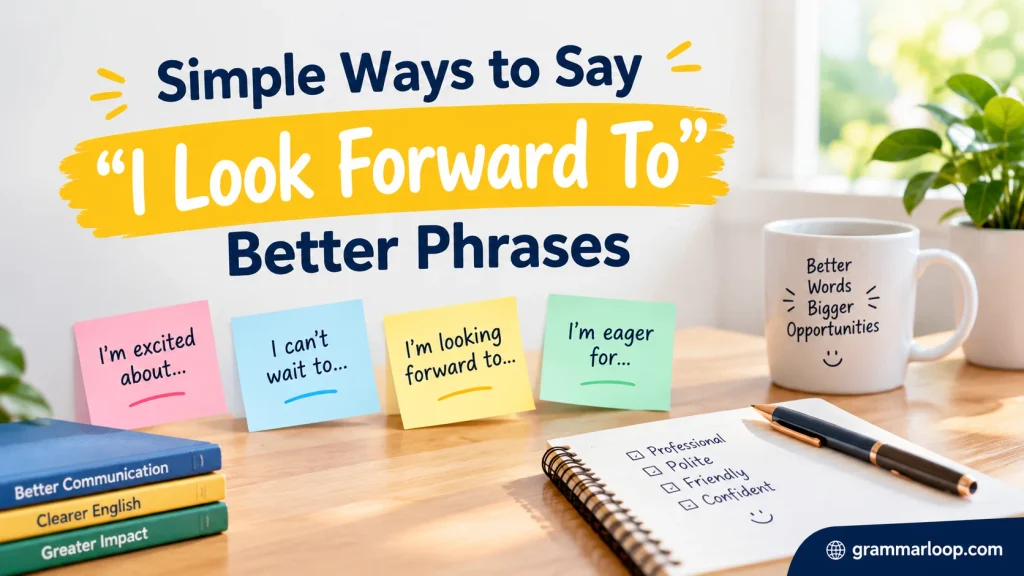
The phrase “I look forward to” is commonly used in professional emails, business messages, and everyday conversations to express excitement or positive expectations about something that will happen in the future. Whether you are waiting for a meeting, planning to see someone, or expecting a response, this expression helps communicate interest and enthusiasm. However, using the same phrase repeatedly can make your writing sound predictable or repetitive. Learning different ways to express anticipation can make your communication more natural, engaging, and meaningful. With the right words, you can share your excitement while keeping your message friendly and appropriate for the situation.
There are many simple alternatives you can use instead of “I look forward to” depending on your audience and the purpose of your message. For example, phrases like “I’m excited about,” “I can’t wait for,” and “I’m eager to” can express enthusiasm in a more conversational way. In professional situations, alternatives such as “I anticipate,” “I welcome the opportunity,” or “I hope to connect soon” may sound more polished and respectful. Each expression has a slightly different meaning, tone, and level of formality, so choosing carefully can improve your writing. Whether you are communicating with a manager, colleague, customer, or friend, the right alternative can help you create a positive impression.
In this guide, you will discover simple ways to say “I look forward to” in emails, workplace conversations, and personal messages. We will explore useful alternatives, explain their meanings and appropriate uses, and provide practical examples to help you understand when each phrase works best. You will also learn how to choose expressions that match different communication styles, from formal business writing to warm and friendly conversations. Whether you want to sound more confident, polite, or enthusiastic, these alternatives will help you express your feelings without repeating the same words. By the end, you will have a collection of useful phrases to make your English communication more clear, professional, and natural.
Why “I Look Forward To” Feels Overused in Modern Communication
The phrase “I look forward to” has been around for a long time in professional English. It became popular because it checks all the polite boxes: respectful, neutral, and safe.
But here’s the issue.
People now send more emails, messages, and DMs than ever before. As a result, the same phrases show up repeatedly. That repetition makes them feel robotic.
For example:
- “I look forward to your response.”
- “I look forward to hearing from you.”
- “I look forward to our meeting.”
They’re correct. No doubt. But they lack personality when overused.
A 2024 workplace communication survey by Grammarly found that over 62% of professionals use the same 5 closing phrases in emails repeatedly, with “I look forward to…” ranking in the top two most common.
That means your message blends in instead of standing out.
What “I Look Forward To” Actually Means (In Simple Terms)
Before replacing it, you should understand what it does.
When you say “I look forward to”, you’re communicating three things:
- You expect something to happen in the future
- You feel positive about it
- You want to sound polite or professional
It’s basically a formal way of saying:
“I’m waiting for this and I feel good about it.”
Tone Breakdown
| Phrase | Tone | Meaning |
| I look forward to your response | Formal | Neutral anticipation |
| I’m excited to hear from you | Warm | Friendly anticipation |
| Can’t wait to hear back | Casual | High energy anticipation |
The meaning stays similar. The tone shifts dramatically.
That’s why learning simple ways to say “I look forward to” is more about tone control than vocabulary.
When You Should Keep It (And When You Should Drop It)
Not every situation needs a replacement.
Keep “I look forward to” when:
- You’re writing formal business emails
- You’re communicating with senior leadership
- You want neutral politeness without emotion
- You’re writing legal, academic, or official messages
Example:
I look forward to your response regarding the contract terms.
It works here because it stays respectful and controlled.
Replace it when:
- You’ve already used it multiple times in the same thread
- You want a warmer tone
- You’re writing to peers or collaborators
- You want to sound more human
Example:
Instead of:
I look forward to your reply.
Try:
I’d love to hear your thoughts on this.
The second version feels more natural and conversational.
Simple rule you can use
If you read your sentence out loud and it feels like a customer service script, switch it.
Simple Professional Alternatives (Formal but Natural)
Sometimes you still need professionalism, but you don’t want stiffness.
Here are simple ways to say “I look forward to” in professional settings:
Reliable alternatives
- I’m looking forward to your response
- I await your feedback
- I appreciate your reply
- I look forward to hearing from you
- I’ll be happy to hear your thoughts
When to use them
| Phrase | Best Use |
| I’m looking forward to your response | Business emails |
| I await your feedback | Formal reports |
| I appreciate your reply | Polite follow-ups |
| I look forward to hearing from you | General professional use |
| I’ll be happy to hear your thoughts | Collaborative discussions |
Example in context
Before:
I look forward to your response on this matter.
After:
I’d appreciate your feedback when you get a chance.
Notice how the second version feels less stiff but still respectful.
Friendly Alternatives That Sound Human
Professional doesn’t always mean formal. Sometimes you want warmth without sounding overly casual.
Here are better simple ways to say “I look forward to” in a friendly tone:
- I’m excited to hear back from you
- I can’t wait to hear your thoughts
- I’m looking forward to your reply
- I’d love to hear your feedback
- I’m eager to continue this conversation
Tone differences matter
- Excited → energetic and positive
- Looking forward → balanced and safe
- Can’t wait → informal and expressive
Example transformation
Before:
I look forward to your reply.
After:
I’m excited to hear what you think about this.
The second version feels like a real person wrote it, not a template.
Casual Alternatives for Everyday Conversations
When you’re texting or chatting, you don’t need formal structure at all.
Try these simple ways to say “I look forward to” casually:
- Talk soon
- Looking forward to it
- Can’t wait
- Hit me back when you can
- Let’s see how it goes
Real-life examples
- “Got it. Talk soon.”
- “Sounds good. Can’t wait.”
- “Let’s do it. Looking forward to it.”
These phrases keep communication light and natural.
Read More: In Route vs En Route: Meaning, Grammar Rules, Real Usage
Context-Based Swaps (The Most Useful Part)
Different situations need different tones. Let’s break it down.
Job applications and interviews
Instead of:
I look forward to hearing from you.
Try:
- I’d welcome the opportunity to speak further
- I look forward to the possibility of working together
- I’m excited about the opportunity to discuss this role
Example:
I appreciate your time and I’d welcome the chance to discuss this role further.
This feels confident but not desperate.
Meetings and scheduling
Instead of:
I look forward to our meeting.
Try:
- See you then
- Looking forward to our conversation
- Excited for our meeting
Example:
Looking forward to our meeting on Tuesday.
Short. Clear. Natural.
Project collaboration
Instead of:
I look forward to working with you.
Try:
- Excited to get started
- Looking forward to collaborating
- Happy to work together on this
Example:
I’m excited to get started on this project with you.
This builds energy and momentum.
Common Mistakes People Make
Even when people try to improve their phrasing, they often slip into new problems.
Mistake 1: Overthinking every sentence
If you spend too long polishing every line, your writing loses flow.
Mistake 2: Mixing tones incorrectly
Don’t write:
I await your response bro
That’s a tone collision. Formal + slang doesn’t mix well.
Mistake 3: Overusing “excited”
If every sentence says “I’m excited,” it starts to feel exaggerated.
Mistake 4: Sounding passive
Avoid phrases that remove ownership:
- “It is looked forward to by me” ❌
- “I look forward to” ✔️
Active voice always wins.
Quick Reference Cheat Sheet
Here’s a fast comparison of simple ways to say “I look forward to”:
| Situation | Better Phrase |
| Formal email | I look forward to your response |
| Professional tone | I’m looking forward to hearing from you |
| Friendly tone | I’m excited to hear back |
| Casual chat | Talk soon |
| Collaboration | Excited to get started |
| Scheduling | See you then |
Keep this handy. It saves mental energy.
Real-World Communication Example (Case Study)
Let’s look at how tone changes a message.
Scenario: Job application follow-up
Version 1 (Generic)
I look forward to hearing from you regarding my application.
Version 2 (Improved)
I’d appreciate the opportunity to discuss my application further and learn more about the role.
Version 3 (Warm + confident)
I’m genuinely excited about this opportunity and would love to discuss it further.
What changed?
- Version 1 = safe but forgettable
- Version 2 = professional and engaging
- Version 3 = human and memorable
Most hiring managers respond better to version 2 or 3 because they feel real.
Why Tone Matters More Than Vocabulary
You don’t win communication by using “perfect words.”
You win by sounding clear, natural, and appropriate for the situation.
Think of tone like clothing:
- Formal phrases = suit and tie
- Friendly phrases = smart casual
- Casual phrases = weekend wear
You wouldn’t wear a suit to a beach. Same idea applies to language.
Conclusion
Learning different ways to say “I look forward to” can make your writing sound more natural, professional, and engaging. Although this phrase is useful in emails and everyday conversations, using alternatives such as “I’m excited about,” “I can’t wait for,” and “I’m eager to” can help you express your feelings in different ways. Each expression has its own tone and works best in particular situations.
When choosing an alternative, consider your audience, purpose, and level of formality. Use professional expressions when communicating with clients or colleagues, and choose friendly phrases when speaking with friends or family. With the right words, you can make your messages more meaningful, confident, and memorable while avoiding repetitive language.
FAQs
1. What is another way to say “I look forward to”?
Some common alternatives include “I’m excited about,” “I’m eager to,” “I can’t wait for,” and “I’m anticipating.” These phrases help express excitement or positive expectations without repeating the same expression.
2. How can I say “I look forward to” professionally?
You can use phrases such as “I welcome the opportunity,” “I anticipate our meeting,” or “I look forward to connecting with you.” These expressions work well in professional emails and business communication.
3. Is “I look forward to” formal or informal?
“I look forward to” is generally considered a polite and professional expression. However, it can also be used in casual conversations, depending on the context and the words that follow it.
4. What can I say instead of “I look forward to hearing from you”?
You can say “I hope to hear from you soon,” “I await your response,” or “I would appreciate your reply.” These alternatives are useful for follow-up messages, and business communication.
5. Is it correct to say “Looking forward to” without “I”?
For example, “Looking forward to meeting you next week” is natural and widely accepted. However, including “I” makes the sentence more complete and formal.




One Response