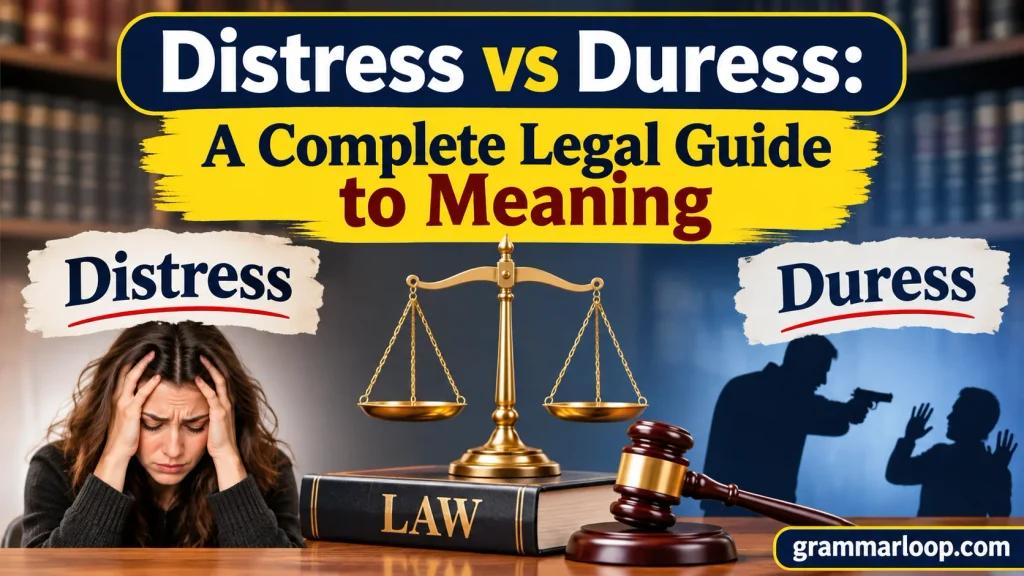
Understanding the difference between distress and duress is important because these two words may sound similar but have different meanings and legal implications. The word distress generally describes a state of emotional suffering, anxiety, pain, or difficulty caused by challenging circumstances. In contrast, duress refers to a situation where someone is forced or pressured to do something against their will through threats, intimidation, or unlawful coercion. Although both terms involve stressful situations, they are used differently in everyday conversations, professional writing, and legal discussions. Learning their meanings can help you communicate more accurately and avoid common vocabulary mistakes.
In everyday English, distress is commonly associated with feelings of sadness, fear, worry, or emotional discomfort. For example, someone might experience distress after receiving unexpected news or facing a difficult personal situation. Duress, however, is more closely connected to pressure, threats, and forced actions. In legal contexts, duress can become particularly significant when discussing contracts, criminal matters, or situations where a person’s freedom to make decisions has been restricted. The distinction between these terms is essential because emotional suffering and coercion are not the same thing. Understanding how each word works in different situations makes it easier to recognize their meanings and use them correctly.
In this complete guide, we will explore distress vs duress, including their definitions, differences, legal significance, and practical examples. You will learn how these terms are used in legal documents, everyday communication, and professional discussions. We will also examine common misunderstandings, compare their meanings in different contexts, and explain how to choose the appropriate word when writing or speaking. Whether you are studying English vocabulary, reading legal information, or improving your writing skills, understanding these expressions can help you communicate with greater clarity and confidence. By the end, you will have a better understanding of how distress and duress differ and why using the correct term matters.
What Is Distress in Law? Meaning of Distress vs Duress Explained Clearly
Distress meaning in legal terms
In law, distress refers to a lawful remedy where a person takes another party’s goods to secure payment of a debt or performance of an obligation.
Historically, it allowed landlords or creditors to seize property when someone failed to pay rent or debts.
Think of it like this:
“You owe me money, so I temporarily hold your property until you settle the debt.”
Core idea behind distress
Distress is not punishment. It is a security mechanism.
It exists to:
- Encourage payment of lawful debts
- Provide leverage to creditors
- Avoid lengthy court battles in certain situations
However, modern law has heavily restricted or replaced it in many countries.
Key characteristics of distress
Distress usually involves:
- A pre-existing legal right
- Seizure of property, not personal coercion
- Action taken under statutory or common law authority
- No requirement of consent from the debtor
Historical use of distress
Historically, distress played a major role in landlord-tenant law.
For example:
- A landlord could seize furniture or goods for unpaid rent
- The goods acted as security until payment occurred
However, many jurisdictions replaced this system due to abuse risks.
Modern legal position of distress
In the UK, for example:
- The Tribunals, Courts and Enforcement Act 2007 replaced it with a regulated enforcement system called Commercial Rent Arrears Recovery (CRAR)
Today, similar systems exist globally:
- Court enforcement orders
- Bailiff or sheriff execution processes
- Statutory seizure mechanisms
Example scenario of distress
Imagine a shop owner who refuses to pay rent for months.
Under a lawful distress-type system:
What Is Duress in Law? Meaning of Duress vs Distress Explained
Duress meaning in legal terms
Duress refers to illegitimate pressure or threats that force a person to act against their free will.
It destroys genuine consent.
If distress is about property, duress is about the human mind and decision-making.
Simple definition
Duress exists when:
That agreement is not truly voluntary.
Core elements of duress
Courts usually look for:
- A threat or unlawful pressure
- Lack of real choice
- A direct link between threat and decision
- Absence of reasonable alternatives
If these exist, the agreement may be void or voidable.
Types of duress in law
Physical duress
- Threat of violence or harm
Duress by threats
- Threats to property, reputation, or family
- Example: blackmail
Economic duress
- Financial pressure that leaves no real choice
- Example: forcing unfair contract terms during urgent supply needs
Key principle of duress
Courts focus on one question:
If force exists, the law steps in to protect consent.
Example scenario of duress
A supplier tells a business owner:
- “If you don’t accept this inflated contract price today, we will shut down your supply chain.”
If the business has no realistic alternative, this may qualify as economic duress.
Read more: Simple Ways to Say Please Disregard My Previous Email
Distress vs Duress: Key Differences in Law Explained Clearly
This is where most confusion disappears.
Let’s break it down in practical legal terms.
Legal nature
- Distress: lawful enforcement remedy
- Duress: unlawful pressure that invalidates consent
Distress operates inside the law. Duress operates outside it.
Purpose
- Distress: recover debt or secure payment
- Duress: force agreement or action
One enforces rights. The other manipulates decisions.
Focus of impact
- Distress: property or goods
- Duress: human will and consent
Consent factor
- Distress: consent is irrelevant
- Duress: consent is invalid if forced
Legal outcome
- Distress: enforcement is valid if lawful
- Duress: contract may be void or voidable
Quick comparison table
| Feature | Distress | Duress |
| Nature | Lawful remedy | Illegal pressure |
| Area of law | Property law | Contract law |
| Target | Goods/property | Consent/will |
| Legal effect | Enforces obligation | Invalidates agreement |
| Requirement | Legal authority | Unlawful threat |
| Outcome | Recovery of debt | Contract may collapse |
Distress vs Duress in Real Life: Practical Applications
Law becomes clearer when you see it in action.
Let’s break down how these concepts show up in real disputes.
Landlord and tenant disputes
Distress historically applied here.
Example:
- Tenant fails to pay rent
- Landlord uses legal enforcement proces
Today, courts regulate this tightly to prevent abuse.
Contract disputes
Duress shows up frequently in contract law.
Example:
- A supplier forces a buyer to accept unfair pricing under threat of cutting essential supply
- The buyer agrees under pressure
- Later, the buyer challenges the contract in court
If proven, the court may cancel the agreement.
Business negotiations
Economic duress appears in high-stakes deals.
Example:
- A company threatens to cancel a critical shipment unless prices increase
- The buyer agrees due to urgency
- Later challenges the price hike as invalid
Courts examine whether real alternatives existed.
Legal consequences of distress vs duress
When distress is lawful
- Courts may uphold seizure of goods
- Debt recovery may succeed
- Creditors maintain legal protection
However, misuse leads to liability.
How courts decide: distress vs duress analysis
Courts do not rely on labels. They look at facts.
They usually examine:
Was there lawful authority?
- If yes → distress may apply
- If no → duress becomes more likely
Courts check:
- Threat level
- Timing
- Severity
Did the victim have alternatives?
If alternatives existed:
- duress claim weakens
If no alternatives existed:
- duress becomes stronger
Did consent exist freely?
Courts ask:
Would a reasonable person have agreed under normal conditions?
Case studies: distress vs duress in real law
Case study 1: Barton v Armstrong (1976)
- A shareholder claimed he signed an agreement under death threats
- The Privy Council ruled that duress invalidated the contract
- Even if other reasons existed, the threat mattered
Key takeaway:
Even partial coercion can void consent.
Case study 2: Universe Tankships v ITWF (1983)
- A union pressured a shipowner with economic threats
- The court recognized economic duress
Key takeaway:
Financial pressure can be just as powerful as physical threats.
Case study 3: Historical distress for rent (UK law)
- Landlords once seized tenant goods for unpaid rent
- Abuse of this system led to reform
Key takeaway:
Distress must remain controlled or it risks unfairness.
Common misconceptions about distress vs duress
“They both mean pressure”
Not exactly.
- Distress = lawful pressure
- Duress = unlawful coercion
“Distress means emotional stress”
In law, it does not.
It refers to property seizure, not emotional suffering.
“Any pressure invalidates a contract”
Wrong.
Only illegitimate pressure counts as duress.
Business negotiations often involve pressure. That alone is not illegal.
Quick summary: how to tell distress and duress apart instantly
Use this mental shortcut:
- If the law authorizes it → Distress
- If the law condemns it → Duress
Or even simpler:
- Distress = “You owe, so we recover
Final takeaway: Distress vs Duress in one clear view
Distress and duress may sound similar, but they serve opposite legal roles.
- Distress protects enforcement of lawful rights
- Duress protects freedom of choice and consent
When you understand that difference, legal disputes become far easier to interpret.
One keeps order in financial obligations. The other protects fairness in human agreement.
And in law, both matter more than they first appear.
Conclusion
Understanding the difference between distress and duress helps you use these words correctly in everyday communication and legal discussions. Distress refers to emotional suffering, anxiety, or hardship, while duress involves pressure, threats, or coercion that forces someone to act against their will. Although both terms describe difficult situations, their meanings and applications are different. Recognizing these distinctions is especially important when reading legal documents, contracts, or professional materials. By understanding their meanings, examples, and legal implications, you can avoid confusion and communicate more accurately. Choosing the correct word will improve your vocabulary, writing skills, and understanding of legal terminology.
FAQs
1. What is the main difference between distress and duress?
Distress means emotional suffering, anxiety, or hardship. Duress means being forced or pressured to do something against your will through threats, coercion, or intimidation.
2. What does distress mean in legal terms?
In legal contexts, distress generally refers to suffering, hardship, or emotional harm. Depending on the jurisdiction and context, it may also have specific legal meanings, such as certain property-related remedies.
3. What does duress mean in law?
Duress generally refers to unlawful threats, coercion, or pressure that causes someone to act against their will. It may be relevant to contracts, criminal law, and other legal matters, depending on the applicable law.
4. What is an example of distress vs duress?
An example of distress is feeling extremely worried after losing your job. An example of duress is signing a contract because someone threatens to harm you if you refuse. The first involves emotional suffering, while the second involves coercion.