
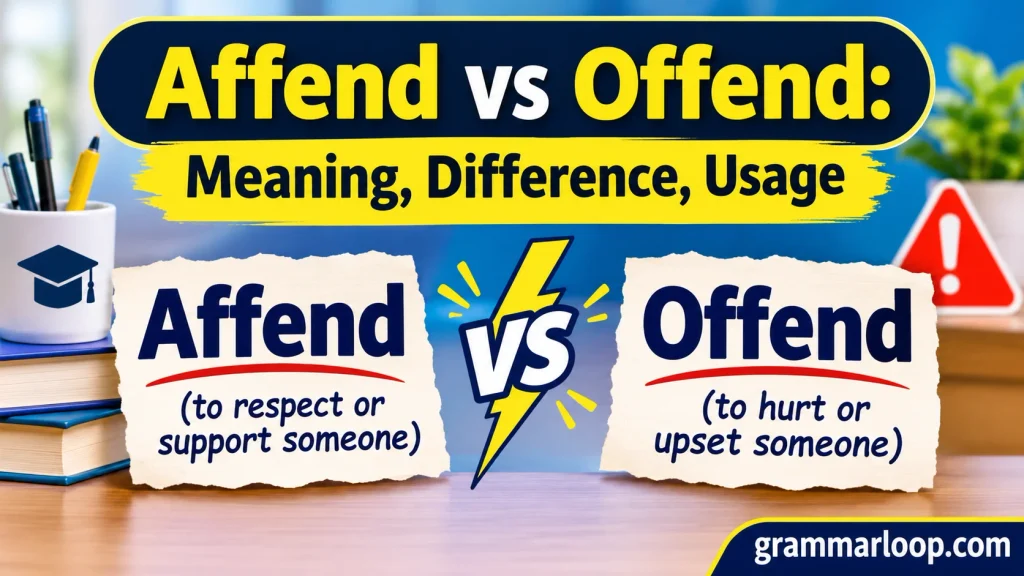
Understanding the difference between “affend” and “offend” can help you avoid common English spelling and grammar mistakes. These two words may look similar, but only one is recognized as the correct spelling in standard English. “Offend” is the correct word, and it means to upset, insult, or hurt someone’s feelings through words or actions. On the other hand, “affend” is an incorrect spelling and does not have an accepted meaning in standard English dictionaries. Many people confuse these words because of their similar sounds and letter patterns. Learning the correct spelling will help you improve your writing accuracy, vocabulary, and everyday communication.
The word “offend” is commonly used in different situations, especially when discussing feelings, behavior, and social interactions. For example, someone might say, “I didn’t mean to offend you” when they accidentally hurt another person’s feelings. You can also use it in professional emails, friendly conversations, and formal writing. Understanding its meaning and sentence structure makes it easier to use the word correctly and confidently. Although “affend” may appear in online searches, text messages, or informal writing, it should not be used as a replacement for “offend.” Knowing this simple spelling rule can prevent confusion and make your sentences sound more natural and professional.
In this guide, we will explore the affend vs offend comparison, including their meanings, spelling differences, grammar rules, and practical examples. You will learn why “offend” is correct, why “affend” is considered a misspelling, and how to use the correct word in different situations. We will also look at common mistakes and useful example sentences to make the difference easier to remember. Whether you are writing a school assignment, professional email, or everyday message, choosing the right spelling matters. By the end, you will understand how to use “offend” accurately and avoid confusing it with “affend” in your daily English writing.
Affend vs Offend: Is “Affend” Even a Real Word?
Let’s get straight to the point.
“Affend” is incorrect in modern English
You will not find “affend” in:
- Oxford English Dictionary
- Merriam-Webster Dictionary
- Cambridge Dictionary
- Standard academic writing
It does not exist as a recognized verb, noun, or adjective.
Where does “affend” come from?
Even though it’s wrong, it still appears in real-world writing. That happens for a few reasons:
- Fast typing on mobile keyboards
- Speech-to-text mishearing the word “offend”
- Confusion with similar words like “affect” or “defend”
- Typing habits from non-native English learners
- Simple spelling guess based on pronunciation
So when you see “affend,” you’re not looking at a new word. You’re looking at a mistake that spread through informal writing.
What Does “Offend” Mean? (Clear and Practical Definition)
Now let’s talk about the correct word.
Core meaning of “offend”
To offend someone means:
To cause emotional hurt, anger, or discomfort through words or actions.
But that definition only scratches the surface. In real use, “offend” works in different layers.
Emotional meaning
You offend someone when your words or behavior hurt their feelings.
- “His joke offended her.”
- “She felt offended by the comment.”
Social meaning
Offense can happen when someone breaks social norms.
- Talking loudly in a quiet place
- Making insensitive jokes in public settings
Cultural meaning
Some actions offend cultural or religious values.
- Dress codes
- Symbols or gestures
- Language choices
Legal or formal meaning
In legal contexts, “offend” connects to wrongdoing or violations.
- “The act may offend public decency laws.”
Affend vs Offend: The Real Difference Explained Clearly
There is no competition between these two words in standard English.
Spelling difference
- Affend → ❌ Incorrect spelling
- Offend → ✅ Correct spelling
Meaning difference
- Affend → No meaning
- Offend → To upset, insult, or hurt someone emotionally or socially
Usage difference
- Affend → Never used in formal writing
- Offend → Used everywhere: conversations, books, law, media
Quick Comparison Table: Affend vs Offend
| Feature | Affend | Offend |
| Dictionary word | No | Yes |
| Meaning | None | To upset or insult |
| Usage | Common mistake | Standard English verb |
| Formal writing | Incorrect | Correct and required |
| Frequency | Rare (errors only) | Very common |
Why People Confuse Affend and Offend
This mistake feels random, but it actually follows patterns.
1. Fast typing on mobile
Most people type quickly without checking spelling. The letters “a” and “o” are close on some keyboards.
2. Sound-based spelling
“Offend” sounds like:
- “uh-fend” or “oh-fend”
Some people incorrectly assume it starts with “a” instead of “o.”
3. Influence of similar words
English has many words starting with “aff-”:
- Affect
- Afford
- Affirm
This makes “affend” feel believable even though it’s wrong.
4. Autocorrect problems
Sometimes autocorrect doesn’t recognize the mistake and leaves it unchanged.
5. ESL learning patterns
English learners often rely on phonetics first. That leads to spelling guesswork instead of memorization.
What “Offend” Looks Like in Real Sentences
Let’s ground this in real usage so you can internalize it.
Basic everyday usage
- “I didn’t mean to offend you.”
- “That comment might offend some people.”
Professional communication
- “We aim to avoid language that may offend customers.”
- “The company apologized for the statement that offended clients.”
Casual conversation
- “Don’t offend him, he’s sensitive about that topic.”
- “She gets offended easily.”
Common Mistakes People Make with “Offend”
Even when people spell it correctly, they sometimes misuse it.
Mistake 1: Overusing it
Some writers use “offend” for every emotional reaction.
- ❌ “He offended me by not replying instantly.”
- ✔️ “I felt ignored when he didn’t reply.”
Not every discomfort equals offense.
Mistake 2: Mixing it with “defend”
These words confuse many learners.
| Word | Meaning |
| Offend | Hurt or insult |
| Defend | Protect or support |
Example:
- “She defended her friend.”
- “She didn’t mean to offend anyone.”
Mistake 3: Confusing tone
“Offend” can sound stronger than intended.
- “Your opinion offends me” → strong emotional weight
- “I disagree with your opinion” → softer alternative
Read More: Choosing vs Chosing: The Complete Guide to Spelling
Synonyms of Offend and When to Use Them
English gives you flexibility. “Offend” is just one option.
Common synonyms
- Insult
- Upset
- Hurt
- Disrespect
- Irritate
How they differ in intensity
| Word | Strength | Usage Context |
| Upset | Mild | Emotional discomfort |
| Irritate | Mild | Annoyance |
| Offend | Medium | Social/emotional insult |
| Insult | Strong | Direct disrespect |
| Disrespect | Strong | Social violation |
Use these carefully because tone changes everything.
Case Studies: How “Offend” Works in Real Life
Let’s make this practical.
Case Study 1: Workplace email misunderstanding
A manager writes:
“This report is unacceptable and careless.”
The employee feels offended.
What happened?
- The manager used harsh wording
- No context or softening language was included
Better version:
“Let’s improve this report. A few sections need revision.”
Same message. Less offense.
Case Study 2: Social media comment
A user posts:
“People who don’t agree are just ignorant.”
Result:
- Many readers feel offended
- Comment sparks argument instead of discussion
Lesson:
Strong opinions without soft language often offend broader audiences online.
Case Study 3: Cultural misunderstanding
A traveler uses a hand gesture that is normal in their country but offensive in another culture.
Result:
- Local people feel disrespected
- No bad intent existed
Lesson:
Offense often depends on cultural context, not intention.
How to Avoid Mistakes Like “Affend”
You don’t need complicated rules. Just use simple habits.
1. Slow down when typing
Speed creates errors. Accuracy builds clarity.
2. Use spelling tools wisely
Don’t rely blindly on autocorrect. Always review suggestions.
3. Train your memory with repetition
Write correct forms like:
- offend
- offended
- offensive
4. Read your writing out loud
If something sounds strange, it usually is.
5. Learn common verb patterns
English has many irregular spellings. Familiarity helps more than memorization tricks.
Quick Practice Exercises
Try these to lock in the difference.
Exercise 1: Choose the correct word
Fill in the blank:
- I didn’t mean to ___ you.
- That joke might ___ someone.
- The word “___” is incorrect.
Answers:
- offend
- offend
- affend (as incorrect spelling recognition)
Exercise 2: Fix the sentence
- “He affended her with his comment.”
Correct version:
- “He offended her with his comment.”
Why This Small Difference Matters More Than You Think
At first glance, “affend vs offend” looks like a tiny spelling issue. But it actually affects:
- Professional credibility
- Academic writing quality
- Clarity in communication
- First impressions in emails or messages
One wrong letter can change how people perceive your writing. And in some cases, it can even confuse meaning completely.
Final Summary: The Only Rule You Need to Remember
Let’s keep it simple.
- “Affend” is not a real English word.
- “Offend” is the correct and only valid form.
- If you see “affend,” you’re looking at a spelling mistake, not a new word.
English doesn’t always play fair with spelling, but this one rule stays consistent. Once you lock it in, you won’t confuse these two again.
And honestly, that’s one less writing headache you’ll ever need to deal with.
Conclusion
Understanding the difference between “affend” and “offend” helps you avoid common spelling mistakes and improve your English writing. The correct spelling is “offend,” which means to upset, insult, or hurt someone’s feelings through words or actions. On the other hand, “affend” is an incorrect spelling and is not accepted as a standard English word. Using the correct form makes your sentences clearer and more professional.
Whenever you want to describe hurting someone’s feelings or causing someone to feel upset, remember to use “offend.” You can also practice with example sentences to become more confident in your writing. Paying attention to small spelling differences can improve your vocabulary, grammar, and communication skills over time.
FAQs
1. Is it affend or offend?
“Offend” is the correct spelling in standard English. “Affend” is a misspelling and should not be used in formal or informal writing.
2. What does offend mean?
Offend means to upset, insult, or hurt someone’s feelings through something you say or do. For example: “I didn’t mean to offend you.”
3. Is affend a real English word?
No, “affend” is not a recognized standard English word. It is usually a spelling mistake made when someone intends to write “offend.”
4. How do you use offend in a sentence?
You can use “offend” when describing something that hurts or upsets another person. For example: “His careless comments might offend some people.”
5. What is the difference between offend and offended?
“Offend” is the base form of the verb, while “offended” is its past tense and past participle. For example.






One Response