
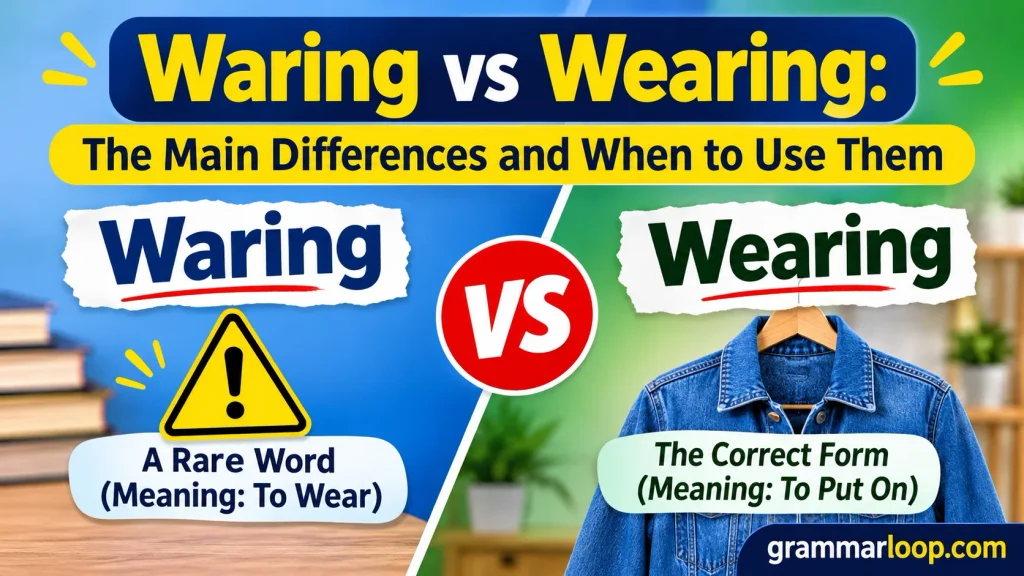
When comparing Waring vs Wearing, it is easy to get confused because these two words have similar spellings and pronunciations. However, they have different meanings, uses, and grammatical purposes. The word wearing is commonly used in everyday English to describe having clothes, shoes, or accessories on your body. It can also refer to something that causes tiredness or emotional exhaustion. On the other hand, waring is a much less common word associated with conflict or warfare, particularly in historical or specialized contexts. Understanding these differences is important if you want to improve your English writing, spelling, and communication skills. Although the words look almost identical, using the wrong one can change the meaning of your sentence.
The most important difference between waring and wearing is their definition and everyday usage. Wearing is the present participle of the verb wear, which means putting on or having something on your body. For example, you might say, “She is wearing a beautiful dress” or “He is wearing black shoes.” The word can also describe something becoming weaker or more exhausting over time, such as a wearing experience. In comparison, waring is rarely used in modern English and is generally connected with the verb war in specialized or historical usage. Because wearing appears much more frequently in daily conversations, emails, and written communication, it is the word most English learners need to recognize and use correctly.
Learning when to use waring vs wearing can help you avoid common spelling mistakes and make your writing more accurate. If you are talking about clothing, accessories, or having something on your body, wearing is the correct choice. However, if you encounter waring in a historical text or specialized context, pay attention to the sentence to understand its intended meaning. You should also remember that wearing is a standard and widely accepted English word, while waring is uncommon and may sometimes appear as a spelling error for wearing. Throughout this guide, we will explore their meanings, grammatical differences, examples, and practical usage rules so you can confidently choose the right word in different situations.
Waring vs Wearing at a Glance
Before diving into the details, here’s a quick comparison.
| Word | Part of Speech | Meaning | Common Usage |
| Waring | Proper noun, rare verb form | Usually a surname or name | Rare |
| Wearing | Present participle of wear | Having something on the body | Very common |
Quick Example
- Correct: She is wearing a red jacket.
- Incorrect: She is waring a red jacket.
In modern English, wearing is the word most people need. Waring appears far less often and is usually encountered as a surname.
What Does Wearing Mean?
The word wearing comes from the verb wear.
It functions as the present participle and can describe someone who has clothing, jewelry, equipment, or another item on their body.
Definition of Wearing
Wearing means:
Having something on your body as clothing, decoration, protection, or equipment.
For example:
- She is wearing a blue dress.
- He is wearing safety goggles.
- They are wearing matching uniforms.
The word appears constantly in spoken and written English because people frequently describe appearance, clothing, and accessories.
Everyday Examples of Wearing
You probably encounter the word dozens of times each day.
Examples include:
- Wearing shoes
- Wearing glasses
- Wearing headphones
- Wearing a watch
- Wearing makeup
- Wearing a wedding ring
- Wearing protective gear
Wearing Beyond Clothing
Interestingly, the word isn’t limited to clothes.
English speakers often use wearing figuratively.
Examples:
- She was wearing a smile.
- He was wearing an expression of surprise.
- The old building was wearing the marks of time.
These examples create vivid imagery and make writing more descriptive.
What Does Waring Mean?
Unlike wearing, the word waring is uncommon in modern English.
Most often, Waring appears as a surname.
Waring as a Family Name
Many people carry Waring as a last name.
Examples include:
- Edward Waring
- John Waring
Historically, the name has English origins and has appeared for centuries in records and literature.
Waring in Business and Brands
The name also appears in companies and products.
Rare Linguistic Uses
Historically, some forms of English used words related to “war” that resembled “waring.” These uses are largely obsolete today.
Modern writers almost never use waring as a regular verb.
Key Fact
If you’re describing clothes, jewelry, uniforms, or accessories, waring is almost certainly wrong.
Why People Confuse Wearing and Wearing
The confusion between these words isn’t surprising.
Several factors contribute to the mistake.
Similar Pronunciation
When people speak quickly, wearing can sound very close to waring.
This happens because unstressed vowels often become less distinct during conversation.
For example:
- Wearing → “WEHR-ing”
- Waring → often sounds nearly identical
Because English spelling doesn’t always match pronunciation perfectly, confusion follows naturally.
Typing Errors
Many mistakes occur during fast typing.
A writer may accidentally omit the letter e:
- Intended: wearing
- Typed: waring
One missing letter creates an entirely different word.
Autocorrect Problems
Spell-check software doesn’t always catch the error because waring is technically a valid word in certain contexts.
As a result, proofreading remains important.
English Learner Challenges
For people learning English as a second language, similar-looking words often create difficulties.
The issue becomes harder because:
- English contains many silent letters.
- Pronunciation varies across regions.
- Context determines meaning.
The Grammar of Wearing
Understanding the grammatical role of wearing helps eliminate confusion.
Wearing as a Present Participle
Most commonly, wearing functions as a present participle.
Examples:
- She is wearing a coat.
- They are wearing helmets.
- We are wearing uniforms today.
In these examples, wearing combines with helping verbs such as:
- is
- am
- are
- was
- were
Wearing as a Gerund
A gerund acts like a noun.
Examples:
- Wearing sunscreen reduces skin damage.
- Wearing safety equipment prevents injuries.
- Wearing comfortable shoes improves performance.
Notice how wearing serves as the subject of each sentence.
Wearing in Continuous Tenses
| Tense | Example |
| Present Continuous | She is wearing a jacket. |
| Past Continuous | He was wearing a hat. |
| Future Continuous | They will be wearing uniforms. |
| Present Perfect Continuous | She has been wearing glasses for years. |
These structures appear frequently in both spoken and written communication.
Read More: Bearable vs Bareable: When To Use Each One in Writing?
Real-World Examples of Wearing in Everyday Communication
The word wearing appears in countless real-life situations.
Workplace Communication
Businesses often discuss dress codes.
Examples:
- Employees must be wearing identification badges.
- Staff members are required to be wearing protective equipment.
Healthcare Settings
Medical professionals frequently use the term.
Examples:
- The patient was wearing a medical bracelet.
- Visitors must be wearing masks in restricted areas.
Education
Schools often describe uniforms and appearance.
Examples:
- Students are required to be wearing uniforms.
- The child was wearing a blue sweater during the event.
Journalism
News reports frequently describe individuals.
Example:
The witness described the suspect as wearing a black jacket and gray pants.
Social Media
Fashion influencers and content creators use the word constantly.
Examples:
- What are you wearing today?
- She is wearing a vintage leather jacket.
- Everyone is wearing summer colors this season.
Common Mistakes Writers Make
Even experienced writers occasionally make errors involving waring and wearing.
Mistake: Using Waring Instead of Wearing
Incorrect:
She is waring a beautiful necklace.
Correct:
She is wearing a beautiful necklace.
The second sentence correctly uses the present participle of wear.
Mistake: Dropping the Letter E
Many people type quickly and accidentally remove the “e.”
Incorrect:
- waring glasses
- waring shoes
- waring a coat
Correct:
- wearing glasses
- wearing shoes
- wearing a coat
Mistake: Ignoring Context
Writers sometimes focus solely on spelling rather than meaning.
A useful question is:
Am I talking about clothing or something worn?
If yes, wearing is almost certainly correct.
Case Study: How One Letter Changes Professional Writing
Consider these two job interview notes.
Version One
The candidate arrived waring a navy suit and carrying a portfolio.
Version Two
The candidate arrived wearing a navy suit and carrying a portfolio.
The first version immediately appears less professional because of the spelling mistake.
A single missing letter can affect:
- Credibility
- Professionalism
- Reader confidence
- Perceived writing quality
This example highlights why proofreading matters.
Memory Tricks to Remember the Difference
Simple memory devices can help you avoid future mistakes.
Remember the Base Word
The easiest trick:
Wear → Wearing
Since clothing relates to wear, the correct form retains the “e.”
Visual breakdown:
Wear
↓
Wearing
Think About Clothes
Ask yourself:
Is someone putting something on their body?
If yes, use wearing.
The Extra E Trick
The word wear contains the letter “e.”
Therefore:
- wear → wearing
Removing the “e” usually creates an error.
Visual Memory Method
Imagine a person:
👒 Hat
🕶️ Glasses
👕 Shirt
👖 Jeans
That person is wearing clothes.
The image reinforces the spelling.
Easy Mnemonic
If it’s on your body, you’re wearing it.
Simple. Memorable. Effective.
Wearing vs Similar Words That Cause Confusion
English contains many words that resemble one another.
Let’s compare a few commonly confused terms.
Wearing vs Wearying
| Word | Meaning |
| Wearing | Having something on |
| Wearying | Causing tiredness |
Examples:
- She is wearing a jacket.
- The long meeting was wearying.
Wearing vs Bearing
| Word | Meaning |
| Wearing | Having on |
| Bearing | Carrying, relating to, or direction |
Examples:
- He was wearing sunglasses.
- She was bearing gifts.
Wearing vs Tearing
| Word | Meaning |
| Wearing | Having on |
| Tearing | Ripping apart |
Examples:
- They were wearing uniforms.
- The child was tearing paper.
Wearing vs Warring
Another commonly confused word is warring.
| Word | Meaning |
| Wearing | Having something on |
| Warring | Engaged in conflict |
Examples:
- She is wearing a coat.
- The two nations were warring for decades.
Historical Background of the Word Wear
Understanding the origin of a word often makes it easier to remember.
The English verb wear comes from Old English roots dating back more than a thousand years.
Historically, the word meant:
- To carry on the body
- To use continuously
- To endure over time
Over centuries, it evolved into the modern forms:
- Wear
- Wears
- Wore
- Worn
- Wearing
Because of its long history, the word appears throughout English literature.
Example Forms
| Form | Example |
| Wear | I wear glasses. |
| Wears | She wears a ring. |
| Wore | He wore a suit yesterday. |
| Worn | The jacket has been worn often. |
| Wearing | They are wearing uniforms. |
How Wearing Is Used in Different Industries
The word takes on specialized importance in many fields.
Fashion Industry
Fashion professionals frequently discuss:
- Wearing trends
- Wearing styles
- Wearing luxury brands
- Wearing seasonal collections
Example:
Models were wearing the designer’s latest collection.
Construction Industry
Safety regulations often mention protective equipment.
Examples:
- Wearing hard hats
- Wearing reflective vests
- Wearing steel-toe boots
Sports Industry
Athletes wear specialized gear.
Examples:
- Wearing helmets
- Wearing mouthguards
- Wearing team uniforms
Healthcare Industry
Medical safety standards often require:
- Wearing gloves
- Wearing masks
- Wearing protective gowns
The word appears repeatedly in training manuals and safety procedures.
Practical Editing Tips to Avoid the Mistake
If you frequently confuse waring and wearing, these techniques can help.
Read Slowly
Many mistakes become obvious when reading at a slower pace.
Proofread Backward
Reading sentences backward forces your brain to focus on individual words.
Search for “Waring”
Before publishing a document:
- Open search.
- Type “waring.”
- Review every occurrence.
Many accidental errors can be fixed instantly.
Use Context Checking
Ask:
- Am I describing clothes?
- Am I discussing accessories?
- Am I referring to safety equipment?
If yes, use wearing.
Practice Quiz: Can You Choose the Correct Word?
Fill in the blanks.
Questions
- She was ______ a black coat.
- The firefighter was ______ protective equipment.
- They arrived ______ matching shirts.
- The athlete was ______ a helmet.
- The witness described a man ______ sunglasses.
Answers
- wearing
- wearing
- wearing
- wearing
- wearing
Because every sentence refers to something being worn on the body, wearing is the correct choice each time.
Conclusion:
Understanding the difference between Waring vs Wearing helps you avoid spelling mistakes and communicate more clearly. Wearing is the correct and commonly used word when talking about clothes, shoes, accessories, or something that causes exhaustion. In contrast, waring is extremely uncommon in modern English and may appear in specialized or historical contexts. It is also sometimes used incorrectly when someone intends to write wearing.
The easiest way to remember the difference is to connect wearing with clothing and the verb wear. Whenever you describe what someone has on, choose wearing. By learning their meanings, examples, and correct usage, you can improve your English grammar, spelling, and everyday writing.
FAQs:
1. What is the main difference between Waring and Wearing?
Wearing is the present participle of the verb wear and refers to having clothes or accessories on. Waring is an extremely uncommon form associated with war-related language and is rarely used in modern English.
2. Is Wearing the correct spelling?
Yes, wearing is the correct spelling when referring to clothes, shoes, accessories, or having something on your body. For example, “She is wearing a red jacket.”
3. What does Waring mean?
Waring is a rare form associated with the verb war. It is not commonly used in everyday English and may appear in specialized or historical writing.
4. How do you use Wearing in a sentence?
You can use wearing to describe clothing or something being worn. For example:She is wearing a beautiful dress. He is wearing new shoes.
5. Why do people confuse Waring and Wearing?
People confuse these words because they have similar spellings and pronunciations. However, their meanings and usage are different. Remember that wearing is the standard word for clothing, while waring is rarely used in modern English.




One Response