
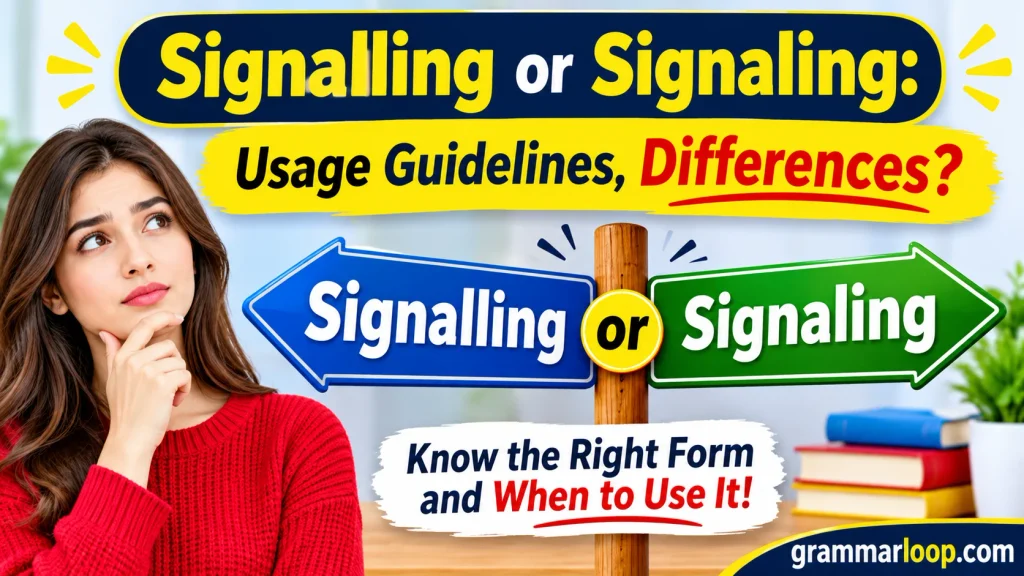
Choosing between signalling and signaling can be confusing, especially when you are writing for an international audience. Both spellings are correct, and they share the same meaning, pronunciation, and grammatical function. The main difference comes from British and American English spelling conventions. British English generally uses signalling with a double L, while American English prefers signaling with a single L. Although the difference may look small, using the appropriate spelling can make your writing appear more professional, consistent, and natural. Whether you are preparing an email, writing an academic paper, or creating online content, understanding these spelling variations helps you avoid unnecessary mistakes and communicate more clearly with your readers.
The word signalling or signaling comes from the verb signal, which means to communicate information, give a sign, or show that something is happening. You can use it in different situations, such as traffic communication, body language, technology, and everyday conversations. For example, a driver may be signalling before turning, or a warning light may be signaling a possible problem. The spelling changes depending on the English variety you follow, but the definition and usage remain exactly the same. British writers usually double the final L when adding -ing, whereas American writers generally keep one L. Understanding this simple spelling rule makes it easier to recognize the correct form in different types of writing.
In this guide, we will explore the real differences between signalling and signaling, including their meanings, spelling rules, and practical examples. You will also learn when to use each spelling and how to choose the right version for your audience. If you are writing for readers in the United Kingdom, Australia, or other regions that follow British English, signalling is generally the preferred choice. However, if your audience is mainly in the United States, signaling is the standard spelling. The most important thing is to maintain consistency throughout your writing rather than switching between the two forms. By the end, you will know exactly which spelling to use and feel more confident using this word in everyday and professional communication.
Signalling or Signaling: Which Spelling Is Correct?
The simple answer is that both spellings are correct.
The difference comes down to the version of English you’re using:
| Spelling | English Variant |
| Signalling | British English |
| Signaling | American English |
For example:
British English:
The railway system is signalling a potential safety issue.
American English:
The railway system is signaling a potential safety issue.
The meaning remains exactly the same. Only the spelling changes.
This distinction is similar to other spelling pairs such as:
- Colour vs. Color
- Travelling vs. Traveling
- Organise vs. Organize
- Labelling vs. Labeling
The key is consistency. Once you choose a spelling style, use it throughout your document.
What Does “Signal” Mean?
Before exploring the spelling differences, it helps to understand the meaning of the root word.
Signal as a Noun
A signal is a sign, indication, message, or gesture used to communicate information.
Examples:
- A traffic light is a signal.
- A hand wave can be a signal.
- A radio transmission may contain signals.
Example Sentences
- The red light was a signal to stop.
- The coach gave a signal to begin the race.
- Investors interpreted the announcement as a positive signal.
Signal as a Verb
As a verb, signal means to communicate, indicate, or convey information.
Examples:
- The driver signaled before turning.
- The company signaled future expansion plans.
- The scientist signaled a need for further research.
When adding “-ing” to the verb, you get:
- Signalling (British English)
- Signaling (American English)
Why Does Signalling Have Double “L” While Signaling Has One?
This is where many writers become confused.
The answer lies in the spelling conventions of British and American English.
The British English Rule
British English generally doubles the final l when adding suffixes such as:
- -ing
- -ed
- -er
Examples:
| Base Word | British Form |
| Signal | Signalling |
| Travel | Travelling |
| Cancel | Cancelling |
| Label | Labelling |
| Fuel | Fuelling |
Under British spelling rules, the double “l” is considered standard.
Why British English Doubles the Letter
Historically, British English developed spelling patterns that preserved visual consistency when suffixes were added.
As a result:
- Signal + ing = Signalling
- Travel + ing = Travelling
The additional “l” became accepted as standard practice.
The American English Rule
American English usually simplifies these spellings.
Examples:
| Base Word | American Form |
| Signal | Signaling |
| Travel | Traveling |
| Cancel | Canceling |
| Label | Labeling |
| Fuel | Fueling |
American spelling often favors shorter and simpler forms.
Thus:
- Signal + ing = Signaling
The extra “l” is dropped.
Historical Origins of the Difference
The distinction largely emerged during the development of American English.
One influential figure was Noah Webster, whose dictionaries promoted spelling simplification.
Webster believed spelling should be:
- Easier to learn
- More logical
- More consistent
This philosophy helped establish many modern American spellings, including:
| British | American |
| Colour | Color |
| Honour | Honor |
| Travelling | Traveling |
| Signalling | Signaling |
Over time, these differences became accepted standards in their respective regions.
Signalling vs. Signaling: Side-by-Side Examples
The meaning never changes between the two spellings.
Only the audience and regional preference change.
Transportation Examples
British English
- The control center is signalling approaching trains.
- Railway signalling systems require constant maintenance.
American English
- The control center is signaling approaching trains.
- Railway signaling systems require regular inspections.
Read More: Blankie or Blanky: Which Spelling Is Correct and How to Use It Properly?
Business Communication Examples
Companies often use signaling to communicate intentions.
Examples:
- Management is signaling confidence in future growth.
- The price increase may be signaling stronger demand.
- The announcement is signaling a strategic shift.
Technology Examples
Technology industries frequently use the term.
Examples:
- Network signaling coordinates communication between devices.
- Digital signaling improves transmission efficiency.
- Signaling protocols ensure reliable connections.
Human Behavior Examples
People constantly signal information without speaking.
Examples:
- Eye contact may signal confidence.
- Body language can signal discomfort.
- Clothing choices often signal group identity.
Comparison Table
| British English | American English |
| Signalling | Signaling |
| Signalling device | Signaling device |
| Signalling network | Signaling network |
| Signalling protocol | Signaling protocol |
| Signalling system | Signaling system |
Which Countries Prefer Signalling and Which Prefer Signaling?
Different countries follow different spelling conventions.
Countries That Commonly Use “Signalling”
The following countries generally prefer British English spelling:
- United Kingdom
- Australia
- New Zealand
- Ireland
- South Africa
In these regions, signalling is usually considered standard.
Countries That Commonly Use “Signaling”
American English dominates in:
- United States
In American publications, signaling is overwhelmingly preferred.
The Canadian Exception
Canada presents an interesting case.
Canadian English often combines elements of British and American English.
As a result:
- Some publications use signalling.
- Others use signaling.
- Organizations typically follow their own style guides.
Consistency matters more than choosing one version over the other.
Signalling vs. Signaling in Professional and Academic Writing
Professional writers cannot simply pick whichever spelling looks better.
Audience expectations matter.
Academic Writing
Universities and journals usually require a specific style guide.
Common examples include:
- APA Style
- MLA Style
- Chicago Style
- Harvard Style
A journal using American English will expect signaling.
A journal using British English will expect signalling.
Switching between the two can create editing problems.
Business Writing
Businesses often localize content.
Examples:
US Website
The report is signaling increased market confidence.
UK Website
The report is signalling increased market confidence.
Both statements are correct.
Technical Documentation
Technical industries often maintain strict style guides.
Examples include:
- Telecommunications
- Aviation
- Railway engineering
- Software development
Many global organizations specify one spelling standard to maintain consistency across documentation.
Marketing Content
Marketing teams often adapt spelling to match target audiences.
For example:
| Audience | Preferred Spelling |
| US Customers | Signaling |
| UK Customers | Signalling |
| Australian Customers | Signalling |
Localized spelling can improve reader trust and engagement.
Common Mistakes Writers Make
Even experienced writers occasionally make mistakes when using signalling and signaling.
Mixing British and American Spellings
This is the most common error.
For example:
The company is signalling future growth while optimizing its organization.
Notice the inconsistency:
- signalling = British
- organization = American
A better approach is choosing one style and using it consistently.
British Version
The company is signalling future growth while optimising its organisation.
American Version
The company is signaling future growth while optimizing its organization.
Assuming One Spelling Is Wrong
Many people incorrectly believe that:
- Signalling is incorrect.
- Signaling is incorrect.
Neither assumption is true.
Both spellings are accepted in major dictionaries.
Switching Mid-Document
Imagine reading a report where:
- Page 1 uses signalling.
- Page 5 uses signaling.
- Page 10 returns to signalling.
The inconsistency distracts readers.
Professional editing eliminates this issue.
Ignoring Audience Expectations
A British audience may expect British spelling.
An American audience may expect American spelling.
Using the audience’s preferred spelling creates a smoother reading experience.
Signalling and Signaling in Major Dictionaries
Major dictionaries recognize both spellings.
Dictionary Comparison
| Dictionary | Preferred Entry |
| Merriam-Webster | Signaling |
| American Heritage | Signaling |
| Oxford English Dictionary | Signalling |
| Collins Dictionary | Signalling |
| Cambridge Dictionary | Signalling / Signaling |
This confirms an important point:
Both spellings are legitimate and widely accepted.
The difference is regional rather than grammatical.
Related Words That Follow the Same Pattern
Understanding signalling versus signaling helps with many similar words.
British vs. American Spelling Patterns
| British English | American English |
| Travelling | Traveling |
| Cancelling | Canceling |
| Labelling | Labeling |
| Modelling | Modeling |
| Dialling | Dialing |
| Fuelled | Fueled |
| Jewellery | Jewelry |
| Marvellous | Marvelous |
Learning this pattern makes it easier to identify the correct spelling for many words.
Quick Recognition Tip
If you are writing in American English:
- The extra “l” is often removed.
If you are writing in British English:
- The extra “l” is often retained.
This rule won’t solve every spelling question, but it works surprisingly often.
Industry-Specific Usage of Signalling and Signaling
Certain industries use these terms frequently.
Understanding the context can help writers choose the appropriate form.
Railway Engineering
Railways rely heavily on signaling systems.
Functions of Railway Signaling
- Prevent collisions
- Manage train movement
- Control track access
- Improve operational safety
In the UK, you’ll commonly see:
Railway signalling systems
In the US, you’ll commonly see:
Railway signaling systems
The meaning remains identical.
Telecommunications
Telecommunications networks depend on signaling mechanisms.
Examples include:
- Call setup
- Routing information
- Network management
- Error handling
Without signaling, modern communication networks would not function efficiently.
Economics
Economists frequently discuss signaling theory.
What Is Signaling Theory?
Signaling theory explains how people and organizations communicate information through actions rather than words.
Examples include:
- A degree signaling expertise
- High prices signaling premium quality
- Dividends signaling financial strength
Investors and analysts use these signals to make decisions.
Psychology and Sociology
Human beings constantly engage in social signaling.
Examples include:
- Facial expressions
- Posture
- Tone of voice
- Clothing choices
- Social media activity
These signals communicate information about:
- Status
- Intentions
- Emotions
- Identity
Researchers study signaling behavior to better understand human interaction.
Case Study: Why Consistency Matters
Consider a software company launching websites for both American and British audiences.
Scenario A: Consistent Localization
US Website:
- Signaling
- Optimization
- Organization
UK Website:
- Signalling
- Optimisation
- Organisation
Result:
- Professional presentation
- Better user experience
- Stronger credibility
Scenario B: Mixed Spelling
Website Content:
- Signalling
- Optimization
- Colour
- Organization
Result:
- Inconsistent branding
- Reduced professionalism
- Potential reader confusion
Small details often influence how readers perceive quality.
How to Choose the Correct Spelling Every Time
Choosing the right spelling becomes easy when you follow a simple framework.
Use “Signaling” When:
- Writing for American readers
- Following American style guides
- Publishing on US websites
- Creating content for American businesses
Example
The company is signaling a major change in strategy.
Use “Signalling” When:
- Writing for British readers
- Following UK style guides
- Publishing in Australia
- Publishing in New Zealand
- Publishing in Ireland
Example
The company is signalling a major change in strategy.
When Either Version Works
In some situations, either spelling is acceptable:
- Internal documents
- Personal notes
- Informal communication
Even then, consistency remains important.
Quick Decision Checklist
Before publishing, ask yourself:
If the answer to all four questions is yes, you’re probably using the correct form.
Conclusion:
Understanding the difference between signalling and signaling makes it easier to write correctly and follow the spelling conventions of different English varieties. Both words have the same meaning and grammatical function, but their spelling depends on the audience. Signalling is the preferred form in British English, while signaling is standard in American English. Neither spelling is incorrect, so your choice should depend on the English style you are following.
When writing emails, articles, academic papers, or professional documents, always maintain spelling consistency. Use signalling for British English audiences and signaling for American English readers. By following this simple rule, you can make your writing more clear, accurate, and professional.
FAQs:
1. Is signalling or signaling correct?
Both signalling and signaling are correct spellings. Signalling follows British English conventions, while signaling follows American English spelling rules.
2. What is the difference between signalling and signaling?
The main difference is regional spelling. British English doubles the final L before adding -ing, whereas American English generally uses a single L. Both forms have the same meaning.
3. Is signalling British or American English?
Signalling is the standard British English spelling. It is also commonly used in other varieties that follow British spelling conventions, including Australian English.
4. Is signaling with one L grammatically correct?
Yes, signaling with one L is grammatically correct in American English. It is commonly used in American writing, including books, newspapers, academic papers, and professional communication.
5. How do you use signalling and signaling in a sentence?
Both spellings can be used in the same way. For example: Both sentences are correct and communicate exactly the same meaning.





One Response