
When choosing between Shakey vs Shaky, you might wonder which spelling is correct in English writing. Both forms look similar, but they are not equally accepted in standard English. The correct spelling is shaky, which describes something that shakes, trembles, or feels unstable. You can use it when talking about a person with unsteady hands, a weak structure, or an uncertain situation. For example, someone may have shaky hands because they feel nervous, cold, or tired. Although shakey sometimes appears in informal writing, usernames, or creative expressions, it is generally considered a misspelling of the standard word. Understanding this small spelling difference can help you write more clearly and avoid common grammar mistakes.
The word shaky has several meanings depending on the context in which you use it. It can describe physical movement, such as a trembling voice, unsteady legs, or a shaking hand. It can also describe something that lacks strength, stability, or reliability. For instance, you might say that a table has a shaky leg or that someone has a shaky understanding of a particular subject. In professional communication, the word can describe an uncertain plan, weak evidence, or an unreliable agreement. On the other hand, writing shakey instead of shaky may make your sentence look incorrect, especially in academic assignments, business emails, and formal documents. Learning the correct spelling makes your writing more accurate and professional.
If you want to improve your English spelling and vocabulary, knowing when to use shaky is a simple but useful step. Remember that shaky is the standard spelling in dictionaries and everyday communication, while shakey is usually an incorrect variation. You can strengthen your understanding by reading real examples, practicing sentences, and noticing how the word works in different situations. For example, you could describe a nervous person’s voice as shaky or explain that a business is standing on shaky financial ground. These examples show how one word can communicate different kinds of instability and uncertainty. Throughout this guide, we will explore the meaning, spelling rules, differences, and practical examples of shaky so you can use it confidently in your writing.
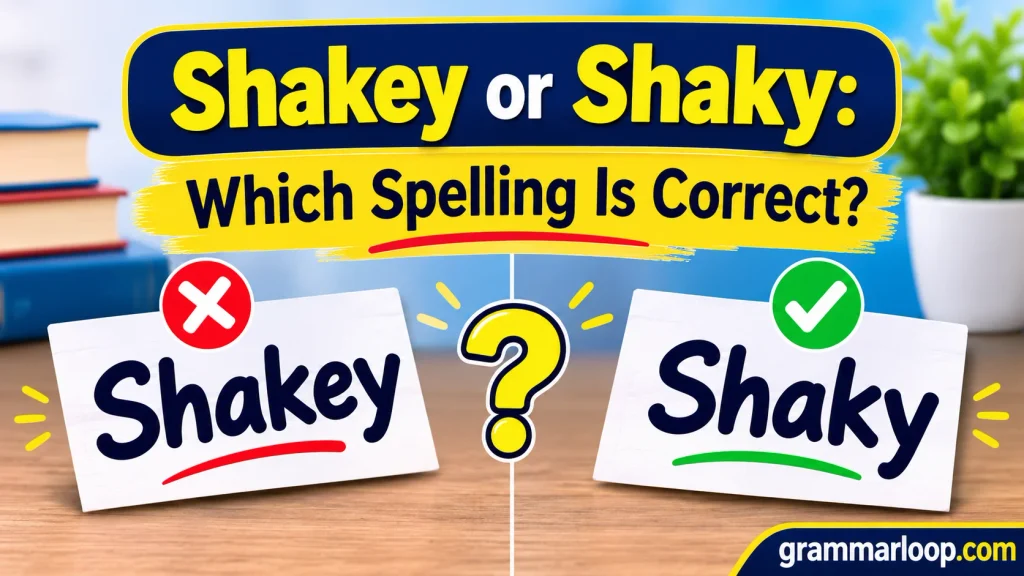
Shakey or Shaky: Which Spelling Is Correct?
Quick Answer
Shaky is the correct and widely accepted spelling in standard English.
Shakey is generally considered a nonstandard variant or misspelling. While it occasionally appears in informal writing, nicknames, business names, and online content, it is not the preferred spelling in formal English.
Correct:
✅ Shaky
Generally Incorrect:
❌ Shakey
Example:
✅ My hands felt shaky before the presentation.
❌ My hands felt shakey before the presentation.
If you’re writing for school, work, publishing, journalism, or professional communication, always choose shaky.
Why Do People Confuse Shakey and Shaky?
The confusion comes from pronunciation.
When people say the word aloud, it often sounds like “shay-key,” which naturally leads some writers to add an extra e before the y.
English spelling isn’t always predictable. Many words contain silent letters or unusual spelling patterns.
For example:
| Pronunciation | Correct Spelling |
| Lay-zee | Lazy |
| Cra-zee | Crazy |
| Sleep-ee | Sleepy |
| Shay-kee | Shaky |
Notice that adjectives ending in -y often do not require an additional e.
Because of this pattern, shaky follows standard English spelling conventions.
What Does “Shaky” Mean?
The word shaky is an adjective that describes something that trembles, lacks stability, or appears uncertain.
Dictionary Meaning
Shaky generally means:
- Trembling or shaking
- Not stable
- Weak or unreliable
- Uncertain or doubtful
- Nervous or lacking confidence
Pronunciation
Shaky
/ˈʃeɪ.ki/
Part of Speech
- Adjective
Common Meanings of Shaky
Physically Trembling
This is the most literal meaning.
Examples:
- Her hands were shaky after the accident.
- The patient felt shaky due to low blood sugar.
- He wrote a shaky signature.
Unsteady or Unstable
Something can be physically unstable.
Examples:
- The chair felt shaky.
- They crossed a shaky bridge.
- The ladder looked shaky.
Lacking Confidence
People often feel shaky when nervous.
Examples:
- She seemed shaky during the interview.
- His voice sounded shaky before the speech.
Weak or Uncertain
The word is frequently used figuratively.
Examples:
- Their argument was shaky.
- The evidence looked shaky.
- The company’s future seemed shaky.
Is “Shakey” a Real Word?
This question creates a lot of debate.
Technically, shakey exists because people use it in writing. However, that doesn’t automatically make it the preferred spelling.
Most major dictionaries list shaky as the standard form.
Where You Might See “Shakey”
You may encounter shakey in:
- User-generated content
- Informal blogs
- Social media posts
- Personal nicknames
- Brand names
- Older texts
However, seeing a word online doesn’t mean it follows modern standard English conventions.
Why Some People Write “Shakey”
Several factors contribute to the mistake.
Pronunciation-Based Spelling
People often write words exactly as they hear them.
Since shaky sounds like “shay-key,” adding an extra “e” feels natural.
Similar English Words
Some writers compare it to words like:
- Smokey
- Pokey
- Hokey
As a result, they assume shakey should follow a similar pattern.
Typing Habits
Autocorrect and predictive text sometimes reinforce spelling habits that aren’t standard.
Shaky vs Shakey: Side-by-Side Comparison
| Feature | Shaky | Shakey |
| Standard English | Yes | No |
| Dictionary Preferred | Yes | Rarely |
| Academic Writing | Yes | No |
| Professional Writing | Yes | No |
| Journalism | Yes | No |
| Business Communication | Yes | No |
| Recommended Choice | Yes | No |
Verdict
For virtually every writing situation, shaky is the better choice.
Why “Shaky” Is the Preferred Standard Spelling
English spelling follows patterns.
The adjective shaky comes from the verb shake.
When forming the adjective, English drops the final e before adding -y.
Similar Examples
| Base Word | Adjective |
| Shake | Shaky |
| Ice | Icy |
| Juice | Juicy |
| Lace | Lacy |
| Spice | Spicy |
This pattern appears throughout English.
Because of this rule, shaky aligns with standard spelling conventions.
Dictionary Support for “Shaky”
Major dictionaries consistently recognize shaky as the standard spelling.
These dictionaries include:
- Merriam-Webster
- Cambridge Dictionary
- Collins Dictionary
- Dictionary.com
- Oxford English Dictionary
Across these references, shaky appears as the primary and accepted spelling.
This consistency is one reason editors and educators strongly prefer it.
Real-Life Examples of “Shaky” Used Correctly
Understanding context makes usage easier.
Physical Movement Examples
Here are some common examples.
- After running five miles, his legs felt shaky.
- The exhausted climber stood on shaky ground.
- Her hands became shaky from nervousness.
- The old table looked shaky and unsafe.
Emotional Examples
The word often describes emotions.
Examples:
- He felt shaky before his job interview.
- She gave a shaky smile.
- The witness sounded shaky while answering questions.
Professional Examples
Business and journalism frequently use the term.
Examples:
- Investors worry about the company’s shaky finances.
- Analysts questioned the shaky forecast.
- The project rests on shaky assumptions.
Academic Examples
Researchers may use the word carefully when evaluating evidence.
Examples:
- The conclusion relies on shaky data.
- Scholars criticized the study’s shaky methodology.
Case Study: How One Letter Changes Professional Writing
Consider these two sentences:
Version A
The report is based on shaky evidence.
Version B
The report is based on shakey evidence.
Most readers instantly recognize Version A as professional.
Version B may distract readers because the spelling looks unusual.
This demonstrates an important writing principle:
Small spelling choices influence credibility.
Even one extra letter can affect how readers perceive expertise.
Common Phrases and Expressions Using “Shaky”
English contains many idioms featuring shaky.
Let’s examine the most common ones.
On Shaky Ground
Meaning
In a risky or uncertain position.
Example
The company is on shaky ground after losing several major clients.
A Shaky Start
Meaning
A weak or problematic beginning.
Example
The new season got off to a shaky start.
Shaky Confidence
Meaning
Uncertain self-belief.
Example
Repeated failures left him with shaky confidence.
Shaky Performance
Meaning
An inconsistent or unreliable performance.
Example
The team delivered a shaky performance in the first half.
Shaky Foundation
Meaning
A weak basis for future success.
Example
The proposal rests on a shaky foundation.
Read More: Signalling or Signaling: Usage Guidelines, Differences?
How “Shaky” Is Used Figuratively
One reason the word remains popular is its flexibility.
It can describe physical objects, emotions, relationships, businesses, economies, and arguments.
Examples
| Situation | Example |
| Relationship | Their marriage seemed shaky. |
| Economy | The economy remains shaky. |
| Confidence | Her confidence felt shaky. |
| Evidence | The evidence looked shaky. |
| Friendship | Their friendship became shaky. |
This versatility makes shaky valuable in both casual and formal communication.
When People Accidentally Use “Shakey”
Several common mistakes lead writers toward the wrong spelling.
Phonetic Writing
People often write what they hear.
Since the pronunciation resembles “shay-key,” the spelling mistake feels logical.
Lack of Proofreading
Fast typing increases errors.
Many writers simply don’t notice the extra “e.”
Exposure to Incorrect Usage
The internet contains millions of pages.
Not all of them follow standard grammar rules.
Repeated exposure to nonstandard spellings can create confusion.
How to Avoid Writing “Shakey”
Fortunately, avoiding the mistake is simple.
Memory Trick
Think:
Shake + Y = Shaky
Not:
Shake + EY
Editing Checklist
Before publishing, check:
- Spelling consistency
- Dictionary-approved forms
- Grammar software suggestions
- Professional style guides
Quick Rule
Whenever you feel tempted to write shakey, remove the extra e.
Shaky in American English vs British English
Many spelling differences exist between American and British English.
Examples include:
| American | British |
| Color | Colour |
| Favor | Favour |
| Organize | Organise |
However, shaky is not one of those differences.
Regional Usage Comparison
| Region | Preferred Spelling |
| United States | Shaky |
| United Kingdom | Shaky |
| Canada | Shaky |
| Australia | Shaky |
| New Zealand | Shaky |
The spelling remains consistent across major English-speaking countries.
Words Commonly Confused With Shaky
Several words overlap in meaning.
Understanding the differences improves precision.
Shaky vs Trembling
Shaky
Can describe both people and situations.
Trembling
Usually focuses on physical shaking.
Example:
- Her hands were trembling.
- The company’s future was shaky.
Shaky vs Unsteady
Shaky
Often implies weakness or uncertainty.
Unsteady
Focuses on lack of balance.
Example:
- He walked with an unsteady gait.
- His explanation sounded shaky.
Shaky vs Wobbly
Shaky
Broader meaning.
Wobbly
Usually physical movement.
Example:
- The table was wobbly.
- The business looked shaky.
Shaky vs Nervous
Shaky
Can describe visible symptoms.
Nervous
Describes emotional state.
Example:
- She felt nervous.
- Her voice sounded shaky.
Comparison Table
| Word | Meaning | Best Context |
| Shaky | Weak, unstable, uncertain | Broad usage |
| Trembling | Physically shaking | Physical movement |
| Unsteady | Lacking balance | Movement |
| Wobbly | Moving irregularly | Objects |
| Nervous | Anxious | Emotions |
Grammar Guide: How to Use Shaky Correctly
Since shaky functions as an adjective, it typically modifies nouns or follows linking verbs.
Before a Noun
Examples:
- A shaky ladder
- A shaky argument
- A shaky bridge
- A shaky economy
After a Linking Verb
Examples:
- The table is shaky.
- His voice was shaky.
- Their position seems shaky.
In Figurative Language
Examples:
- The proposal stands on shaky ground.
- The claim rests on shaky evidence.
Shaky in Professional Writing
Professional writers frequently use the word.
However, they use it carefully.
Business Example
The company faces a shaky financial outlook.
Journalism Example
Analysts expressed concern about the shaky recovery.
Legal Example
The case depends on shaky testimony.
Research Example
The study’s conclusions rely on shaky assumptions.
In all these contexts, shaky signals weakness, instability, or uncertainty.
Common Mistakes to Avoid
Writers often make predictable errors.
Avoid these pitfalls.
Using Shakey in Formal Documents
Incorrect:
❌ The proposal is shakey.
Correct:
✅ The proposal is shaky.
Trusting Pronunciation Alone
English spelling doesn’t always match pronunciation.
Always verify uncertain words.
Assuming Both Spellings Are Equal
They are not equally accepted.
Professional editors overwhelmingly prefer shaky.
Ignoring Context
Remember that shaky can describe both physical and figurative instability.
Quick Reference Guide
Use “Shaky” When You Mean:
- Trembling
- Unsteady
- Weak
- Uncertain
- Doubtful
- Unreliable
Avoid “Shakey” In:
- Academic papers
- Business reports
- Professional emails
- News articles
- Published content
- Formal writing
Expert Writing Tip
A useful habit is to rely on trusted dictionaries whenever you encounter a spelling question.
Professional writers rarely depend on memory alone.
Instead, they verify uncertain words before publication.
That simple practice eliminates many common spelling mistakes and improves credibility.
As the saying goes:
“Good writing is clear thinking made visible.”
Choosing the correct spelling helps readers focus on your message rather than your mistakes.
Conclusion:
When comparing Shakey vs Shaky, the correct standard English spelling is shaky. It describes something that is trembling, unstable, weak, or uncertain. You can use it to talk about shaky hands, a trembling voice, an unstable object, or an unreliable situation. Although shakey sometimes appears in informal writing, usernames, and creative expressions, it is not the accepted spelling in standard English.
To avoid spelling mistakes, always choose shaky in professional emails, academic writing, articles, and everyday communication. Remembering this simple rule will help you improve your English vocabulary, spelling accuracy, and writing confidence.
FAQs:
1. Is it Shakey or Shaky?
Shaky is the correct standard English spelling. Shakey is generally considered a misspelling, although it may appear as a name or creative variation.
2. What does the word Shaky mean?
Shaky means trembling, unstable, weak, or uncertain. It can describe physical movement, an object, or a situation that lacks stability.
3. Is Shakey ever a correct word?
Shakey is not the standard spelling of the adjective. However, it may be used as a personal name, nickname, or creative spelling.
4. What is an example sentence using Shaky?
Here is an example: “My hands were shaky because I was nervous before the interview.” It describes hands that are trembling or unsteady.
5. What are some synonyms for Shaky?
Common synonyms for shaky include unstable, unsteady, trembling, wobbly, and uncertain. The best choice depends on the context in which you use the word.





One Response