
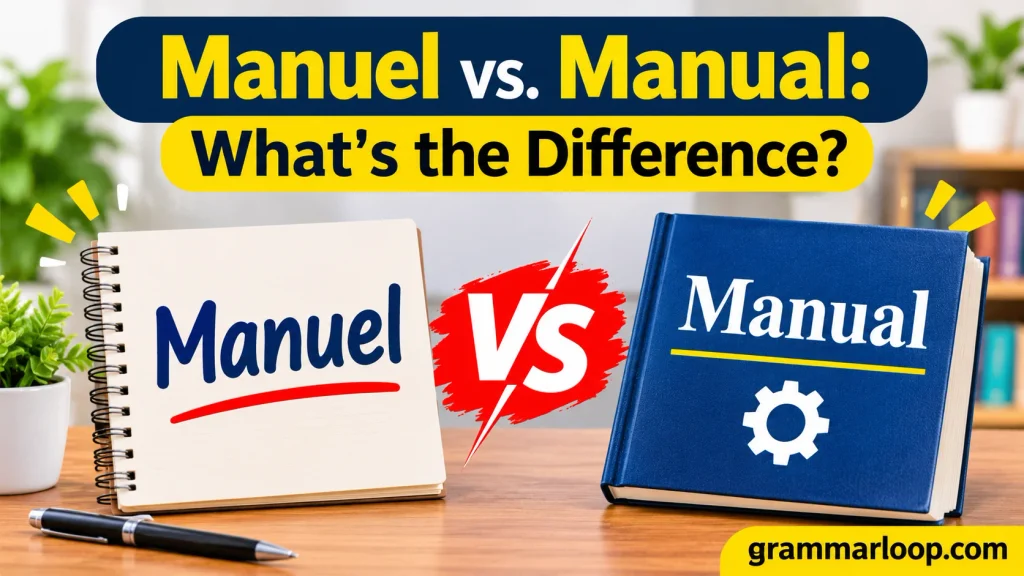
The words Manuel vs. Manual may look almost identical, but they have completely different meanings, uses, and grammatical purposes. The main difference is that Manuel is usually a proper name given to a person, while manual is a common word that describes something done by hand or a guidebook containing instructions. Because these words differ by only one letter, it is easy to confuse them when writing or reading. However, understanding their meanings can help you avoid spelling mistakes and use each word correctly. Whether you are writing an email, preparing an assignment, or explaining a process, knowing the difference makes your communication clearer and more professional.
The word Manuel is commonly used as a masculine first name in Spanish, Portuguese, and several other languages. It has historical and cultural connections and is often used as a personal name in different countries. For example, you might meet someone named Manuel Garcia or read about a famous person with this name. On the other hand, manual has several practical meanings in everyday English. It can describe work performed using your hands rather than machines, such as manual labor, or refer to a book that provides instructions, directions, and useful information about operating something. These different meanings make it important to recognize the context in which each word appears.
Learning when to use Manuel or manual is simple once you understand their roles in a sentence. Use Manuel when referring to a person’s name, and choose manual when discussing hand-operated tasks, written guides, or processes completed without automation. For instance, you might say, “Manuel reads the car’s instruction manual before driving.” In this sentence, Manuel identifies a person, while manual describes a guidebook. Paying attention to sentence meaning, spelling, and context will help you choose the correct word every time. By understanding these distinctions, you can improve your English vocabulary, write more accurately, and avoid confusing two words that look similar but serve very different purposes.
Quick Answer
If you’re in a hurry, here’s the simple distinction:
| Word | Meaning | Part of Speech |
| Manuel | A male given name | Proper noun |
| Manual | An instruction guide or something done by hand | Noun or adjective |
Simple Rule
Manuel = a person’s name
Manual = a book of instructions or work performed by hand
For example:
✅ Manuel submitted the report before lunch.
✅ Read the instruction manual before assembling the furniture.
❌ Read the instruction Manuel before assembling the furniture.
What Does Manuel Mean?
The word Manuel is not a common English vocabulary term. Instead, it is a personal name used in many countries around the world.
Definition of Manuel
Manuel is a masculine given name that originated from the Hebrew name Immanuel, which means:
“God is with us.”
The name later became popular throughout Spain, Portugal, Latin America, and parts of Europe.
Origin of the Name Manuel
The name has a long history stretching back centuries.
| Language | Variation |
| Hebrew | Immanuel |
| Spanish | Manuel |
| Portuguese | Manuel |
| Italian | Emanuele |
| English | Emmanuel |
Many kings, politicians, artists, athletes, and historical figures have carried this name.
Examples of Manuel in Sentences
- Manuel arrived early for the meeting.
- I spoke with Manuel about the project deadline.
- Manuel graduated from college last year.
- The manager asked Manuel to prepare the presentation.
- Manuel lives in Madrid.
In every example, Manuel refers to a person.
Famous People Named Manuel
Because Manuel is a widely used given name, many well-known individuals have carried it.
Examples include:
- Manuel Neuer – German professional football goalkeeper.
- Manuel Pellegrini – Chilean football manager.
- Manuel Noriega – Former Panamanian military leader.
- Manuel L. Quezon – Former President of the Philippines.
- Manuel de Falla – Renowned Spanish composer.
These examples reinforce an important point:
Manuel is almost always someone’s name.
What Does Manual Mean?
Unlike Manuel, manual is a standard English word used daily in workplaces, schools, industries, and households.
Definition of Manual
The word manual can function as both:
- A noun
- An adjective
Its meaning changes slightly depending on how it’s used.
Manual as a Noun
When used as a noun, a manual is a document that explains how something works.
It provides instructions, guidance, procedures, or reference information.
Common Types of Manuals
- User manuals
- Employee manuals
- Training manuals
- Operations manuals
- Safety manuals
- Technical manuals
- Vehicle manuals
Examples
- The software manual contains troubleshooting steps.
- Read the owner’s manual before driving the vehicle.
- Every employee receives a training manual.
- The technician consulted the repair manual.
Manual as an Adjective
When used as an adjective, manual describes something done by human effort rather than automation.
Examples
- Manual labor
- Manual transmission
- Manual data entry
- Manual operation
- Manual process
Example Sentences
- The company still relies on manual inventory tracking.
- Manual labor can be physically demanding.
- The machine requires manual adjustment.
- She completed the calculations manually.
Manuel vs. Manual: Side-by-Side Comparison
Understanding the differences becomes easier when you compare them directly.
| Feature | Manuel | Manual |
| Meaning | A person’s name | Instructions or work done by hand |
| Part of Speech | Proper noun | Noun or adjective |
| Capitalized? | Yes | Usually no |
| Refers To | A human being | A document or process |
| Common Usage | Personal names | Business, technology, education |
| Plural Form | Rare | Manuals |
| Possessive Form | Manuel’s | Manual’s |
Why People Confuse Manuel and Manual
Although the meanings are completely different, people mix them up surprisingly often.
Let’s look at the reasons.
Similar Spelling
Only one letter separates the two words.
Compare:
- Manuel
- Manual
When typing quickly, it’s easy to substitute “e” for “a”.
Similar Pronunciation
Depending on a speaker’s accent, the two words may sound very similar.
This creates confusion when people write words they’ve only heard spoken.
Autocorrect Errors
Modern spell-check systems often fail to catch the mistake because both words are legitimate.
For example:
Please review the employee Manuel.
The spelling checker sees no error because Manuel is a real name.
However, the sentence is incorrect.
Fast Typing Habits
Many workplace mistakes happen simply because writers rush.
A missing letter can completely change the meaning of a sentence.
English Learners Often Struggle
For non-native speakers, distinguishing between names and common nouns can be challenging.
Because both words look nearly identical, confusion becomes understandable.
Common Mistakes Writers Make
Let’s examine some frequent errors.
Using Manuel Instead of Manual
Incorrect
❌ Please read the safety Manuel.
Correct
✅ Please read the safety manual.
Why?
Because you’re referring to an instruction document, not a person.
Using Manual Instead of Manuel
Incorrect
❌ Manual joined our team yesterday.
Correct
✅ Manuel joined our team yesterday.
Why?
Because the sentence refers to a person’s name.
Forgetting Capitalization Rules
Incorrect
❌ manuel submitted the proposal.
Correct
✅ Manuel submitted the proposal.
Names always require capitalization.
Confusing Manual Labor with a Person
Incorrect
❌ The factory depends on Manuel labor.
Correct
✅ The factory depends on manual labor.
The adjective “manual” describes labor performed by humans.
How to Remember the Difference
Fortunately, several simple memory tricks can help.
Remember That Manuel Is a Name
Think about people you know.
Names like:
- Michael
- Daniel
- Samuel
- Manuel
All refer to individuals.
If the word identifies a person, choose Manuel.
Manual Contains “A” for Action
The letter A in manual can remind you of:
- Actions
- Activities
- Assembly instructions
Most manuals explain actions people should take.
Ask One Question
Before writing the word, ask:
Am I talking about a person or instructions?
If it’s a person, use Manuel.
If it’s instructions, use manual.
Real-World Examples of Manual in Different Industries
The word manual appears across nearly every profession.
Let’s explore how.
Technology Industry
Technology companies create manuals to help users operate products.
Examples:
- Software installation manuals
- User guides
- Technical documentation
- Network setup manuals
Without manuals, troubleshooting becomes difficult.
Automotive Industry
Vehicle manufacturers provide extensive manuals.
These documents explain:
- Maintenance schedules
- Safety features
- Dashboard indicators
- Tire specifications
- Engine care
Every vehicle owner benefits from reading the manual.
Manufacturing Industry
Factories frequently use manual processes alongside automation.
Examples include:
- Manual inspections
- Manual assembly
- Manual quality checks
Even advanced factories still rely on human oversight.
Healthcare Industry
Healthcare organizations use manuals for:
- Clinical procedures
- Emergency response protocols
- Infection control guidelines
- Medical equipment operation
Accuracy can directly affect patient safety.
Education Sector
Schools and universities distribute manuals covering:
- Student policies
- Faculty procedures
- Academic guidelines
- Administrative processes
These documents ensure consistency across institutions.
Read More: Unenroll vs Disenroll: Meaning, Differences
Grammar Rules for Using Manuel and Manual Correctly
Understanding grammar rules prevents costly mistakes.
Capitalization Rules
Manuel
Always capitalize because it’s a proper noun.
Examples:
✅ Manuel attended class.
✅ Manuel’s report was excellent.
Manual
Usually lowercase unless it begins a sentence.
Examples:
✅ Read the manual carefully.
✅ The manual explains everything.
Plural Forms
Manuel
Names generally don’t use plural forms.
However:
The party included three Manuels.
This usage is rare.
Manual
Plural form:
Manuals
Examples:
- Employee manuals
- Safety manuals
- User manuals
Possessive Forms
Manuel’s
Used when showing ownership.
Example:
- Manuel’s laptop needs repair.
Manual’s
Used when referring to something belonging to a manual.
Example:
- The manual’s introduction explains the system.
Manuel vs. Manual in Business Writing
Business communication leaves little room for spelling mistakes.
Using the wrong word can damage professionalism.
Emails
Incorrect
Please review the employee Manuel.
Correct
Please review the employee manual.
A simple typo changes the meaning completely.
Training Documents
Companies rely heavily on manuals.
Examples include:
- Onboarding manuals
- Procedure manuals
- Compliance manuals
- Operations manuals
Accuracy matters because employees depend on these documents.
Corporate Reports
Imagine writing:
Manuel procedures were followed.
Readers might wonder who Manuel is.
The correct phrase is:
Manual procedures were followed.
Human Resources Materials
HR departments frequently create:
- Policy manuals
- Benefits manuals
- Employee handbooks
Confusing Manuel and manual can create confusion for staff members.
Frequently Confused Words Related to Manual
Manual isn’t the only word that causes confusion.
Several related terms often overlap.
Manual vs. Handbook
| Manual | Handbook |
| Detailed instructions | General reference information |
| Often technical | Often broader |
| Process-focused | Information-focused |
Manual vs. Guide
A guide typically offers advice.
A manual provides detailed instructions.
Example:
- Travel guide
- Equipment manual
Manual vs. Documentation
Documentation refers to a collection of information.
A manual is usually a single instructional resource.
Manuel vs. Emmanuel
Both are names.
However:
- Manuel
- Emmanuel
They are different spellings with different cultural traditions.
Neither means the same thing as manual.
Manuel vs. Emanuel
These names are also closely related.
Examples:
- Manuel
- Emanuel
- Emmanuel
All are personal names.
None refer to instructional documents.
Practice Quiz: Can You Choose the Correct Word?
Fill in the blanks.
Question 1
Please read the employee ______ before your first day.
Answer:
✅ manual
Question 2
______ completed the project ahead of schedule.
Answer:
✅ Manuel
Question 3
The technician checked the repair ______.
Answer:
✅ manual
Question 4
I met ______ at the conference yesterday.
Answer:
✅ Manuel
Question 5
The factory still relies on ______ processes.
Answer:
✅ manual
Examples of Manual Used Correctly
- Read the manual before installation.
- The user manual explains setup procedures.
- Every employee received a training manual.
- The repair manual contains diagrams.
- The operations manual outlines workflows.
- The machine requires manual calibration.
- Manual labor remains essential in construction.
- The manual process takes longer.
- We switched from manual tracking to software.
- The vehicle includes a detailed owner’s manual.
- Manual inspections improve quality control.
- The safety manual covers emergency procedures.
- Manual adjustments were necessary.
- The technician consulted the manual.
- Manual testing identified several issues.
- The manual transmission performed well.
- The operator followed the manual carefully.
- The procedure manual needs updating.
- The manual includes troubleshooting steps.
- Manual verification reduced errors.
Case Study: How One Letter Created a Workplace Problem
A large organization distributed a new onboarding document to employees.
The email stated:
Please review the Employee Manuel before orientation.
Several workers responded asking:
Who is Manuel?
The sender intended to write:
Please review the Employee Manual before orientation.
The typo delayed communication and generated unnecessary confusion.
Lesson Learned
Even small spelling mistakes can:
- Cause misunderstandings
- Reduce professionalism
- Create unnecessary questions
- Slow workplace productivity
Proofreading matters.
Quick Reference Cheat Sheet
| If You Mean… | Use |
| A person’s name | Manuel |
| User guide | Manual |
| Instruction book | Manual |
| Employee handbook | Manual |
| Something done by hand | Manual |
| A man named Manuel | Manuel |
Conclusion:
Understanding the difference between Manuel vs. Manual is simple once you know how each word is used. Manuel is a proper name commonly given to boys and men, while manual is a common English word that refers to something done by hand or a book containing instructions. Although their spelling is similar, their meanings and grammatical roles are completely different.
To avoid confusion, always consider the context and meaning of your sentence before choosing either word. Use Manuel when referring to a person and manual when discussing hand-operated work, instruction guides, or non-automatic processes. Remembering this simple distinction will help you improve your spelling, vocabulary, and everyday writing skills.
FAQs:
1. What is the main difference between Manuel and Manual?
Manuel is a proper name used for a person, whereas manual refers to something done by hand or a book that provides instructions. They have different meanings despite their similar spelling.
2. Is Manuel a proper noun?
Yes, Manuel is a proper noun because it is a personal name. It should always begin with a capital letter when used as someone’s name.
3. What does the word manual mean?
Manual has two common meanings. It can describe an activity performed by hand rather than by a machine, or it can refer to a guidebook containing instructions.
4. Is manual the same as a handbook?
Yes, in many situations, a manual and a handbook have similar meanings. Both provide useful information, instructions, or guidance, although their specific purposes can differ.
5. How can I remember the difference between Manuel and Manual?
An easy way to remember is that Manuel refers to a person’s name, while manual relates to hands or instructions. Checking the sentence’s context will help you choose the correct spelling.



One Response