
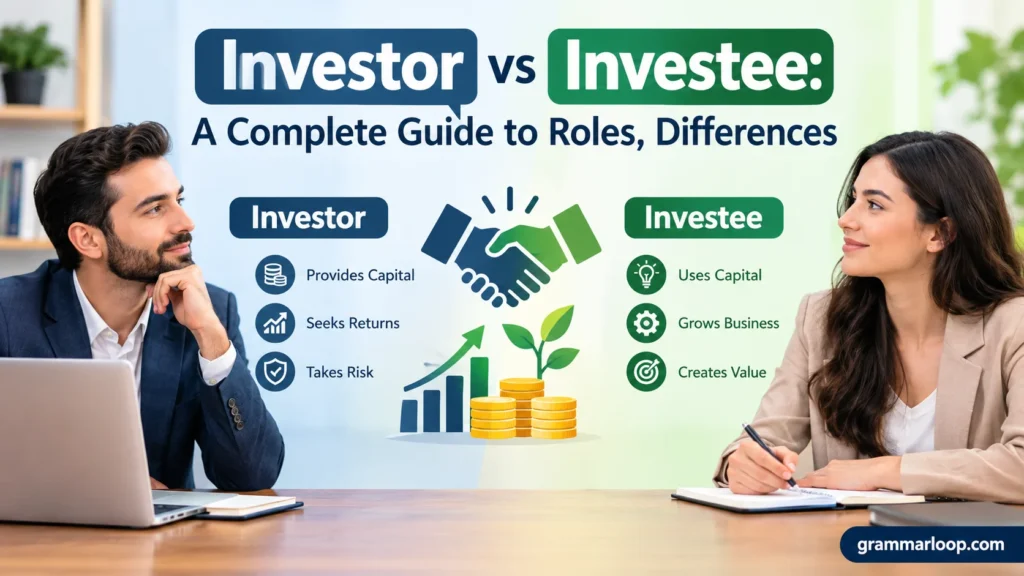
Understanding investor vs investee is important if you want to learn how business investments work and how money moves between individuals and companies. An investor is a person or organization that provides money or other resources to earn a potential return. An investee, on the other hand, is the individual, business, or organization that receives the investment to support its goals. These two roles are closely connected because one party provides capital while the other uses it for growth and development. Whether you are starting a business, exploring investment opportunities, or learning about financial terminology, knowing the difference can help you make smarter decisions.
The main difference between an investor and an investee lies in their responsibilities, financial positions, and goals. Investors usually focus on profit potential, risk management, and the expected return on their money. They may invest in startups, established companies, real estate, or other financial opportunities. In comparison, investees use the received funds to develop products, expand operations, purchase equipment, or achieve other business objectives. Depending on the agreement, an investee may provide company shares, interest payments, or other returns to the investor. However, not every investment guarantees a profit, and the exact arrangement depends on the investment type and contractual terms.
Learning about investor vs investee can help you understand the relationship between capital providers and recipients in different financial situations. For example, when an entrepreneur receives money from an investor to launch a new company, the entrepreneur or company becomes the investee, while the person providing the funds becomes the investor. Both parties should understand the investment terms, potential risks, and expected outcomes before entering an agreement. Investors should evaluate the business carefully, while investees should use the funds responsibly and strategically. Clear communication, proper documentation, and realistic expectations can strengthen their relationship.
What Is an Investor in the Investor vs Investee Relationship?
An investor is a person or institution that allocates capital with the expectation of future financial return.
That sounds formal, but the idea is simple:
Investors put money into something today so they can get more money back tomorrow.
But investors don’t just throw money around randomly. They follow structure, logic, and risk assessment.
Core purpose of an investor
Investors aim to:
- Grow wealth over time
- Reduce risk across a portfolio
- Support scalable businesses or assets
- Exit with profit (via sale, dividends, or equity growth)
Main types of investors
Different investors behave differently in the investor vs investee ecosystem:
Angel Investors
- Invest personal money
- Often invest early-stage startups
- Typical range: $5,000 to $250,000 per deal
- Example: early-stage startup backing before product-market fit
Venture Capitalists (VCs)
- Invest pooled capital from funds
- Focus on high-growth startups
- Typical investment: $1M to $50M+ per round
- Expect high returns (10x–100x in rare cases)
Institutional Investors
- Pension funds, hedge funds, insurance firms
- Invest billions across assets
- Focus on stability and long-term returns
Retail Investors
- Everyday individuals investing personal savings
- Use stocks, ETFs, mutual funds
What investors actually evaluate
Investors don’t just look at ideas. They look at execution potential.
They evaluate:
- Market size (Is it big enough to scale?)
- Team strength (Can this team execute?)
- Traction (Is there proof of demand?)
- Risk level (What can go wrong?)
- Exit opportunity (How do we get returns?)
A VC once summed it up like this:
“We don’t invest in ideas. We invest in outcomes.”
That mindset defines the investor side of the investor vs investee dynamic.
What Is an Investee in the Investor vs Investee Structure?
An investee is the individual, startup, or company that receives investment capital.
In simple terms:
The investee is the builder who turns money into results.
Who counts as an investee?
Investees can include:
- Startup founders raising seed or Series A funding
- Companies expanding into new markets
- Businesses scaling operations
- Project-based ventures seeking capital injection
Core responsibility of an investee
Investees must:
- Use capital efficiently
- Build and grow the business
- Deliver returns indirectly through performance
- Maintain transparency with investors
Unlike investors, investees don’t just manage money. They manage execution under pressure.
What investees are expected to deliver
Investors expect investees to:
- Show consistent growth metrics
- Maintain reporting discipline
- Hit agreed milestones
- Increase company valuation
In venture capital, failure to meet milestones often triggers:
- Reduced future funding
- Loss of investor confidence
- Board intervention in extreme cases
Example scenario
A startup raises $2 million in seed funding.
The investee (founder team) must now:
- Hire talent
- Build product
- Acquire users
- Prove scalability
If they fail to execute, capital alone won’t save the business.
Investor vs Investee: Core Differences Explained Clearly
The investor vs investee relationship works because both sides play opposite but connected roles.
Let’s break it down in a clean comparison.
Key structural differences
| Factor | Investor | Investee |
| Role | Provides capital | Uses capital |
| Objective | Return on investment | Business growth |
| Control | Oversight or partial control | Operational control |
| Risk type | Financial loss | Business failure + dilution |
| Reward | Profit, equity gains | Growth, ownership, valuation increase |
Power dynamics in investor vs investee relationships
Control is rarely equal.
Investors often gain:
- Board seats (in VC deals)
- Voting rights
- Financial oversight rights
Investees retain:
- Day-to-day operations
- Hiring decisions (within limits)
- Product direction (sometimes shared)
However, as funding increases, investor influence usually grows.
A Series A startup often experiences a shift where:
- Founders lose full autonomy
- Strategic decisions require investor approval
- Financial reporting becomes mandatory
Read More: Village vs Subdivision: Real Differences, Costs
How the Investor–Investee Relationship Actually Begins
The investor vs investee relationship doesn’t start with money. It starts with persuasion.
Step 1: The pitch
The investee presents:
- Business model
- Market opportunity
- Growth projections
- Product demo or prototype
Investors listen for signals, not just ideas.
Step 2: Due diligence
Investors investigate:
- Financial records
- Legal structure
- Customer validation
- Founder background
This phase filters out weak opportunities.
Step 3: Negotiation
Key terms include:
- Valuation
- Equity percentage
- Voting rights
- Exit conditions
Step 4: Deal structure
Common funding structures:
Equity investment
- Investor receives ownership shares
SAFE agreement
- Future equity based on valuation trigger
- Common in startups (popularized by Y Combinator)
Convertible notes
- Loan that converts into equity later
Step 5: Capital deployment
Once funding closes:
- Investor transfers capital
- Investee begins execution
- Reporting cycle starts
Investor vs Investee Risks: Both Sides Face Pressure
Money exchange always involves risk. The investor vs investee relationship is no exception.
Risks investors face
Investors can lose capital due to:
- Startup failure (very common in early-stage investing)
- Market downturns
- Poor management decisions
- Liquidity lock-in (cannot easily exit)
Startup failure rates are high:
- Roughly 70% of startups fail within 10 years
- Many early-stage investments never return capital
Risks investees face
Investees face different but equally intense risks:
- Loss of equity (ownership dilution)
- Loss of decision control
- Pressure to meet aggressive growth targets
- Investor interference in strategy
A founder once described it like this:
“You don’t just take money. You take expectations that never stop growing.”
What Makes a Strong Investor vs Investee Relationship Work
The best investor vs investee relationships feel less like transactions and more like partnerships.
Alignment of goals
Both sides must agree on:
- Growth timeline
- Exit strategy (IPO, acquisition, etc.)
- Risk tolerance
Misalignment causes conflict early.
Communication rhythm
Strong relationships rely on:
- Monthly or quarterly updates
- Transparent financial reporting
- Honest discussion of setbacks
Trust backed by data
Trust without data creates friction.
Investors want:
- Metrics (user growth, revenue, retention)
- Forecast updates
- Performance dashboards
Governance structure
Healthy governance includes:
- Board meetings
- Voting rights
- Clear decision boundaries
Common Mistakes in Investor vs Investee Dynamics
Many deals fail not because of bad ideas, but because of avoidable mistakes.
Overvaluation problems
Startups sometimes inflate valuation too early.
This leads to:
- Unrealistic investor expectations
- Down rounds later
- Reduced investor trust
Misaligned timelines
Investors may expect returns in 3–5 years.
Founders may need 7–10 years to scale.
That gap creates tension.
Lack of transparency
Hiding problems destroys trust faster than failure itself.
Ignoring exit planning
Every investor wants an exit:
- IPO
- Acquisition
- Secondary sale
If no exit exists, investment loses logic.
Real-World Case Study: Startup Funding in Action
Let’s walk through a simplified but realistic scenario.
The startup
A fintech startup builds a mobile payment solution.
The investor
An early-stage VC fund invests $3 million for 20% equity.
Outcome possibilities
Success scenario
- Company sells for $50 million
- Investor earns 10x return
Struggle scenario
- Growth stalls
- Additional funding required
- Ownership diluted
Conclusion
Understanding Investor vs Investee helps you recognize how investments work and how both parties contribute to financial and business growth. An investor provides money or resources to earn a potential return, while an investee receives those resources to support business activities, expand operations, or achieve specific goals. Although their roles are different, both parties are important to a successful investment relationship.
Before making an investment, it is essential to understand the risks, responsibilities, legal agreements, and expected returns. Investors should carefully evaluate opportunities, while investees should manage funds responsibly and communicate openly. Ultimately, a clear understanding of these roles helps both parties build trust, manage expectations, and make better financial decisions.
FAQs
1. What is the main difference between an investor and an investee?
An investor is the person or organization that provides money or resources for an investment. An investee is the person, business its goals or operations.
2. Can a company be both an investor and an investee?
Yes, a company can be both an investor and an investee in different transactions. It may invest in another business while also receiving investment from individuals or other organizations.
3. What are the main responsibilities of an investor?
An investor typically evaluates opportunities, assesses financial risks, provides capital, and monitors investment performance.
4. What does an investee do with the investment?
An investee uses the received funds according to the investment agreement. This may include expanding operations, developing products, hiring employees.
5. Does an investor always earn a profit from an investee?
No, an investor does not always earn a profit. Every investment involves some level of financial risk, and the investee’s performance may affect the outcome.






One Response