
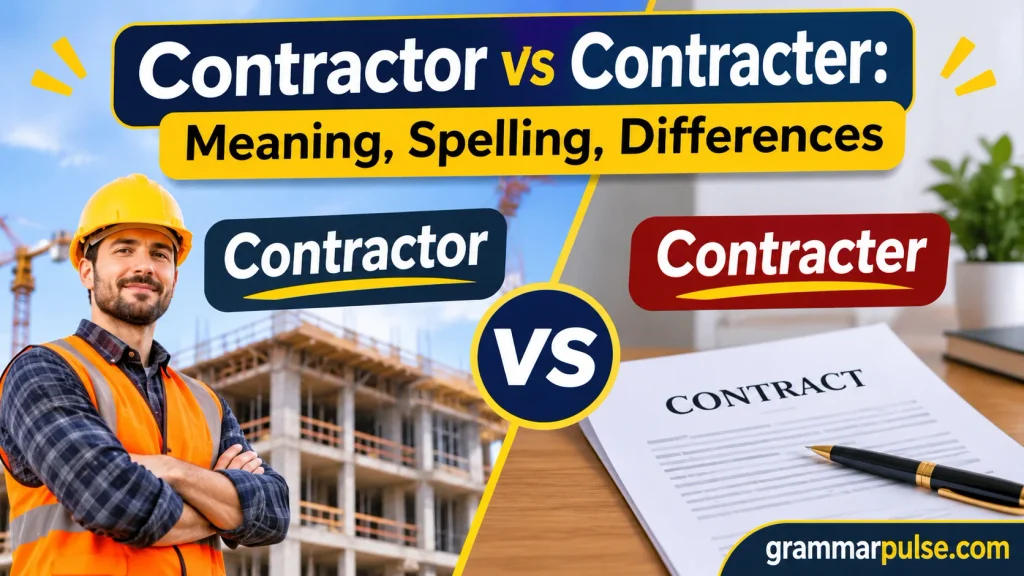
When comparing Contractor vs Contracter, it is important to understand which spelling is correct in English and how each word is used in everyday writing. These two words look almost identical, so it is easy to become confused when typing emails, preparing documents, or writing professional content. However, only contractor is the standard and correct spelling. It refers to a person or company hired to perform specific work under an agreement or contract. A contractor may work in construction, business, technology, or other industries. Understanding this spelling difference can help you improve your writing accuracy and avoid common mistakes. Although contracter may look reasonable because of its pronunciation, it is not accepted as the standard English spelling.
The word contractor is commonly used in professional communication, especially when discussing construction projects, business services, and independent workers. For example, a company may hire a contractor to build an office, repair equipment, or complete a particular project within an agreed period. The word comes from contract, which refers to a formal agreement between two or more parties. Adding the suffix -or creates a word for someone who performs work or provides services under that agreement. On the other hand, contracter is a spelling error that sometimes appears because writers misunderstand the word’s formation. Knowing this simple rule makes it easier to choose the correct spelling whenever you need it.
Learning the difference between contractor and contracter is useful for students, employees, business owners, and anyone who wants to communicate more professionally. Using the correct word can make your emails, reports, applications, and other written documents look clear and reliable. If you are unsure which spelling to use, remember that contractor is always the preferred standard form in modern English. You can also improve your vocabulary by reading examples, practicing sentences, and checking unfamiliar words before publishing your writing. In this guide, we will explore their meanings, spelling rules, and practical differences, along with useful examples to help you understand when and how to use the correct form confidently.
Why “Contractor vs Contracter” Confusion Happens
Let’s start with the root of the problem.
People don’t usually misspell words randomly. They hear something and try to write it the way it sounds.
Here’s what causes the mistake:
- The word “contractor” gets pronounced quickly in conversation
- The ending “-or” sounds like “-er” in casual speech
- Autocorrect sometimes “learns” the wrong pattern
- Non-native English speakers often apply phonetic spelling rules
- Search engines reinforce the mistake when many people type it
Think of it like this:
You hear “doctor,” but you might be tempted to write “docter.” Same pattern, same mistake.
So if you’ve ever typed “contracter,” you’re actually following sound logic. You just hit a spelling rule wall.
Contractor vs Contracter: The Correct Spelling Explained
Let’s make this crystal clear.
✔ Correct:
- Contractor
❌ Incorrect:
- Contracter
Why “contractor” is correct:
The word comes from “contract” + “-or”, not “-er.”
In English, the suffix “-or” is commonly used for roles involving action or responsibility:
- Actor (acts)
- Director (directs)
- Inspector (inspects)
- Contractor (contracts work)
Meanwhile, “-er” often appears in simpler action words:
- Worker
- Builder
- Teacher
So grammatically, “contractor” follows standard word formation rules.
What Is a Contractor? (Simple Definition That Actually Makes Sense)
A contractor is a person or company hired to complete a specific task or project under a contract.
That’s it. No confusion needed.
They are not permanent employees. Instead, they work on:
- Fixed projects
- Temporary assignments
- Agreed deliverables
Simple explanation:
A contractor is someone you hire for a job, not someone who joins your team permanently.
Real-Life Examples of Contractors
Let’s make this practical.
Example 1: Home Renovation
You hire someone to remodel your kitchen.
- They design the plan
- They buy materials
- They complete the renovation
- You pay them for the project
That person is a contractor.
Example 2: Freelance Web Developer
A company hires a developer to build a website.
- They agree on a fixed price
- The developer works remotely
- The job ends once the site is delivered
That’s a contractor relationship.
Example 3: Government Road Project
A construction firm builds a highway under a government contract.
- They follow strict deadlines
- They meet safety standards
- They invoice based on milestones
Again, a contractor.
Read more: Ways to Say “Thank You for Your Concern”: A Complete Guide to Natural
Types of Contractors (And How They Actually Differ)
Not all contractors do the same work. The term covers several roles.
Independent Contractors
These people work alone or as small operators.
- Freelancers
- Consultants
- Designers
- Writers
They control their schedule and choose their clients.
General Contractors
These professionals manage entire projects.
- Oversee construction sites
- Hire subcontractors
- Coordinate timelines and materials
Think of them as project leaders.
Subcontractors
These contractors handle specialized tasks inside a bigger project.
- Electricians
- Plumbers
- HVAC technicians
They usually report to a general contractor.
Government Contractors
These companies work on public sector projects.
- Roads
- Defense systems
- Infrastructure development
They must follow strict legal and compliance rules.
Comparison Table
| Type | Role | Works With | Example |
| Independent Contractor | Solo worker | Clients directly | Freelance designer |
| General Contractor | Project manager | Teams & subcontractors | Construction manager |
| Subcontractor | Specialist worker | General contractor | Electrician |
| Government Contractor | Public projects | Government agencies | Road construction firm |
How Contractors Actually Work (Step-by-Step Breakdown)
Contractor work is structured but flexible.
Step 1: Agreement
Both sides agree on:
- Scope of work
- Timeline
- Payment terms
This agreement forms the contract.
Step 2: Execution
The contractor starts the job.
- Works independently
- Uses their own tools or team
- Follows agreed milestones
Step 3: Delivery
The contractor completes the work.
- Submits final output
- Fixes any revisions if needed
- Hands over deliverables
Step 4: Payment
Payment depends on agreement:
- Fixed price
- Hourly rate
- Milestone payments
Once paid, the contract ends.
Simple Analogy: Contractor vs Employee
Here’s a clean way to understand it.
An employee is like a permanent team member.
A contractor is like a specialist you call when you need something specific done.
Think of it like this:
- Employee = owning a car
- Contractor = renting a car when needed
Both get you where you need to go. But ownership and responsibility differ.
Where People Commonly Get “Contracter” Wrong
Let’s break down why this spelling mistake spreads so easily.
1. Pronunciation confusion
People say it quickly, and the ending blends.
2. Typing habits
Fast typing leads to phonetic spelling.
3. Search engine autocorrect
Search engines sometimes “guess” wrong queries.
4. Social media influence
If enough people misspell it, others copy it.
Why Correct Spelling Matters More Than You Think
This might feel small, but spelling impacts real-world outcomes.
1. Job Searches
Typing “contracter jobs” can:
- Reduce search accuracy
- Miss relevant listings
- Limit opportunities
2. Professional Documents
Incorrect spelling in contracts or resumes can:
- Look unprofessional
- Cause confusion
- Reduce credibility
3. Legal Clarity
In legal writing, precision matters.
A misspelling in a contract may not invalidate it, but it can create unnecessary doubt.
Case Study: Small Spelling Error, Big Visibility Problem
Imagine two freelancers:
Freelancer A:
Searches “contractor jobs”
- Finds 500+ listings
- Applies to multiple gigs
- Gets consistent responses
Freelancer B:
Searches “contracter jobs”
- Finds fewer relevant listings
- Misses key opportunities
- Assumes the market is slow
Same skill level. Different spelling. Different outcomes.
This is how a single letter changes visibility online.
Quick Grammar Insight: Why “-or” Wins Here
English often borrows from Latin-based patterns.
Words ending in “-or” usually describe:
- Roles
- Professions
- Functions
Examples:
- Doctor
- Actor
- Editor
- Contractor
So “contractor” follows a long-standing linguistic pattern, while “contracter” breaks it.
Common Questions About Contractor vs Contracter
Is “contracter” ever correct?
No. Standard English does not recognize it.
What does a contractor do?
A contractor completes a specific job or project under a contract agreement.
Is a freelancer a contractor?
Yes, in most cases. Freelancers often work as independent contractors.
Do contractors get benefits like employees?
Usually no. Contractors manage their own taxes, insurance, and benefits.
What industries use contractors the most?
- Construction
- IT and software
- Creative services
- Consulting
- Government projects
Key Differences at a Glance
| Feature | Contractor | Contracter |
| Correct spelling | Yes | No |
| Dictionary recognized | Yes | No |
| Professional usage | Standard | Incorrect |
| Search accuracy | High | Low |
| Legal usage | Valid term | Invalid term |
Conclusion:
The difference between contractor vs contracter is simple: contractor is the correct and standard English spelling, while contracter is a common misspelling. A contractor is a person or company hired to complete specific work under an agreement. The word is widely used in construction, business, technology, and other professional fields. When writing emails, reports, applications, or business documents, always use contractor to maintain accuracy and professionalism. Remembering this simple spelling rule will help you avoid mistakes and improve your English writing skills.
FAQs:
1. Is contractor or contracter the correct spelling?
Contractor is the correct spelling in standard English. Contracter is a misspelling and should be avoided in professional and everyday writing.
2. What does contractor mean?
A contractor is a person or company hired to perform specific work or provide services under an agreement. Contractors commonly work in construction, business, and other industries.
3. Why do people spell contractor as contracter?
People sometimes write contracter because they confuse the spelling with the word contract. However, the correct suffix is -or, making contractor the standard spelling.
4. What is the plural form of contractor?
The plural form of contractor is contractors. For example: “The company hired three contractors to complete the building project.”
5. Can I use contracter in formal writing?
No. Contracter is not the standard spelling and should not be used in formal writing. Always use contractor in emails, reports, business documents, and professional communication.

One Response