
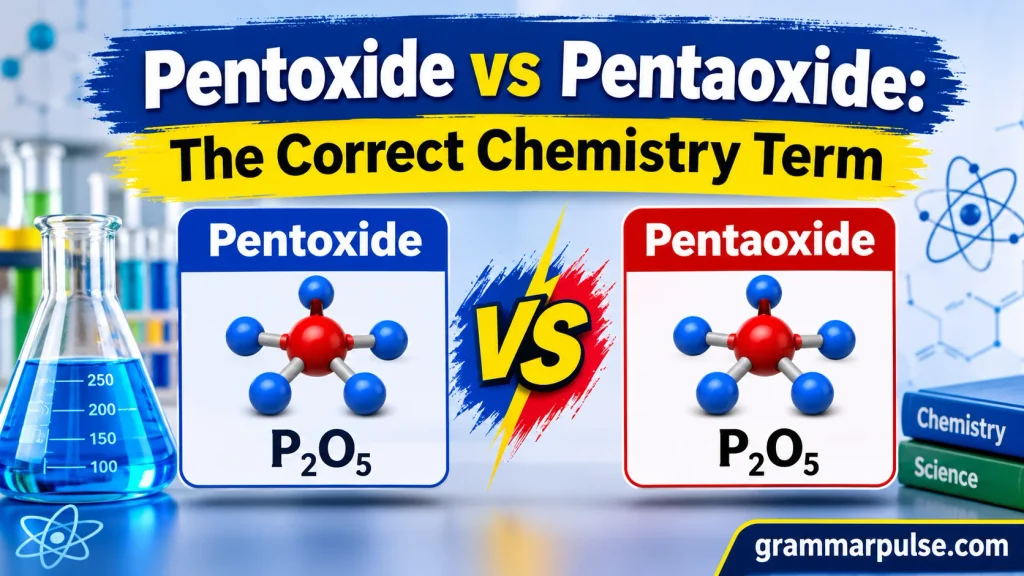
When studying chemistry, you may come across different spellings of chemical terms that seem almost identical. One common example is Pentoxide vs Pentaoxide, which often creates confusion among students, teachers, and science enthusiasts. Both words appear to describe compounds containing five oxygen atoms, but only one spelling is generally accepted in standard chemical terminology. Understanding the correct form is important for writing chemistry assignments, preparing laboratory reports, and communicating scientific information accurately. Although the difference between these two words may seem small, using the correct spelling helps maintain clarity and precision in scientific writing. Learning the rule behind this spelling difference can also make other chemical names easier to understand.
The correct chemistry term is pentoxide, rather than pentaoxide, in standard chemical nomenclature. This spelling follows an established naming convention in which the vowel at the end of the prefix penta- is commonly dropped before the word oxide. The same pattern appears in familiar chemical names such as dinitrogen pentoxide and phosphorus pentoxide. These examples demonstrate how chemical prefixes combine with element names to create shorter, standardized terms. Knowing this convention helps students avoid spelling mistakes and recognize chemical names more confidently. It also makes it easier to understand how prefixes and suffixes work together when naming compounds.
In this guide, we will explore the difference between pentoxide and pentaoxide, explain which spelling is correct, and examine the chemical naming rule behind it. You will learn how the term pentoxide is used in real chemical examples and why the alternative spelling is generally considered incorrect in standard usage. We will also discuss common mistakes, practical examples, and simple ways to remember the correct spelling. Whether you are a chemistry student, a teacher, or someone interested in scientific terminology, this explanation will help you use the word correctly. By the end, you will understand why pentoxide is the preferred form and how to apply this rule in everyday scientific writing.
What “Oxide” Means in Chemistry
Before we compare pentoxide vs pentaoxide, we need to understand the word oxide itself.
An oxide is a chemical compound that contains:
- Oxygen (O)
- Another element (like nitrogen, phosphorus, carbon, or metals)
Oxygen usually carries a charge of -2, and it bonds with other elements to form stable compounds.
Common real-world oxides:
- Carbon dioxide (CO₂) → found in your breath
- Carbon monoxide (CO) → toxic gas from incomplete combustion
- Sulfur dioxide (SO₂) → pollution gas from burning fuels
- Iron oxide (Fe₂O₃) → rust
These compounds show how common oxides are in both nature and industry.
Now here’s where naming becomes important.
Chemists don’t just say “nitrogen oxygen compound.” They use a structured naming system called prefix-based nomenclature.
That system is what creates the difference between pentoxide and pentaoxide.
Read More: Contractor vs Contracter: Meaning, Spelling, Differences
The Correct Term: What “Pentoxide” Actually Means
Let’s break down the correct term: pentoxide.
Word structure:
- Penta- = five oxygen atoms (Greek prefix)
- Oxide = oxygen compound
When combined properly, the word becomes pentoxide, not pentaoxide.
Why the spelling changes:
In chemistry, words adjust slightly when prefixes meet oxygen-based roots. This avoids awkward pronunciation.
So instead of:
- ❌ penta + oxide = pentaoxide
Chemistry simplifies it to:
- ✅ pentoxide
Real examples of pentoxide compounds:
Dinitrogen pentoxide (N₂O₅)
- A white crystalline solid
- Strong oxidizing agent
- Used in nitration reactions (important in organic chemistry)
Reaction example:
4 HNO₃ → 2 N₂O₅ + 2 H₂O
Phosphorus pentoxide (P₄O₁₀)
- Extremely strong dehydrating agent
- Removes water from compounds
- Often written as P₂O₅ in simplified chemical equations
Key takeaway:
Pentoxide is the accepted IUPAC-style name used in textbooks, labs, and research papers.
Why “Pentaoxide” Is Incorrect in Standard Chemistry
Now let’s address the wrong term: pentaoxide.
At first glance, it looks logical. You see:
- “penta” = five
- “oxide” = oxygen compound
So people assume: “penta + oxide = pentaoxide”
But chemistry doesn’t follow English intuition. It follows structured naming rules defined by IUPAC (International Union of Pure and Applied Chemistry).
Why it is wrong:
1. Pronunciation conflict
Chemists avoid awkward double-vowel transitions like:
- “penta-oxide” → sounds broken and unnatural in technical speech
So the word contracts.
2. Established naming conventions
Standard chemistry prefers:
- pentoxide
- tetroxide
- dioxide
Not:
- pentaoxide
- tetraoxide
- di-oxide (in most formal usage)
3. Lack of recognition in scientific literature
If you search academic journals:
- “pentoxide” → thousands of results
- “pentaoxide” → rare or incorrect usage
Where you typically see “pentaoxide”:
- Student mistakes
- Informal blog posts
- Automated content generation errors
- Misheard classroom terms
Important point: If a chemical term does not appear in IUPAC references or textbooks, it is not considered valid.
Real Naming Rules Behind Oxides (Simple Breakdown)
Chemistry uses a system called covalent compound nomenclature for non-metal oxides.
This system relies on Greek prefixes.
Common prefixes used in oxides:
| Number | Prefix | Example |
| 1 | mono- | carbon monoxide (CO) |
| 2 | di- | carbon dioxide (CO₂) |
| 3 | tri- | sulfur trioxide (SO₃) |
| 4 | tetra- | tetroxide compounds |
| 5 | penta- | pentoxide compounds |
| 6 | hexa- | hexoxide compounds |
Important naming rule:
When a prefix ends in a vowel and the next word starts with a vowel, chemists often simplify pronunciation.
So:
- tetra + oxide → tetroxide
- penta + oxide → pentoxide
Why this rule exists:
It keeps chemical names:
- Easier to pronounce
- Faster to write
- More consistent across languages
Quick analogy:
Think of it like contraction in English:
- “do not” → “don’t”
- “penta oxide” → “pentoxide”
Same idea. Cleaner communication.
Common Compounds That Use “Pentoxide”
Let’s look at real chemical compounds where pentoxide appears.
Dinitrogen pentoxide (N₂O₅)
- Color: white solid
- Stability: unstable at room temperature
- Role: strong nitrating agent
Uses:
- Organic synthesis (especially explosives and dyes)
- Laboratory nitration reactions
Phosphorus pentoxide (P₄O₁₀ / P₂O₅)
This compound is especially important.
- Extremely hygroscopic (absorbs water quickly)
- Strong dehydrating agent
- Used in chemical drying processes
Example reaction:
P₄O₁₀ + 6 H₂O → 4 H₃PO₄
This shows how it removes water to form phosphoric acid.
Why chemists sometimes write P₂O₅
Even though the real molecule is P₄O₁₀, chemists often use:
- empirical formula (P₂O₅) for simplicity
But the name remains:
Phosphorus pentoxide
Side-by-Side Comparison: Pentoxide vs Pentaoxide
Let’s make the difference crystal clear.
| Feature | Pentoxide | Pentaoxide |
| Correctness | ✔ Accepted | ❌ Incorrect |
| IUPAC usage | ✔ Standard | ❌ Not recognized |
| Academic usage | ✔ Common | ❌ Rare |
| Textbook presence | ✔ Yes | ❌ No |
| Pronunciation | Smooth | Awkward |
| Search results in journals | High | Minimal |
| Recommended use | Always | Never |
Why Accuracy in Chemical Naming Matters
This might sound like a small spelling issue, but it actually matters a lot in science.
1. Lab communication
Imagine a lab technician misreads a compound name.
- One wrong letter can lead to using the wrong chemical
- That can change reaction outcomes completely
2. Academic writing
Students often lose marks for incorrect naming.
Professors expect:
- IUPAC-compliant terminology
- Standard spelling conventions
3. Search and research accuracy
Search engines and databases rely on exact terms.
- “pentoxide” → accurate scientific data
- “pentaoxide” → incomplete or misleading results
Simple analogy:
It’s like searching for a street using the wrong spelling. You might still get close, but you won’t reach the exact destination.
How to Remember the Correct Form Easily
Here’s a simple trick you can use forever.
The golden rule:
If it involves oxygen compounds, trust “pentoxide,” not “pentaoxide.”
Memory hacks:
Trick 1: Drop the extra vowel
- penta + oxide → pentoxide
Trick 2: Think contraction
- Just like “don’t,” chemistry also shortens words
Trick 3: Sound test
Say both aloud:
- “penta-oxide” → feels clunky
- “pentoxide” → flows naturally
Your brain usually prefers the correct form once you hear it.
Case Study: Student Confusion in Chemistry Exams
Let’s look at a real classroom-style scenario.
Situation:
A student writes:
“Phosphorus pentaoxide is used as a dehydrating agent.”
Problem:
- The term “pentaoxide” is incorrect
- The correct answer is “phosphorus pentoxide”
Result:
- Partial or full marks deduction depending on strictness
What the teacher expects:
- Correct IUPAC terminology
- Proper spelling: pentoxide
Lesson learned:
Even small naming errors can affect academic performance.
Conclusion:
Understanding Pentoxide vs Pentaoxide is important for using correct chemical terminology in scientific writing. Although both spellings may seem reasonable, pentoxide is the standard and preferred form in chemistry. The final vowel in the prefix penta- is usually dropped when it combines with oxide, making the word shorter and easier to pronounce. Examples such as dinitrogen pentoxide and phosphorus pentoxide demonstrate this naming convention.
Remembering this simple rule can help you avoid spelling mistakes in chemistry assignments, laboratory reports, and exams. Whenever you need to describe a compound containing five oxygen atoms, use pentoxide according to standard chemical naming conventions.
FAQs:
1. Is pentoxide or pentaoxide correct?
Pentoxide is the standard and preferred spelling in chemical nomenclature. Pentaoxide is generally considered an incorrect spelling in conventional chemical names.
2. Why is pentoxide spelled without the letter “a”?
The vowel “a” in the prefix penta- is commonly dropped before oxide to make the chemical name easier to pronounce and follow standard naming conventions.
3. What does pentoxide mean in chemistry?
Pentoxide refers to a chemical compound containing five oxygen atoms per molecule or formula unit, as indicated by the prefix pent-.
4. Is pentaoxide ever used in chemistry?
The spelling pentaoxide may appear in informal writing or spelling mistakes, but pentoxide is the accepted conventional form in standard chemical terminology.






One Response