
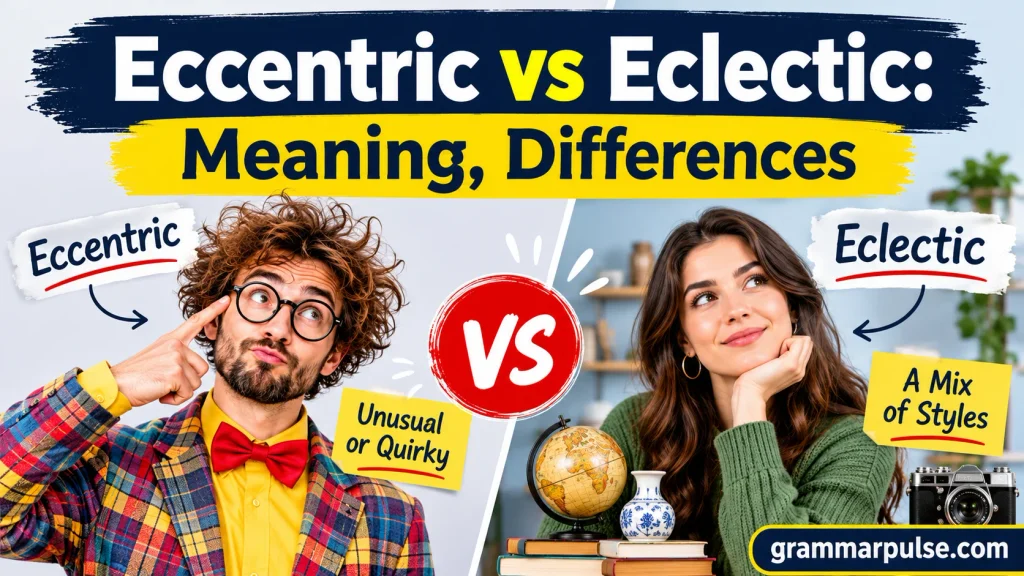
Understanding the difference between eccentric vs eclectic can help you improve your vocabulary, writing, and everyday communication. Although these two words look and sound somewhat similar, they have different meanings and are used in different situations. The word eccentric describes someone or something that is unusual, unconventional, or different from what people generally expect. In contrast, eclectic refers to a style, taste, or approach that combines ideas, influences, or elements from various sources. Because both words are often associated with individuality and creativity, people sometimes confuse them. Learning their meanings and differences will help you choose the correct word in conversations, essays, and professional writing.
The word eccentric is commonly used to describe a person with unusual habits, behavior, or preferences that make them stand out from others. For example, an eccentric artist might wear colorful clothes, follow unusual routines, or express ideas in unexpected ways. However, being eccentric does not necessarily mean being negative or strange in an unpleasant way. On the other hand, eclectic is often used when discussing fashion, music, interior design, literature, and personal interests. An eclectic person may enjoy different musical genres, combine various decorating styles, or appreciate ideas from multiple cultures. In this context, the word highlights variety, diversity, and the ability to bring different elements together creatively.
In this guide, we will explore the meaning, differences, and practical usage of eccentric and eclectic through simple explanations and examples. You will learn how to identify the correct word based on context, grammar, and intended meaning. We will also discuss common mistakes, similar expressions, and situations where each term works best. Whether you are describing a creative personality, unusual behavior, or a mixture of different styles, understanding these words will help you communicate more accurately. By the end, you will know how to use eccentric and eclectic confidently in everyday conversations, academic writing, and professional communication without confusing their meanings.
Quick Meaning of Eccentric vs Eclectic (Simple Version First)
Before we go deep, here’s the cleanest possible distinction:
- Eccentric = a person who behaves in unusual, quirky, or unconventional ways
- Eclectic = a mix of different styles, ideas, or influences pulled from many sources
Now think of it like this:
- An eccentric artist might paint upside down because they prefer it that way.
- An eclectic artist might paint using styles from surrealism, realism, and street art in one piece.
Same creative space. Totally different meaning.
What Does Eccentric Mean? (Deep Breakdown)
Core Definition of Eccentric
An eccentric person behaves in ways that differ from social norms. The behavior often feels unusual, unexpected, or highly individualistic.
But here’s the important part:
Eccentricity is not random behavior. It is consistent individuality that doesn’t follow social expectations.
So an eccentric person doesn’t act weird once in a while. They often build a recognizable pattern of “being different.”
Key Traits of Eccentric People
Eccentric individuals often show:
- Strong independence of thought
- Unusual daily habits
- Distinct personal routines
- Creative or unconventional problem-solving
- Resistance to social conformity
However, eccentricity does not automatically mean chaotic or irrational behavior. Many eccentric people operate with logic that simply doesn’t match mainstream thinking.
Real-World Examples of Eccentric Behavior
Without turning this into celebrity trivia, here are grounded examples that clearly show eccentricity:
- A scientist who insists on working only at night because they believe their thinking sharpens after midnight
- A writer who uses different colored pens for each emotional tone in their writing
- A person who eats the same meal every day for years because they prefer predictability
These actions feel unusual, but they follow internal logic.
That’s the key difference.
Eccentricity in Psychology and Personality
Psychologically, eccentricity often overlaps with:
- High openness to experience
- Strong internal value systems
- Low dependence on social approval
But it’s important not to confuse eccentricity with mental illness. Eccentric people remain functional, self-aware, and often highly productive.
Tone and Perception of “Eccentric”
The word carries a dual tone:
- Positive: creative, original, fascinating
- Neutral/negative: strange, odd, unconventional
Context decides how people interpret it.
For example:
- “She has an eccentric genius vibe” feels positive
- “He behaves in an eccentric way” can feel uncertain or critical
What Does Eclectic Mean? (Deep Breakdown)
Core Definition of Eclectic
Eclectic describes a deliberate combination of different styles, ideas, or influences.
Unlike eccentricity, eclecticism is not about personality quirks.
It’s about selection and variety.
Eclectic means you choose from many sources and blend them into one cohesive result.
Key Traits of Eclectic Style or Taste
An eclectic approach usually includes:
- Mixing multiple styles or genres
- Pulling inspiration from different cultures or eras
- Combining contrasting elements intentionally
- Creating balance from diversity
Eclecticism is not accidental. It is curated.
Real-World Examples of Eclectic Style
Let’s look at practical scenarios:
Eclectic Interior Design
- A room with a modern sofa
- A vintage wooden table
- Wall art from different cultures
- Mixed lighting styles (industrial + warm ambient)
It works because the designer blends elements intentionally.
Eclectic Music Taste
Someone might enjoy:
- Classical piano
- Hip-hop beats
- Jazz improvisation
- Indie rock
That’s eclectic taste because it pulls from multiple genres without restriction.
Eclectic Fashion Style
- A traditional jacket paired with modern sneakers
- Vintage accessories with contemporary clothing
- Cultural prints mixed with minimalist basics
Nothing matches perfectly, but everything connects through personal taste.
Read More: Distress vs Duress: A Complete Legal Guide to Meaning
Eclecticism in Art and Creativity
Artists often use eclectic approaches when they:
- Combine different art movements
- Merge traditional and digital techniques
- Blend cultural influences into one piece
This creates layered meaning rather than uniform style.
Tone and Perception of “Eclectic”
The word almost always carries a positive tone:
- Creative
- Cultured
- Sophisticated
- Open-minded
Unlike eccentric, eclectic rarely sounds strange or controversial.
Instead, it sounds intentional and artistic.
Eccentric vs Eclectic: Side-by-Side Comparison
Let’s make this crystal clear.
| Feature | Eccentric | Eclectic |
| Core Idea | Unusual personality or behavior | Mix of styles or influences |
| Focus | Individual expression | Combination of sources |
| Structure | Consistent uniqueness | Structured variety |
| Intent | Personal identity | Curated selection |
| Context | People, behavior | Art, design, taste, ideas |
| Example | A person with odd habits | A room mixing multiple design styles |
Why People Confuse Eccentric and Eclectic
The confusion makes sense. Here’s why it happens:
1. Both feel “non-traditional”
They sit outside mainstream language, so people group them together mentally.
2. Both appear in creative contexts
You’ll hear them in:
- Art discussions
- Fashion reviews
- Personality descriptions
3. They sound similar
Phonetically, they almost mirror each other.
4. Both suggest uniqueness
But uniqueness works differently in each word.
How to Use “Eccentric” Correctly
Use eccentric when describing a person or behavior.
Correct Examples
- “He has an eccentric way of organizing his workspace.”
- “The professor follows eccentric routines before lectures.”
- “She displays eccentric humor that surprises people.”
What NOT to Do
- Don’t use eccentric to describe a design style mix
- Don’t use it for playlists or fashion combinations
Think: personality, not collection
How to Use “Eclectic” Correctly
Use eclectic when describing combinations or mixtures.
Correct Examples
- “Her playlist has an eclectic mix of genres.”
- “The café uses an eclectic interior design.”
- “He has an eclectic collection of books from different eras.”
What NOT to Do
- Don’t use eclectic to describe strange behavior
- Don’t use it for personality quirks
Think: variety, not behavior
Common Mistakes People Make
Here are the most frequent mix-ups:
- Calling a quirky person “eclectic” ❌
- Calling a mixed design “eccentric” ❌
- Using both words interchangeably in writing ❌
- Overusing them to sound sophisticated ❌
A simple rule fixes this:
If it describes a person, think eccentric. If it describes a mix, think eclectic.
Real-Life Scenarios Where the Difference Matters
This distinction actually matters in practical writing.
1. Interior Design
- Correct: “The room has an eclectic design.”
- Wrong: “The room feels eccentric.”
2. Character Writing
- Correct: “The character is eccentric.”
- Wrong: “The character is eclectic.”
3. Music Reviews
- Correct: “An eclectic album blending multiple genres.”
- Wrong: “An eccentric album blending genres.”
4. Branding and Marketing
Brands often misuse these terms to sound stylish. But precision builds credibility.
Case Study: Two Creative Profiles
Let’s make this real with a simple comparison.
Case Study A: The Eccentric Designer
- Works at odd hours
- Keeps unusual desk rituals
- Prefers unconventional problem-solving
- Builds unique systems that others don’t understand at first
This person is eccentric because their uniqueness lives in behavior.
Case Study B: The Eclectic Designer
- Mixes Scandinavian minimalism with Japanese aesthetics
- Uses vintage textures with modern layouts
- Draws inspiration from multiple cultures
This person is eclectic because their uniqueness comes from combination of styles.
Memory Trick to Never Confuse Them Again
Here’s a simple mental shortcut:
- Eccentric = “One strange person”
- Eclectic = “Many mixed things”
Or even simpler:
Eccentric = single dot of uniqueness
Eclectic = cluster of mixed dots
Conclusion:
Understanding the difference between eccentric vs eclectic helps you use these words correctly in everyday conversations and professional writing. Eccentric describes someone or something that is unusual, unconventional, or different from the norm. In contrast, eclectic refers to a combination of different styles, ideas, influences, or interests. Although both words are associated with individuality and creativity, their meanings are clearly different.
Remember to use eccentric when describing unusual behavior or personality traits, and choose eclectic when discussing variety or a mixture of different elements. Learning this distinction will improve your vocabulary, writing accuracy, and communication skills.
FAQs:
1. What is the main difference between eccentric and eclectic?
Eccentric means unusual or unconventional, while eclectic means combining different styles, ideas, or influences. One describes something distinctive, and the other highlights variety.
2. Can a person be both eccentric and eclectic?
Yes, a person can be both eccentric and eclectic. Someone might have unusual habits while enjoying music, fashion, and art from many different cultures and styles.
3. Is eccentric a positive or negative word?
Eccentric can be positive, negative, or neutral depending on the context. It often describes someone as interesting, creative, or unique, although it can sometimes suggest unusual behavior.
4. What is an example of eclectic?
An example is: “Her living room has an eclectic style, combining vintage furniture, modern artwork, and traditional decorations.” This describes a mixture of different influences.
5. What are synonyms for eccentric and eclectic?
Some synonyms for eccentric include unusual, quirky, unconventional, and peculiar. Synonyms for eclectic include diverse, varied, mixed, and wide-ranging. The best synonym depends on the context.

One Response