
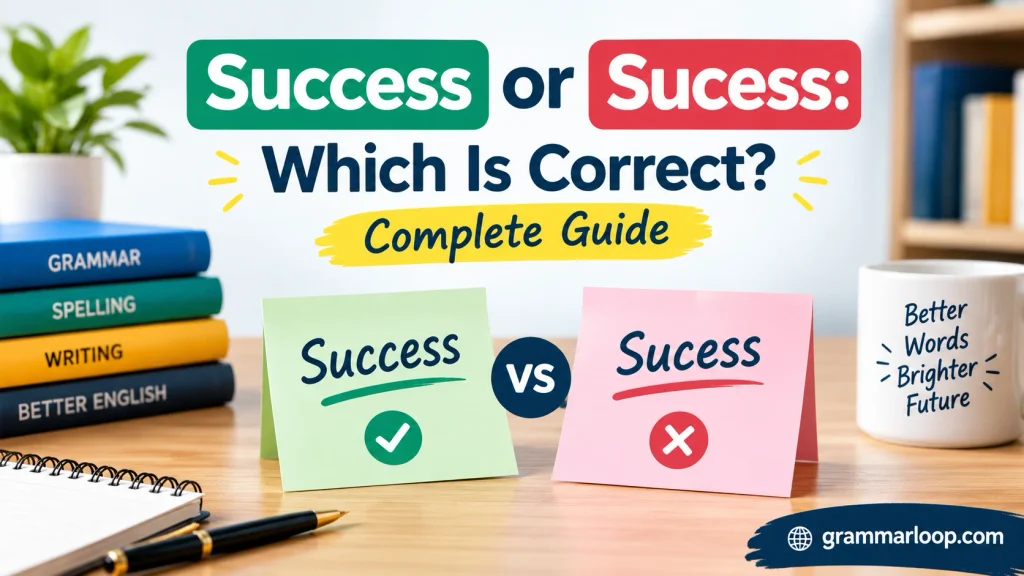
When you are writing in English, choosing the correct spelling is important for clear and professional communication. Many people get confused between “Success” and “Sucess” because both words look almost identical. However, only one of these spellings is correct in standard English. Whether you are writing an email, preparing a school assignment, or creating professional content, using the right spelling helps you communicate your ideas more confidently. Even a small spelling mistake can affect the quality of your writing, so learning the difference is always useful.
The correct spelling is “Success,” which means achieving a goal, reaching a desired result, or accomplishing something important. The word is commonly used in conversations about personal growth, education, business, and career development. For example, you might say, “Hard work is the key to success,” when discussing the importance of effort and determination. In contrast, “Sucess” is a misspelling and should not be used in formal or informal English writing. Remembering the correct spelling will help you avoid common mistakes and make your sentences more accurate.
One easy way to remember “Success” is to notice that it contains two C’s and two S’s. This simple spelling pattern can help you recognize the correct form whenever you write the word. You can also improve your spelling by reading regularly, practicing new vocabulary, and checking your work before publishing or submitting it. If you are a student, blogger, professional writer, or English learner, understanding common spelling differences can strengthen your language skills. In this complete guide, we will explore the meaning of success, correct spelling, common mistakes, practical examples, and useful tips to help you confidently use the word in your everyday writing.
Quick Answer:
Success is correct. Sucess is incorrect.
The standard English spelling is success, which contains two C’s and two S’s. The incorrect version, sucess, leaves out the second C.
- Correct: Her hard work led to great success.
- Incorrect: Her hard work led to great sucess.
- Correct spelling: S-U-C-C-E-S-S
Remember this simple rule: Success has two C’s and two S’s. You can use this memory trick whenever you write the word.
Comparison Overview: Success vs. Sucess
The main difference between success and sucess is spelling. These aren’t two words with different meanings. Instead, one is the accepted English word, and the other is a spelling error.
| Feature | Success | Sucess |
| Spelling status | Correct | Incorrect |
| Standard English word | Yes | No |
| Number of C’s | Two | One |
| Number of S’s | Two | Two |
| Meaning | Achievement or a favorable result | No standard meaning |
| Suitable for formal writing | Yes | No |
| Example | The event was a success. | The event was a sucess. |
The easiest way to spot the mistake is to look at the middle of the word. The correct spelling contains CC before the E, followed by SS at the end.
Once you recognize this pattern, you’ll find it much easier to catch the error while proofreading.
Main Differences Between Success and Sucess
Although the two forms look similar, they serve different purposes in written English. In fact, only success is the standard spelling of the word.
Success Is the Correct English Spelling
The word success is a noun that describes an achievement, a positive result, or the accomplishment of a goal. English dictionaries recognize this spelling, and it works in both American and British English.
For example:
- Her success came after years of practice.
- The new restaurant became a local success.
- Completing the difficult assignment was a personal success.
Notice how the word describes an achievement or a favorable outcome in each sentence.
Sucess Is a Misspelling
The spelling sucess leaves out one of the two C’s. It doesn’t represent a separate word with its own definition, and it isn’t an accepted alternative in standard English.
For example:
- Incorrect: The team celebrated its sucess.
- Correct: The team celebrated its success.
The error can occur when you type too quickly or rely on memory instead of checking the spelling. Because the missing letter doesn’t change how most people pronounce the word, you might not notice the problem immediately.
Does the Difference Change the Meaning?
No. Sucess doesn’t have a separate standard English meaning. When someone writes it, they usually intend to write success.
If you encounter the incorrect spelling in a message, the intended meaning will often be clear from the context. Nevertheless, you should use the correct spelling in your own writing.
What Does Success Mean?
Success means achieving a goal, obtaining a desired result, or accomplishing something worthwhile. The exact meaning depends on the situation in which you use the word.
For one person, success might mean earning a degree. For another, it might mean starting a business, learning a new skill, or completing a challenging project.
The word doesn’t have to describe a major public achievement. It can also refer to a small personal victory that matters to you.
Success as Achieving a Goal
One of the most common meanings of success involves reaching a goal through effort, planning, or persistence.
Consider these examples:
- Passing the final exam was a major success.
- She achieved success by practicing every day.
- His success in the competition reflected months of preparation.
- Finishing the course was a personal success.
In each example, the word describes reaching an intended outcome. The goal may be academic, professional, athletic, or personal.
Success as a Positive Result
Sometimes, success describes how well an activity, plan, or event turns out. You don’t necessarily need to achieve fame or long-term recognition to use the word this way.
For example:
- The charity event was a great success.
- Their new product launch was a success.
- The meeting was a success because everyone agreed on the next steps.
- The experiment was a success.
Here, success focuses on the outcome rather than the person who achieved it.
Success as Achievement or Recognition
People also use success when discussing professional accomplishments, public recognition, or a person who performs particularly well.
Examples include:
- The author became a literary success.
- Her business achieved international success.
- The young musician found success through years of dedication.
- The film became a commercial success.
However, success doesn’t always mean becoming wealthy or famous. Someone can achieve success by meeting a meaningful personal goal, improving their skills, or making steady progress toward something important.
Different Types of Success
Success can describe many kinds of achievements. The following table shows how the meaning changes with context.
| Context | What Success Means | Example |
| Education | Reaching an academic goal | Her success in school opened new opportunities. |
| Career | Achieving professional goals | He found success in graphic design. |
| Business | Getting favorable business results | The product launch was a success. |
| Personal growth | Reaching an individual milestone | Learning to drive was a personal success. |
| Sports | Winning or improving performance | The team’s success followed months of training. |
| Community | Achieving a shared goal | The fundraiser was a great success. |
The common thread is a favorable result. What counts as success, however, can vary from one person or situation to another.
Why Is Success Spelled With Two C’s and Two S’s?
The correct spelling contains eight letters:
S – U – C – C – E – S – S
The two C’s appear together in the middle, while the two S’s appear at the end. Both pairs belong to the standard spelling.
By comparison, sucess contains only seven letters because it omits one C.
| Spelling | Letter Pattern | Status |
| Success | S-U-C-C-E-S-S | Correct |
| Sucess | S-U-C-E-S-S | Incorrect |
| Succes | S-U-C-C-E-S | Incorrect |
| Sucsess | S-U-C-S-E-S-S | Incorrect |
| Saccess | S-A-C-C-E-S-S | Incorrect |
English spelling often includes letter patterns that aren’t obvious from pronunciation alone. That’s why memorizing a word’s written form can be more reliable than trying to spell it only by sound.
Understanding the Double C
The two C’s are the main difference between success and sucess. When you write the word, make sure both letters appear before the E.
A useful visual breakdown is:
SU + CC + ESS = SUCCESS
This isn’t a formal linguistic rule for building every English word. It’s simply a convenient way to remember this particular spelling.
For example, compare these sentences:
- Correct: Consistent effort contributed to her success.
- Incorrect: Consistent effort contributed to her sucess.
Reading the word slowly as you write it can help reinforce the correct pattern.
Understanding the Double S
The final two S’s matter just as much. Remembering only the double C isn’t enough if you accidentally leave out the last letter.
The complete spelling is success, not succes.
For example:
- Correct: Their success surprised everyone.
- Incorrect: Their succes surprised everyone.
When proofreading, check both letter pairs. This small habit can prevent two common spelling errors at once.
How to Spell Success Correctly
The simplest way to learn the spelling is to look at the complete word, practice writing it, and check its repeated letters.
Correct spelling: S-U-C-C-E-S-S
Try these three steps whenever you’re unsure:
- Step one: Write the first two letters, S and U.
- Step two: Add both C’s followed by E.
- Step three: Finish with two S’s.
The result is success.
A Simple Trick to Remember Success
Use this short reminder:
“Double C, double S—that’s success!”
It’s easy to remember because it highlights the two letter pairs that people often miss.
You can also connect the word with a sentence you already know, such as “Hard work leads to success.” Each time you read or write that sentence, pay attention to the spelling.
Another useful method is to type the word correctly several times while checking each letter. Repeated practice helps you recognize the correct form more quickly.
Correct and Incorrect Spellings of Success
Here are some forms you might encounter when writing or proofreading:
- Success: Correct standard spelling.
- Sucess: Incorrect; one C is missing.
- Succes: Incorrect; the final S is missing.
- Sucsess: Incorrect; the letters appear in the wrong order.
- Successful: Correct adjective form.
- Successfully: Correct adverb form.
Don’t rely entirely on a word processor to catch every error. Spellcheck can help, but proofreading remains useful, especially when you’re preparing an important document.
The Origin and History of the Word Success
Understanding a word’s history can make its spelling more memorable. The word success has roots in Latin and has been part of English for centuries.
According to the word was first recorded in English during the 1530s. It comes from Latin successus, which is related to succedere, meaning to follow, come after, or advance. <Cite refs={[“turn854911search1″,”turn854911search10”]}/>
Over time, success developed its familiar meaning of a result or outcome, especially a favorable one. Today, people use it to describe achievements in education, business, relationships, sports, and many other areas of life.
The word’s history helps explain why its spelling follows an established pattern. However, you don’t need to understand Latin to spell it correctly. Learning the modern form is enough for everyday writing.
Why the Historical Origin Matters
A word’s history can explain its spelling, but history doesn’t always provide an easy spelling rule. English has borrowed words from Latin, French, Germanic languages, and many other sources.
As a result, some spellings reflect older language patterns rather than modern pronunciation. Success is one example of a word whose written form you should learn as a whole.
The practical lesson is simple: remember the established spelling instead of trying to remove letters that seem unnecessary.
Is Sucess Ever Correct in English?
In standard English, sucess is not a correct alternative spelling of success. You should use success in academic work, professional communication, published articles, and everyday writing.
The incorrect form might still appear in a social media post, an online comment, or a message. Its appearance doesn’t make it an accepted spelling.
There are a few situations in which you might reproduce the letters sucess intentionally, such as when quoting someone’s original spelling error or discussing misspellings in a language lesson. In those cases, you’re referring to the error rather than using it as the correct word.
For example:
- Correct usage: The project was a success.
- Discussing an error: The writer accidentally typed “sucess” instead of “success.”
- Incorrect usage: The project was a sucess.
This distinction matters because mentioning an incorrect spelling isn’t the same as recommending it.
Is Sucess an American or British Spelling?
No. American and British English both use success.
Some English words have recognized regional spelling differences. For instance, American English typically uses color, while British English uses colour. The same pattern appears in center and centre.
However, success doesn’t change between these varieties.
| English Variety | Correct Spelling | Example |
| American English | Success | The event was a success. |
| British English | Success | The event was a success. |
| Canadian English | Success | The event was a success. |
| Australian English | Success | The event was a success. |
These examples use the standard spelling across the listed varieties. You don’t need to choose between different regional forms.
Whether you’re writing for an American school, a British employer, or an international audience, success remains the correct choice.
How to Use Success in a Sentence
Knowing the spelling is important, but understanding how to use the word makes your writing stronger. Because success is a noun, it can describe an achievement, an outcome, or the state of achieving a goal.
You can use it in formal writing, everyday conversation, professional emails, and personal messages.
Success in School and Education
In education, success often refers to achieving academic goals, learning new skills, or completing an important milestone.
Examples:
- Her success in mathematics came from regular practice.
- Academic success requires effort, patience, and good study habits.
- Passing the entrance exam was a major success.
- The students celebrated the success of their science project.
- His teacher praised his success in improving his writing.
Notice that success doesn’t always refer to grades. A student might also experience success by overcoming a difficult subject, developing confidence, or completing a long-term assignment.
Success at Work and in Business
In professional settings, the word often describes reaching a goal, completing a project, or producing favorable results.
Examples:
- The new marketing campaign was a success.
- Her success in sales helped the company reach its target.
- The team worked together to achieve success.
- Their first product launch became a commercial success.
- Clear communication contributed to the project’s success.
These examples show that success can refer to individual achievements or shared results. The surrounding sentence usually makes the intended meaning clear.
Success in Everyday Conversations
You don’t need formal language to use success correctly. The word fits naturally into casual conversations about goals, plans, and experiences.
For example:
- “Good luck with your interview! I hope it’s a success.”
- “The family reunion was a huge success.”
- “Learning to cook that dish felt like a personal success.”
- “Their trip was a success because everything went smoothly.”
- “I hope your presentation goes well and brings you success.”
In everyday speech, the word can sound encouraging or celebratory. It helps you describe something that worked out well.
Success in Emails and Professional Messages
Spelling mistakes can distract readers from an otherwise clear message. If you’re writing to a manager, customer, teacher, or colleague, take a moment to check the word before sending your message.
Compare these examples:
Incorrect email:
“Congratulations on your sucess with the new project.”
Correct email:
“Congratulations on your success with the new project.”
The corrected sentence communicates the same idea without an avoidable spelling error.
Here’s another example:
Incorrect: “We look forward to your continued sucess.”
Correct: “We look forward to your continued success.”
The difference is small, but accurate spelling helps your writing look polished and professional.
Common Mistakes Related to Success
The spelling sucess is only one mistake worth watching for. Related forms can also cause confusion, particularly when a word gains a suffix or changes its grammatical role.
Learning these forms together can help you avoid errors.
Success vs. Sucess
This is the main spelling confusion.
- Incorrect: Her sucess made her family proud.
- Correct: Her success made her family proud.
The incorrect form contains one C instead of two. Always check the middle of the word before using it.
Success vs. Succes
Some writers remember the two C’s but leave out the final S.
- Incorrect: The school event was a succes.
- Correct: The school event was a success.
Remember that the word ends in SS, not a single S.
Successful vs. Succesful
Successful is the correct adjective form. Succesful is incorrect because it leaves out one C.
Compare the sentences:
- Incorrect: She became a succesful designer.
- Correct: She became a successful designer.
The spelling of successful retains the double C and the double S from success. The suffix -ful then adds the remaining letters.
Successfully vs. Sucessfully
Successfully is the correct adverb form. It describes how someone completes an action or achieves a result.
- Incorrect: They sucessfully finished the project.
- Correct: They successfully finished the project.
The word may look long, but its spelling becomes easier to manage when you recognize the base form success.
Successor vs. Successive
These related-looking words have different meanings and grammatical uses.
- Successor: A person or thing that follows another in a position or role.
- Successive: Following one after another in a sequence.
Examples:
- The director’s successor took over the following month.
- The team won three successive matches.
Both words are spelled differently from successful, so don’t assume that every word beginning with success- has the same meaning.
Success, Successful, and Successfully: What’s the Difference?
The words success, successful, and successfully belong to the same word family. They share a common base but perform different jobs in a sentence.
Understanding their grammatical roles helps you choose the right form.
| Word | Part of Speech | Meaning | Example |
| Success | Noun | An achievement or favorable outcome | Her success inspired the team. |
| Successful | Adjective | Achieving a desired result | She led a successful project. |
| Successfully | Adverb | In a way that achieves the intended result | She successfully completed the project. |
When to Use Success
Use success when you’re naming an achievement or result. As a noun, it often follows words such as great, major, business, or personal.
Examples:
- The event was a great success.
- His success encouraged other students.
- The project achieved considerable success.
You can also use the plural form successes when referring to multiple achievements.
For example: “Her successes in school gave her confidence.”
When to Use Successful
Use successful when describing a person, plan, activity, or result that achieves its purpose.
Examples:
- They launched a successful business.
- She is a successful author.
- The team completed a successful trial.
In each sentence, successful describes a noun. It tells the reader what kind of business, author, or trial you’re discussing.
When to Use Successfully
Use successfully when describing how an action was completed. It commonly modifies a verb.
Examples:
- The engineers successfully tested the system.
- She successfully completed her degree.
- The company successfully introduced its new service.
A quick way to remember the difference is to ask yourself what you’re describing. If you’re naming an achievement, use success. If you’re describing a person or thing, use successful. If you’re explaining how an action happened, use successfully.
Synonyms for Success and When to Use Them
Sometimes, you may want another word to avoid repetition or express a more specific meaning. Several words have meanings similar to success, but each carries a slightly different emphasis.
Choosing the right synonym helps your writing sound more precise.
Achievement and Accomplishment
Achievement usually refers to something important that someone has done through skill, effort, or determination.
Example: “Completing her degree was a significant achievement.”
Accomplishment also describes something successfully completed, often after considerable work.
Example: “Publishing his first novel was a personal accomplishment.”
These words work well when discussing education, careers, personal goals, and completed projects.
Triumph and Victory
Triumph suggests a major success, particularly after a difficult challenge.
Example: “Finishing the race after recovering from an injury felt like a triumph.”
Victory often refers to winning a contest, competition, or conflict.
Example: “The team’s victory secured its place in the final.”
Although both words can replace success in some sentences, they aren’t perfect substitutes. A successful meeting, for instance, isn’t necessarily a triumph or a victory.
Prosperity and Progress
Prosperity usually refers to financial well-being or a period of growth and favorable conditions.
Example: “The business experienced years of prosperity.”
Progress means movement toward a goal or improvement over time.
Example: “Her progress in learning English was steady.”
Progress doesn’t always mean you’ve reached the finish line. You can make progress toward success even when the final goal remains ahead.
Which Synonym Should You Choose?
Use this quick guide to match the word to your intended meaning:
- Achievement: A notable result earned through effort.
- Accomplishment: Something successfully completed.
- Triumph: A significant success after difficulty.
- Victory: A win in a competition or struggle.
- Prosperity: Financial well-being or flourishing conditions.
- Progress: Improvement or movement toward a goal.
Choose the word that best expresses your meaning rather than replacing success automatically. Clear writing depends on accuracy, not simply variety.
<WritingBlock id=”58321″ variant=”document”>## How to Avoid Spelling Success Incorrectly
You can prevent most spelling errors with a few simple habits. The goal isn’t to memorize complicated grammar rules. It’s to recognize the correct word and check it when necessary.
Check the Double Letters
Before submitting an assignment, sending an email, or publishing an article, look for both letter pairs in success.
Use this checklist:
- Does the word contain two C’s?
- Does it end with two S’s?
- Have you used the correct form for your sentence?
- Does your spellchecker flag the word?
If the answer to the first two questions is yes, you’ve probably written the word correctly.
Learn Related Words Together
Learning success, successful, and successfully as a group helps reinforce their shared spelling pattern.
For example:
- The project was a success.
- The team completed a successful project.
- The team successfully completed the project.
Notice how the words change according to their grammatical roles while retaining the correct spelling.
Use Spellcheck and Proofreading Together
Spellcheck can identify many typing errors, but it shouldn’t replace careful proofreading. A quick review can help you catch mistakes that automatic tools miss.
For important documents, read your writing slowly before sending or publishing it. Pay particular attention to words that contain repeated letters.
Quick Practice: Can You Spell Success Correctly?
Test what you’ve learned with these five questions. Choose the correct answer before checking the explanations.
Question One: Which Spelling Is Correct?
- A. Sucess
- B. Success
- C. Succes
Answer: B. Success. The correct word contains two C’s and two S’s.
Question Two: Complete the Sentence
“Her dedication contributed to her professional _____.”
- A. sucess
- B. succes
- C. success
Answer: C. success. The noun describes the achievement or favorable outcome.
Question Three: Which Sentence Is Correct?
- A. They sucessfully completed the assignment.
- B. They successfully completed the assignment.
- C. They successfull completed the assignment.
Answer: B. They successfully completed the assignment. Successfully is the correct adverb form.
Question Four: How Many C’s Are in Success?
- A. One
- B. Two
- C. Three
Answer: B. Two. Both C’s appear together before the E.
Question Five: Which Word Describes a Project That Achieves Its Goal?
- A. Successful
- B. Sucessful
- C. Succesful
Answer: A. Successful. The adjective contains the same double-C and double-S pattern as success.
If you answered all five correctly, you’ve mastered the main spelling distinction. If you missed one, review the relevant section and try again.
Conclusion
The correct spelling is “Success,” not “Sucess.” Although these two words look similar, “Sucess” is a common spelling mistake and is not accepted as the standard English spelling. The word “Success” means achieving goals, accomplishing something important, or getting a desired result. Whether you are writing an article, sending a professional email, or completing a school assignment, using the correct spelling makes your writing clearer and more professional.
To remember the difference, keep in mind that “Success” contains two C’s and two S’s. Practice writing the word in sentences and check your spelling whenever necessary. By learning common spelling mistakes like this one, you can improve your English vocabulary, writing accuracy, and communication skills.
FAQs
1. Is it Success or Sucess?
Success is the correct spelling in English. Sucess is incorrect and should be avoided in your writing.
2. What does the word Success mean?
Success means achieving a goal, accomplishing something, or obtaining a desired result. For example, passing an important exam can be considered a success.
3. Why do people misspell Success as Sucess?
People often misspell Success because they forget the double C in the middle of the word. Regular practice can help you remember the correct spelling.
4. How can I remember the correct spelling of Success?
Remember that Success has two C’s and two S’s. Writing the word several times and using it in sentences can also help you learn the correct spelling.
5. What is an example sentence using Success?
Here is an example: “Hard work and dedication are important keys to success.” This sentence shows how the word describes achieving a goal through effort and commitment.






One Response