
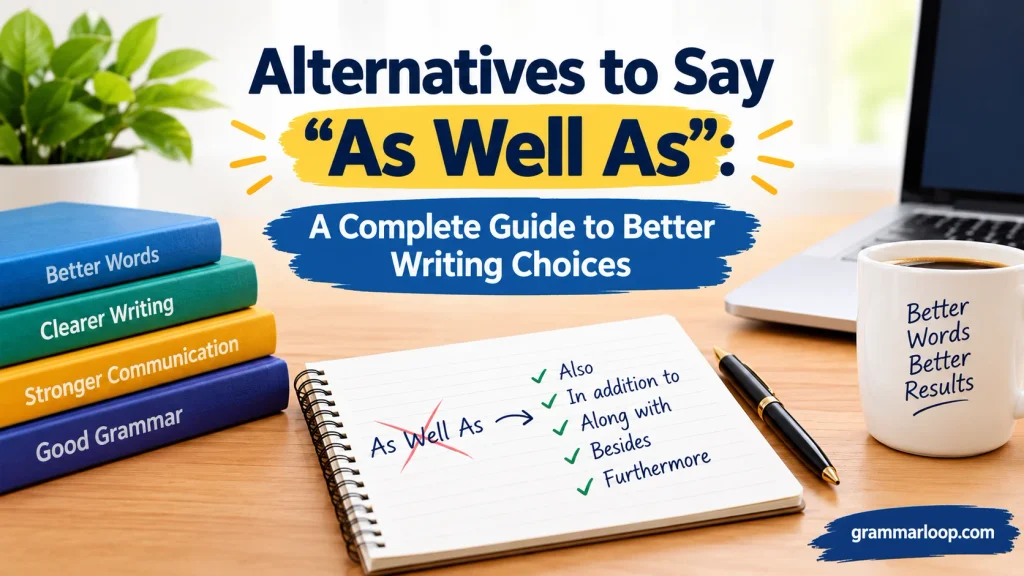
When it comes to clear and effective writing, choosing the right words can make your sentences sound more natural and professional. The phrase “as well as” is commonly used to connect ideas, add information, and show that someone or something includes another element. However, using the same phrase repeatedly can make your writing feel repetitive and less engaging. Learning different alternatives to say “as well as” can help you express your thoughts more clearly. Whether you are writing an email, an essay, a blog post, or a professional report, having a variety of expressions allows you to communicate your message with greater confidence.
There are many useful synonyms and alternative phrases for “as well as,” but the best choice depends on your sentence and its meaning. For example, “in addition to” works well in formal writing, while “along with” sounds natural in everyday conversations. Similarly, “together with” can highlight a connection between people or things, and “besides” can introduce extra information. Understanding these small differences helps you choose the most suitable expression for each situation. Instead of replacing every occurrence with the same synonym, consider the tone, context, and purpose of your sentence to make your writing more accurate and appealing.
In this complete guide, you will discover practical alternatives to “as well as” that can improve your writing in different situations. Each expression will help you understand when to use it, what it means, and how it works in real sentences. You will also learn which phrases are best for formal emails, academic assignments, professional communication, and casual conversations. With simple explanations and helpful examples, choosing the right words will become much easier. Whether you want to avoid repetition, improve your vocabulary, or make your content sound more polished, these alternatives will help you create clearer, smoother, and more engaging sentences.
What “As Well As” Actually Means
Before swapping it out, you need to understand what it does in a sentence.
“As well as” adds extra information. It connects ideas, but it does not always carry equal weight like “and.”
Core meanings of “as well as”
- Adding extra items or ideas
- Showing inclusion
- Linking two related actions or qualities
- Introducing secondary information
Simple example
- I bought apples as well as oranges.
This means apples are the main focus, and oranges are additional.
Now compare:
- I bought apples and oranges.
Here, both items feel equal.
That small difference matters more than most people realize.
Is “As Well As” the Same as “And”?
Short answer: No.
Long answer: they behave differently in grammar and tone.
Key differences
| Phrase | Function | Emphasis | Example |
| and | Joins equal ideas | Equal weight | She sings and dances |
| as well as | Adds secondary idea | First item stronger | She sings as well as dances |
Common mistake
People often replace “and” with “as well as” thinking they mean the same thing.
But that can quietly shift meaning.
- Incorrect: He and his team as well as finished early
- Correct: He and his team finished early
Keep this distinction in mind before swapping phrases blindly.
Quick Alternatives to Say “As Well As”
Here’s a fast reference table you can use while writing.
| Alternative | Best Use | Tone |
| and | Equal ideas | Neutral |
| along with | Added detail | Neutral |
| together with | Formal writing | Formal |
| in addition to | Academic or business | Formal |
| also | Simple addition | Neutral |
| plus | Casual writing | Informal |
| besides | Conversational contrast | Informal |
| additionally | Structured writing | Formal |
| moreover | Argumentative writing | Formal |
| furthermore | Academic writing | Formal |
| too | Spoken English | Informal |
| likewise | Similarity | Formal |
| not only… but also | Emphasis | Neutral |
| alongside | Parallel actions | Neutral |
| including | Examples or subsets | Neutral |
| on top of that | Emphasis in speech | Informal |
Best Alternatives to Say “As Well As” (Deep Dive)
Let’s break these down so you know exactly how to use them in real sentences.
“And”
This is the simplest replacement, but also the most powerful.
Use it when both ideas carry equal importance.
Examples:
- I cooked dinner and cleaned the kitchen.
- She writes and edits articles.
When to avoid it:
If you want to show one idea is secondary, don’t use “and.”
“Along with”
This phrase feels natural and flexible.
It works well when you want to add extra context without sounding stiff.
Examples:
- I brought snacks along with drinks.
- The manager, along with her team, attended the meeting.
Notice how the second part feels like supporting detail.
“Together with”
This one sounds more formal than “along with.”
It often appears in reports or official writing.
Examples:
- The CEO together with senior staff approved the plan.
- The design together with the data improves clarity.
It adds structure without sounding heavy.
“In addition to”
This is one of the most useful formal alternatives.
It works especially well in academic or business writing.
Examples:
- In addition to marketing skills, she has strong analytical ability.
- In addition to the report, we submitted the budget plan.
It clearly signals extra information.
“Also”
Short. Clean. Direct.
You can place it almost anywhere.
Examples:
- I also enjoy reading.
- She is also responsible for training new staff.
It works best in everyday writing.
“Plus”
This is informal and conversational.
Think of it as spoken English on paper.
Examples:
- The movie was fun, plus it had great visuals.
- You get free shipping, plus a discount.
Use it when you want a relaxed tone.
“Besides”
This one adds attitude or contrast.
It often suggests “on top of everything else.”
Examples:
- Besides work, I manage a small business.
- Besides that issue, everything is fine.
It can feel slightly opinionated.
“Additionally”
This is structured and professional.
Writers use it in reports, essays, and formal documents.
Examples:
- Additionally, the system improves performance.
- Additionally, we reviewed customer feedback.
It keeps writing organized.
“Moreover”
Now we move into argument-building language.
Use “moreover” when you want to strengthen a point.
Examples:
- The plan is cost-effective. Moreover, it saves time.
- He lacks experience. Moreover, he missed deadlines.
It adds persuasive weight.
“Furthermore”
Very similar to “moreover,” but slightly more formal.
Examples:
- The study is outdated. Furthermore, it lacks data.
- The policy is unclear. Furthermore, it is inconsistent.
Use it in academic writing.
“Too”
Simple and conversational.
Usually placed at the end of a sentence.
Examples:
- I want to join too.
- She likes coffee too.
It feels natural in speech.
“Likewise”
This shows similarity between ideas.
Examples:
- He enjoys coding. Likewise, his brother works in tech.
- The manager approved it. Likewise, the director agreed.
It connects parallel thoughts smoothly.
“Not only… but also”
This is a powerful emphasis structure.
Examples:
- She is not only smart but also hardworking.
- The app is not only fast but also secure.
It adds rhetorical strength.
“Alongside”
This works well when describing parallel roles or items.
Examples:
- She works alongside experienced developers.
- The tool runs alongside existing systems.
It suggests equality and cooperation.
“Including”
Use this when you want to list examples.
Examples:
- We serve desserts including cakes and pastries.
- The package includes tools including a wrench and screwdriver.
It clarifies scope.
Read More: Uncollectible vs Uncollectable: What’s the Difference
Formal Alternatives to “As Well As”
Formal writing needs precision. These phrases help you sound structured and clear.
Best formal options
- In addition to
- Furthermore
- Moreover
- Additionally
- Together with
- Coupled with
- Alongside
- Including
Example comparison
- Informal: I wrote the report as well as the summary
- Formal: I wrote the report in addition to the summary
The second version feels more professional and controlled.
Informal Alternatives to “As Well As”
These work better in conversation and casual writing.
Common informal choices
- And
- Plus
- Also
- Too
- Besides
- On top of that
Example in casual tone
- I went to class, plus I finished my homework.
It sounds natural, like speech.
Alternatives by Writing Situation
Different contexts need different connectors.
Academic Writing
Use:
- In addition to
- Furthermore
- Moreover
- Additionally
Example:
- The research shows improvement. Furthermore, it identifies key risks.
Business Writing
Use:
- Additionally
- Together with
- In addition to
- Alongside
Example:
- The strategy reduces costs in addition to improving efficiency.
Emails
Use:
- Also
- Along with
- In addition to
Example:
- I shared the file along with the updated notes.
Creative Writing
Use:
- And
- Plus
- Too
- Besides
Example:
- She laughed, and the room felt lighter too.
Conversations
Use:
- And
- Plus
- Also
- On top of that
Example:
- I was tired, and on top of that, I missed my bus.
Sentence Comparison Table
Here’s how different alternatives change tone and clarity.
| Original | Alternative | Result |
| I studied as well as worked | I studied and worked | Equal emphasis |
| She is talented as well as experienced | She is not only talented but also experienced | Strong emphasis |
| He is responsible as well as reliable | He is additionally responsible and reliable | Formal tone |
| I like tea as well as coffee | I like tea plus coffee | Casual tone |
| We delivered the report as well as the slides | We delivered the report in addition to the slides | Professional tone |
Common Grammar Mistakes with “As Well As”
Many writers misuse this phrase without noticing.
Mistake: Treating it like “and”
- Wrong: She as well as her friends are coming
- Correct: She, as well as her friends, is coming
Mistake: Subject-verb agreement errors
“as well as” does not always make subjects plural.
- Incorrect: The manager as well as the staff are ready
- Correct: The manager as well as the staff is ready
Mistake: Overuse
Repetition weakens writing.
Instead of:
- He wrote the report as well as edited it as well as reviewed it
Use:
- He wrote, edited, and reviewed the report
How to Choose the Right Alternative
Think about three things: tone, clarity, and emphasis.
If you want formal writing
Use:
- In addition to
- Furthermore
- Moreover
If you want simple writing
Use:
- And
- Also
- Along with
If you want conversational tone
Use:
- Plus
- Too
- On top of that
Quick decision guide
| Goal | Best Choice |
| Add equal ideas | And |
| Add extra info | In addition to |
| Emphasize point | Moreover |
| Keep it casual | Plus |
| Show similarity | Likewise |
Words That Are NOT True Synonyms
Some words look similar but don’t replace “as well as” directly.
“Likewise”
- Works for similarity, not addition
“Similarly”
- Compares ideas, not adds them
“Including”
- Shows examples, not full addition
“Too”
- Casual addition, not structural replacement
“Either”
- Used in negatives, not additions
Conclusion
Choosing the right alternatives to say “as well as” can make your writing more clear, natural, and engaging. Expressions such as “in addition to,” “along with,” “together with,” “besides,” and “as well” help you communicate your ideas without repeating the same phrase too often. Each alternative has a slightly different meaning or tone, so it is important to consider your sentence and the message you want to convey. Some phrases work best in formal writing, while others are more suitable for everyday conversations.
The key to better writing is knowing when and how to use each expression. By practicing these alternatives in your emails, essays, articles, and daily communication, you can develop a more versatile vocabulary and express your thoughts with confidence. Remember, the goal is not simply to replace words but to make your writing smoother, more professional, and easier to understand. Choose the phrase that fits your context, and your writing will become more effective over time.
FAQs
1. What are the best alternatives to “as well as”?
Some of the best alternatives are “in addition to,” “along with,” “together with,” “as well,” and “besides.” The best choice depends on your sentence and whether you want a formal or casual tone.
2. Is “in addition to” a formal alternative to “as well as”?
Yes, “in addition to” is a suitable choice for formal writing, including business emails, academic papers, and professional reports. It helps introduce extra information clearly.
3. Can I use “along with” instead of “as well as”?
Yes, you can often use “along with” as an alternative to “as well as.” For example, “She brought her laptop along with her notebook” expresses that she brought both items.
4. Is “as well as” the same as “and”?
Not always. “And” usually connects two items equally, while “as well as” often adds secondary information or emphasis. The correct choice depends on the sentence’s intended meaning.
5. How can I avoid repeating “as well as” in my writing?
You can avoid repetition by using alternatives such as “in addition to,” “alongside,” “together with,” and “as well.” Choose each phrase according to its meaning and context to keep your writing natural and easy to read.





One Response