
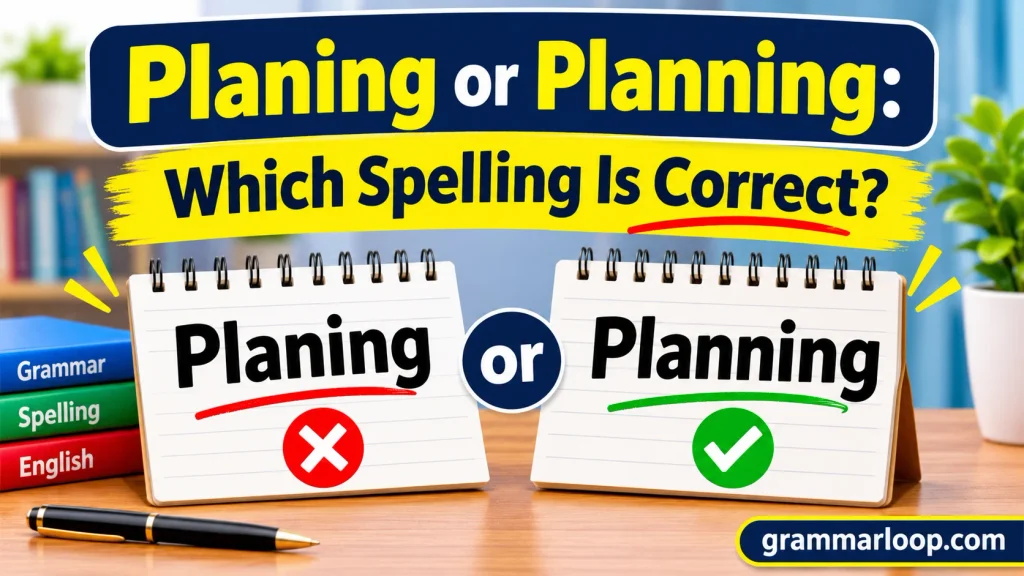
When writing in English, choosing the correct spelling can make a big difference in how clearly you communicate your ideas. One common spelling confusion is planing or planning, as both words look almost identical but have very different meanings. The correct choice depends on the context, meaning, and purpose of your sentence. Many people accidentally leave out or add an extra letter, especially when writing quickly or using unfamiliar words. Although planning is the spelling most people need in everyday writing, planing is also a valid English word with a different meaning. Understanding this small spelling difference can help you avoid common mistakes and make your writing more professional. Whether you are preparing an email, completing an assignment, or writing a business document, knowing when to use each form is useful.
The word planning is the correct spelling when you want to talk about making arrangements, preparing ahead, or deciding what to do in the future. It is the present participle and gerund form of the verb plan. For example, you might say, “I am planning a family vacation” or “She is planning to start a new business.” Notice that the final consonant N doubles when the suffix “-ing” is added to the verb “plan.” This spelling rule is important because English often doubles the final consonant in short words with a single vowel followed by a single consonant. On the other hand, planing refers to a completely different action, usually involving smoothing or cutting wood with a special tool. Knowing these meanings helps you select the right word without confusion.
In this guide, we will explain the difference between planing and planning, including their definitions, spelling rules, and practical examples. You will learn why planning is correct for discussing future arrangements and why planing is used in woodworking and certain technical situations. We will also explore common spelling mistakes, sentence examples, and simple tips to remember which version to use. If you often confuse these two words, understanding their individual meanings will make your writing much easier. By the end, you will know how to use both words confidently and correctly in everyday conversations, professional emails, and academic writing. Whether you are a student, professional, or English learner, this guide will help you improve your spelling accuracy and communicate more effectively.
Planing or Planning: Which One Is Correct?
The answer depends on what you want to say.
Use planning when talking about:
- Making plans
- Organizing future activities
- Preparing strategies
- Setting goals
- Arranging events
Use planing when talking about:
- Smoothing wood
- Shaping materials
- Machining surfaces
- Certain marine and aviation concepts
For example:
✅ We are planning our vacation for next summer.
✅ The carpenter is planing a wooden tabletop.
Both sentences are correct because they use the appropriate word for the context.
The confusion happens because both words look similar and sound almost identical in casual speech.
What Does “Planning” Mean?
The word planning comes from the verb plan.
It refers to the process of thinking ahead and organizing actions to achieve a goal.
Definition of Planning
Planning is the act of deciding in advance what needs to be done and how it will be accomplished.
In business, planning often involves creating strategies.
In everyday life, planning might involve organizing a trip, a budget, or a schedule.
Examples of Planning
- Financial planning
- Business planning
- Event planning
- Career planning
- Travel planning
- Retirement planning
- Strategic planning
Every successful project begins with some form of planning.
Without planning, people often waste resources, miss deadlines, and encounter avoidable problems.
Examples of Planning in Sentences
Here are some common examples:
- We are planning a family reunion this summer.
- The company is planning a major expansion.
- Effective planning helps reduce project risks.
- She spent months planning her wedding.
- Careful planning improved the team’s productivity.
Notice that all examples involve preparation or future arrangements.
What Does “Planing” Mean?
Unlike planning, planing has nothing to do with creating plans.
It comes from the verb plane.
Definition of Planing
Planing refers to smoothing, shaping, or leveling a surface using a plane or a machine designed for that purpose.
The term is widely used in:
- Woodworking
- Carpentry
- Manufacturing
- Metalworking
- Engineering
Planing in Woodworking
In woodworking, planing removes thin layers from a piece of wood.
The goal is usually to:
- Smooth rough surfaces
- Create uniform thickness
- Straighten edges
- Improve appearance
A carpenter may spend hours planing boards before assembling furniture.
Example
A rough wooden plank often contains uneven spots.
By planing the surface, the wood becomes smooth and ready for finishing.
Planing in Manufacturing and Engineering
Industrial planing machines perform similar functions on metal and other materials.
Manufacturers use planing to create:
- Flat surfaces
- Precise dimensions
- Smooth finishes
This process is especially important in industries that require high precision.
Planing in Marine Engineering
The word planing also appears in boating.
A planing boat rises and glides across the water at high speed rather than moving deeply through it.
Characteristics of Planing Hulls
| Feature | Description |
| Speed | High |
| Water Resistance | Reduced |
| Fuel Efficiency | Better at higher speeds |
| Common Use | Speedboats and racing boats |
Examples of Planing in Sentences
- The carpenter is planing a cedar board.
- The technician is planing the metal surface.
- The speedboat began planing across the lake.
- Workers spent the afternoon planing timber.
In each case, the word relates to shaping or smoothing rather than organizing.
Planing vs. Planning: The Key Difference
The easiest way to remember the difference is to focus on meaning.
| Word | Meaning | Example |
| Planning | Making plans | We are planning a conference. |
| Planing | Smoothing or shaping surfaces | He is planing a wooden board. |
Quick Rule
If you’re talking about:
- Goals → Planning
- Strategy → Planning
- Future arrangements → Planning
- Woodworking → Planing
- Surface finishing → Planing
This distinction solves nearly every usage question.
Why Is “Planning” Spelled With Double N?
Many writers wonder why planning contains two Ns.
The answer lies in a standard English spelling rule.
The Consonant Doubling Rule
When a one-syllable verb ends in:
Consonant + Vowel + Consonant
the final consonant is usually doubled before adding -ing.
Examples
| Base Verb | -ing Form |
| Run | Running |
| Sit | Sitting |
| Swim | Swimming |
| Plan | Planning |
| Stop | Stopping |
Since plan follows this pattern, the correct form becomes:
plan + ning = planning
Why “Planing” Is Not the Gerund of Plan
If English followed a simpler pattern, many people might expect:
Plan → Planing
However, that spelling already belongs to another word:
Plane → Planing
As a result:
- Planning comes from plan
- Planing comes from plane
Although the words look similar, they have different roots and meanings.
Why People Confuse Planing and Planning
This mistake happens more often than many grammar errors.
Several factors contribute to the confusion.
Similar Pronunciation
In everyday speech, many speakers pronounce both words very similarly.
The extra “n” often becomes difficult to hear.
Because of that, people frequently rely on sound rather than spelling.
Fast Typing
Typing quickly can cause writers to accidentally omit one letter.
For example:
Correct: planning
Mistake: planing
This small typo can completely change the meaning.
Autocorrect Limitations
Spell-check tools often fail to catch this mistake.
Why?
Because planing is a legitimate English word.
The software sees no spelling error.
It cannot always determine whether you meant “planning.”
Limited Exposure to Technical Terms
Most people encounter planning regularly.
Far fewer people encounter planing in woodworking or engineering.
As a result, many assume planing must be a typo.
Planning in Business Writing
Business environments rely heavily on planning.
Organizations use planning to allocate resources, manage risks, and achieve goals.
Strategic Planning
Strategic planning focuses on long-term objectives.
Examples include:
- Market expansion
- Product development
- Competitive positioning
- Revenue growth
Read more: Bellies or Bellys: Correct Plural, Usage Rules, Examples, and Common Mistakes
Case Study
Imagine a technology startup seeking international growth.
Without strategic planning, the company might expand too quickly and exhaust its budget.
With proper planning, leaders can:
- Assess risks
- Analyze markets
- Allocate resources effectively
The result is a stronger chance of success.
Financial Planning
Financial planning helps businesses:
- Forecast expenses
- Manage cash flow
- Set budgets
- Improve profitability
Companies that neglect financial planning often struggle during economic downturns.
Workforce Planning
Workforce planning ensures organizations have the right people in the right roles.
Benefits include:
- Reduced hiring gaps
- Better productivity
- Improved employee retention
Planning in Academic Writing
Students and researchers constantly engage in planning.
Examples include:
- Research planning
- Thesis planning
- Study planning
- Curriculum planning
A well-planned project typically produces stronger results than one started without preparation.
Research Planning Example
Suppose a researcher wants to study climate patterns.
Before collecting data, they must:
- Define objectives
- Choose methods
- Determine sample size
- Establish timelines
This process is planning in action.
Planning in Everyday Life
Planning isn’t limited to businesses and schools.
Everyone uses planning daily.
Common Everyday Examples
Travel Planning
- Booking flights
- Reserving hotels
- Creating itineraries
Budget Planning
- Managing expenses
- Saving money
- Reducing debt
Family Planning
- Setting family goals
- Preparing for major life events
Career Planning
- Learning new skills
- Pursuing promotions
- Changing professions
Common Mistakes and How to Avoid Them
Let’s examine mistakes that appear frequently.
Why These Errors Matter
Incorrect spelling can:
- Reduce credibility
- Confuse readers
- Create misunderstandings
- Make professional writing appear careless
In competitive business environments, even small language errors can affect perception.
Memory Tricks to Remember the Difference
Simple memory techniques can prevent future mistakes.
Extra N for Future Plans
Think of it this way:
Planning has an extra N because it deals with the Next step.
Planning = Next
Both contain an extra N.
Think About the Tool
A woodworking tool called a plane creates the word planing.
Whenever wood, metal, or surfaces are involved, planing is usually correct.
The Context Test
Ask yourself:
“Am I talking about preparing for the future?”
If yes, choose planning.
“Am I talking about shaping a surface?”
If yes, choose planing.
Related Words Commonly Confused
Several related words create similar confusion.
Planned vs. Planed
Planned
Past tense of plan.
Example:
- We planned the event months ago.
Planed
Past tense of plane.
Example:
- The carpenter planed the tabletop.
Planner vs. Planer
Planner
A person or tool used for organizing.
Examples:
- Wedding planner
- Daily planner
Planer
A machine used for shaping materials.
Examples:
- Wood planer
- Thickness planer
Comparison Table
| Word | Meaning |
| Planning | Organizing future actions |
| Planing | Smoothing surfaces |
| Planned | Arranged beforehand |
| Planed | Smoothed with a plane |
| Planner | Organizer |
| Planer | Woodworking machine |
Real-World Industries That Use “Planing”
Many people never encounter planing because it belongs to specialized industries.
Woodworking Industry
Furniture makers regularly use planing to achieve:
- Smooth finishes
- Consistent dimensions
- Better aesthetics
Without planing, furniture surfaces often remain rough and uneven.
Construction Industry
Builders frequently plane lumber before installation.
Benefits include:
- Better fit
- Improved appearance
- Reduced material waste
Manufacturing Industry
Manufacturers use planing machines to produce precise parts.
Precision matters because even tiny imperfections can affect performance.
Marine Industry
High-speed boats often rely on planing hulls.
When enough speed is reached, the hull rises partially out of the water.
This reduces drag and improves performance.
Mini Quiz: Test Your Understanding
Choose the correct word.
Question 1
We are _____ our annual conference.
Answer: Planning
Question 2
The carpenter is _____ a wooden beam.
Answer: Planing
Question 3
Good _____ helps prevent project delays.
Answer: Planning
Question 4
The technician is _____ the metal surface.
Answer: Planing
Question 5
She spent months _____ her dream wedding.
Answer: Planning
Quick Reference Chart
| If You Mean… | Correct Word |
| Creating goals | Planning |
| Organizing events | Planning |
| Preparing strategies | Planning |
| Smoothing wood | Planing |
| Shaping metal | Planing |
| Using a woodworking plane | Planing |
Conclusion:
Understanding the difference between planing and planning helps you avoid common spelling mistakes and improve your English writing. Planning is the correct spelling when talking about making arrangements, preparing for the future, or organizing activities. In contrast, planing is a real word used mainly in woodworking to describe smoothing or shaping a surface with a special tool.
Remember the simple rule: when you add -ing to the verb “plan,” you double the final N to form “planning.” By learning their meanings and practicing with examples, you can use both words correctly and confidently in everyday conversations, emails, and professional writing.
FAQs:
1. Which spelling is correct: planing or planning?
Both planing and planning are correct English words, but they have different meanings. Planning refers to making arrangements, while planing usually refers to smoothing or shaping wood.
2. Why is planning spelled with two Ns?
The word planning has two Ns because the verb “plan” follows a spelling rule that doubles the final consonant before adding “-ing.” Therefore, plan becomes planning.
3. What does planing mean?
Planing means smoothing, flattening, or shaping a surface, especially wood, using a tool called a plane. It is commonly used in woodworking and carpentry.
4. Is planning or planing used for future arrangements?
Planning is the correct word for future arrangements. For example: “We are planning a family vacation next month.”
5. What is the difference between plan and planning?
Plan is the base verb or noun referring to an idea or arrangement. Planning is the “-ing” form of the verb, describing the process of preparing or organizing something.



One Response