
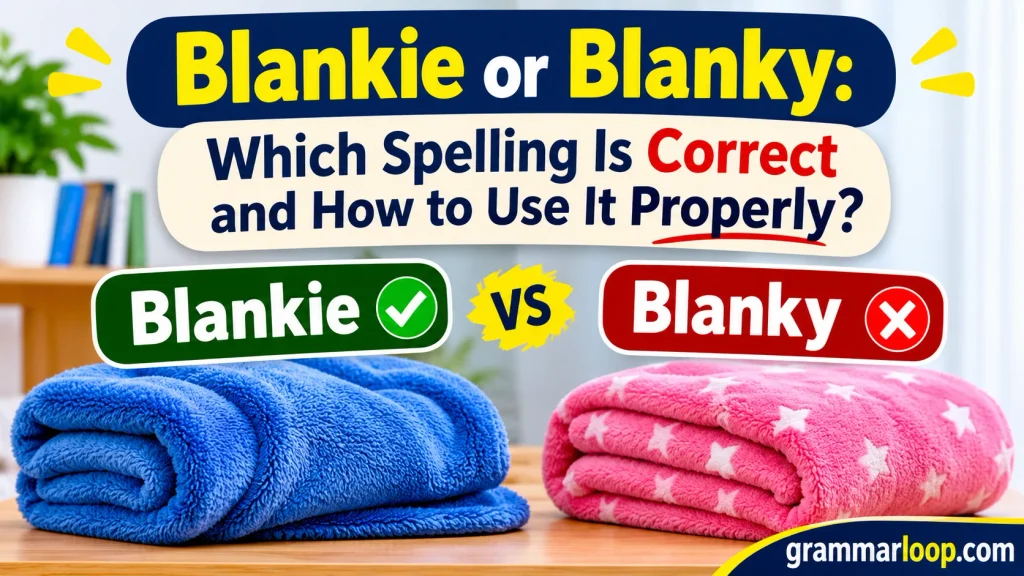
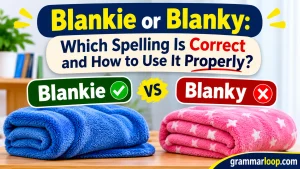
When choosing between blankie or blanky, you might wonder which spelling is correct, standard, and appropriate for everyday writing. Both forms are used to describe a small, soft blanket, especially one that a baby or young child loves to carry, cuddle, or sleep with. The word often brings a sense of comfort, warmth, and childhood memories. You may hear parents use it when talking about a child’s favorite blanket or a special item that helps them feel safe. Although both spellings appear in informal writing, blankie is generally the more common and widely recognized spelling. Understanding how these variations are used can help you choose the right form for your conversations, messages, and written content.
The main difference between blankie and blanky is their spelling rather than their meaning or pronunciation. Both words sound almost identical and are commonly associated with babies, toddlers, and affectionate family language. The spelling blankie is often preferred because it follows a familiar pattern used in cute or informal words, while blanky is a simpler alternative that some writers also use. Neither spelling is typically considered formal English, so you may want to use blanket in professional documents, academic writing, or situations where a more standard word is appropriate. However, in casual conversations, parenting blogs, and children’s stories, either variation can communicate the intended meaning naturally.
Knowing when to use blankie or blanky can make your writing clearer and more consistent. If you are writing a parenting article, social media post, or a sweet message about a child’s favorite blanket, blankie is usually a safe choice. You can also use blanky when matching someone’s preferred spelling or maintaining a particular writing style. For example, a parent might say, “My daughter never sleeps without her favorite blankie.” The important thing is to understand the informal nature of both words and choose the spelling that best fits your audience. In this guide, we will explore their meanings, differences, examples, and proper usage so you can confidently decide which spelling works best.
Quick Answer:
Both blankie and blanky refer to a blanket, usually a small, soft, cherished blanket associated with comfort, security, or childhood.
However, blankie is the more common and widely accepted spelling in modern English.
Quick Comparison
| Feature | Blankie | Blanky |
| Meaning | Affectionate term for a blanket | Same meaning |
| Popularity | More common | Less common |
| Dictionary Recognition | Widely recognized | Less frequently listed |
| Usage | Parents, writers, publishers | Personal preference |
| Formal Writing | Preferred informal choice | Less preferred |
| Meaning Difference | None | None |
What Does “Blankie” Mean?
The word blankie is an affectionate form of blanket.
People often use it when talking to young children or referring to a special blanket that provides emotional comfort.
A blankie isn’t usually just any blanket. It often carries sentimental value.
For example:
- A toddler’s favorite sleeping blanket
- A comfort object during stressful moments
- A treasured childhood keepsake
- A blanket carried everywhere by a young child
Definition
Blankie (noun): A small blanket or cherished blanket, especially one used by a child for comfort and security.
The term belongs to a category of words called diminutives, which make something sound smaller, cuter, or more affectionate.
Examples include:
- Dog → Doggie
- Bird → Birdie
- Sweet → Sweetie
- Blanket → Blankie
Why Children Become Attached to a Blankie
Psychologists often describe favorite blankets as transitional objects.
These objects help children develop independence while still feeling secure.
A favorite blankie may:
- Reduce anxiety
- Improve sleep quality
- Help during separation from parents
- Provide emotional comfort during change
Many adults still remember their childhood blankie decades later.
That emotional connection helps explain why the word remains so popular.
Example Sentences Using Blankie
- My daughter refuses to sleep without her blankie.
- The old blankie traveled with him everywhere.
- She found her childhood blankie in the attic.
- The toddler wrapped himself in his favorite blankie.
What Does “Blanky” Mean?
Blanky means exactly the same thing as blankie.
There is no meaningful difference in definition.
The variation exists because English often allows multiple spellings for affectionate words.
Some families naturally spell the word with a “y” while others prefer an “ie.”
Definition
Blanky (noun): An alternative spelling of blankie, referring to a cherished blanket or comfort blanket.
The spelling often reflects family tradition rather than any grammatical rule.
Where You Might See Blanky
Although less common, blanky still appears in:
- Family blogs
- Parenting forums
- Social media posts
- Children’s conversations
- Personal journals
- Character dialogue
Many people spell it the way they heard it growing up.
As a result, spelling preferences often become family habits.
Example Sentences Using Blanky
- Don’t forget your blanky before we leave.
- The puppy sleeps with a tiny blanky.
- Her favorite blanky is beginning to wear out.
- He still keeps his childhood blanky in storage.
Is Blankie or Blanky More Common?
Yes.
Blankie is significantly more common than blanky.
Most modern publications, parenting websites, educational materials, and dictionaries favor blankie.
When readers encounter the word, they generally expect the “ie” ending.
Why Blankie Became More Popular
English frequently forms affectionate words using the -ie ending.
Consider these examples:
| Standard Word | Affectionate Form |
| Dog | Doggie |
| Bird | Birdie |
| Sweet | Sweetie |
| Aunt | Auntie |
| Blanket | Blankie |
Because English speakers already recognize this pattern, blankie feels more natural.
Usage Pattern Comparison
| Spelling | Relative Popularity |
| Blankie | Very Common |
| Blanky | Less Common |
This doesn’t make blanky wrong.
It simply means blankie has become the dominant spelling.
What Major Dictionaries and Language References Say
Most major dictionaries recognize blankie as an informal noun meaning a favorite blanket.
Several language references either omit blanky entirely or identify it as a spelling variant.
The reason is straightforward.
Language authorities generally record the most commonly used forms of words.
Since blankie appears more often in published writing, it receives greater recognition.
Why Dictionaries Favor Blankie
Dictionary editors rely on:
- Published books
- Newspapers
- Magazines
- Academic sources
- Digital publications
- Historical records
When one spelling consistently appears more often, it typically becomes the preferred entry.
What Writers Should Choose
If you’re writing:
- Articles
- Blog posts
- Children’s content
- Educational materials
- Product descriptions
Choose blankie.
It aligns with reader expectations and standard usage.
Why English Creates Spelling Variants Like Blankie and Blanky
English is full of spelling variations.
Many emerge naturally through speech rather than formal grammar rules.
People often write words the way they hear them.
Over time, multiple spellings may develop.
Understanding Diminutives
A diminutive is a word form that expresses:
- Affection
- Familiarity
- Smallness
- Emotional closeness
English speakers create diminutives constantly.
Examples include:
| Original Word | Diminutive |
| Mom | Mommy |
| Dad | Daddy |
| Cat | Kitty |
| Dog | Doggie |
| Blanket | Blankie |
The goal isn’t precision.
The goal is warmth.
Why Some Words End in “-ie”
The -ie ending has long been associated with affectionate language.
Examples include:
- Sweetie
- Cutie
- Bestie
- Doggie
- Auntie
As a result, blankie fits naturally into an existing linguistic pattern.
Why Some Words End in “-y”
The -y ending serves a similar purpose.
Examples include:
- Mommy
- Daddy
- Doggy
- Kitty
- Blanky
Neither ending is inherently wrong.
Usage patterns determine which version becomes more popular.
When Should You Use a Blankie?
For most situations, blankie is the best choice.
It looks familiar to readers and appears more frequently in published content.
Best Situations for Using Blankie
Parenting Articles
Parents commonly recognize this spelling.
Children’s Books
Publishers often favor blankie.
Educational Content
Teachers and childcare professionals frequently use blankie.
Product Listings
Comfort blankets marketed for babies often use this spelling.
Sample Sentences
- Every child deserves a soft blankie for bedtime comfort.
- The blankie became part of her nightly routine.
- He packed his blankie before the family vacation.
Why Readers Prefer Blankie
Readers process familiar words faster.
Since blankie appears more often in books and media, it usually feels more natural.
When Can You Use Blanky?
Blanky remains acceptable in many informal situations.
The choice often reflects personality rather than correctness.
Appropriate Uses for Blanky
Family Conversations
Many households naturally use blanky.
Character Dialogue
Writers sometimes use blanky to create an authentic voice.
Social Media Posts
Casual communication welcomes personal spelling choices.
Personal Journals
Informal writing allows flexibility.
Sample Sentences
- My nephew won’t leave home without his blanky.
- The worn-out blanky means the world to her.
- His blanky survived countless adventures.
When Blanky May Look Unusual
In professional writing, some readers may assume blanky is a typo.
That’s why blankie often remains the safer choice.
Blankie vs. Blanket: What’s the Difference?
Although related, these words are not identical.
A blanket is a standard household item.
A blankie is usually a blanket with emotional significance.
Comparison Table
| Word | Meaning | Tone |
| Blanket | Any blanket | Neutral |
| Blankie | Cherished blanket | Warm and affectionate |
| Blanky | Alternative spelling of blankie | Very informal |
Example Comparison
Blanket
“Please bring an extra blanket for the guest room.”
Blankie
“The toddler cried when she couldn’t find her blankie.”
Notice how the emotional meaning changes.
The second sentence suggests attachment and comfort.
Read more: Plushie vs Plushy: When to Opt for One Term Over Another
The Psychology Behind a Child’s Blankie
A blankie is more than fabric.
For many children, it serves an important developmental purpose.
Transitional Objects
The British psychoanalyst Donald Winnicott introduced the concept of transitional objects.
These objects help children move from complete dependence toward greater independence.
Common examples include:
- Blankies
- Stuffed animals
- Favorite toys
- Comfort pillows
Benefits of a Comfort Blanket
A cherished blankie may help children:
- Feel safe
- Fall asleep faster
- Manage stress
- Cope with change
- Handle separation anxiety
This explains why many parents treat a lost blankie like a family emergency.
Common Mistakes People Make
Even simple words create confusion.
Here are the most common errors.
Assuming Blanky Is Incorrect
Many people believe blanky is wrong.
It isn’t.
It’s simply less common.
Thinking the Meanings Are Different
The meanings are identical.
The difference lies only in spelling preference.
Using Either Word in Formal Documents
Formal writing typically requires blanket.
For example:
Less Formal
- The patient requested her blankie.
More Formal
- The patient requested her blanket.
Overcorrecting Informal Language
Some writers replace blankie with blanket everywhere.
Doing so may remove emotional meaning.
Sometimes blankie is exactly the right word.
Examples of Blankie and Blanky in Everyday Writing
Understanding context makes word choice easier.
Family Conversation
Parent: Where’s your blankie?
Child: It’s on my bed.
Social Media Example
“Found my childhood blankie while cleaning the attic today.”
Children’s Story Example
“The little rabbit hugged his blankie before drifting to sleep.”
Text Message Example
“Did Emma bring her blanky for the trip?”
Regional and Cultural Differences
The difference between blankie and blanky is not strongly regional.
Unlike some spelling variations, neither form belongs exclusively to a particular country.
However, exposure matters.
American English
American English generally favors blankie.
Many parenting resources use this spelling.
British English
British writers also use blankie frequently, although individual preferences vary.
Online Communities
Social media has increased spelling diversity.
People often choose whichever version feels familiar.
As a result, blanky continues to survive despite being less common.
Real-World Case Study: Why One Family Uses Blankie and Another Uses Blanky
Imagine two families.
Family A
Parents read children’s books that use blankie.
Their children adopt the same spelling.
Family B
Grandparents have always said blanky.
The spelling passes naturally from generation to generation.
Neither family is wrong.
Language often spreads through habit rather than formal instruction.
This small example demonstrates how spelling variants survive for decades.
Quick Reference Guide
| Question | Answer |
| Do blankie and blanky mean the same thing? | Yes |
| Which spelling is more common? | Blankie |
| Is blanky wrong? | No |
| Which spelling do dictionaries favor? | Blankie |
| Which spelling should writers use? | Blankie |
| Can adults say blankie? | Absolutely |
| Is blanket more formal? | Yes |
FAQs:
Is blankie a real word?
Yes. Blankie is a recognized informal word referring to a cherished blanket, especially one used for comfort.
Is blanky listed in dictionaries?
Some references acknowledge blanky as a variant spelling, although blankie receives broader recognition.
Which spelling is more common in the United States?
Blankie is noticeably more common in American English.
Can adults use the word blankie?
Absolutely. Adults often use the term when discussing childhood memories, parenting, pets, or sentimental belongings.
Is blanky considered incorrect?
No. Blanky is a legitimate alternative spelling used in informal contexts.
Conclusion
The debate over blankie or blanky isn’t really about right versus wrong. Both spellings refer to the same cherished comfort blanket that many children—and even some adults—hold dear. The main difference comes down to usage and popularity rather than meaning.
If you’re writing for a broad audience, creating content for publication, or simply want to follow the most widely recognized spelling, blankie is usually the best choice. It appears more often in dictionaries, parenting resources, children’s books, and everyday writing. On the other hand, blanky remains a perfectly acceptable informal variant that often reflects personal, family, or regional preferences.

One Response