
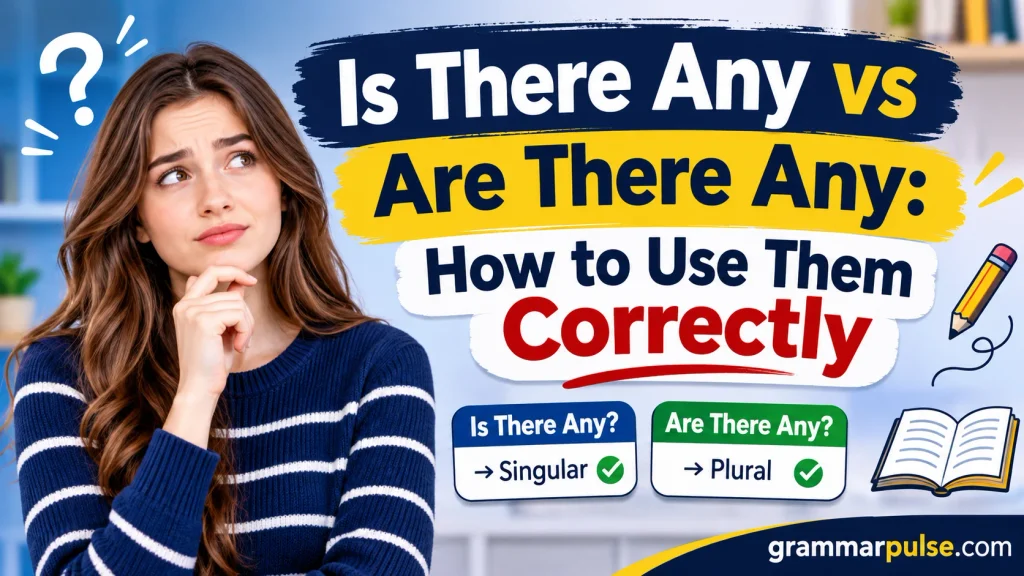
Understanding the difference between “Is there any” and “Are there any” is essential for improving your English grammar, writing, and everyday communication. Both expressions are commonly used to ask questions about the existence, availability, or presence of something. However, choosing the correct phrase depends on whether you are talking about a singular noun, plural noun, or an uncountable noun. Many English learners find these expressions confusing because they look almost identical and often appear in similar situations. Learning their basic rules can help you avoid common grammar mistakes and make your sentences sound more natural. Whether you are writing an email, asking a question, or having a conversation, knowing when to use each expression will improve your language skills and confidence.
The phrase “Is there any” is generally used with singular countable nouns and uncountable nouns when asking whether something exists or is available. For example, you might say, “Is there any milk in the refrigerator?” or “Is there any problem with the computer?” On the other hand, “Are there any” is used with plural countable nouns, such as books, people, questions, or opportunities. For instance, “Are there any books on the table?” and “Are there any questions about the lesson?” These examples demonstrate how the choice of is or are depends on the noun that follows. Understanding this subject-verb agreement rule is the key to using both expressions correctly.
In this complete guide, we will explore the meaning, grammar rules, and practical differences between “Is there any” and “Are there any.” You will learn how to recognize singular, plural, and uncountable nouns, avoid common mistakes, and construct grammatically correct questions. We will also examine real-life examples, everyday conversations, and situations where each expression is appropriate. Whether you are a student, English learner, professional, or someone who wants to communicate more effectively, this guide will make the topic easier to understand. By the end, you will have a clear understanding of both expressions and know how to use them naturally in spoken English, formal writing, and everyday communication.
Is There Any vs Are There Any: The Quick Answer
The difference comes down to the noun that follows.
| Phrase | Use With | Example |
| Is there any | Singular nouns | Is there any reason to leave? |
| Is there any | Uncountable nouns | Is there any water left? |
| Are there any | Plural countable nouns | Are there any tickets available? |
Quick Rule
Use is there any when talking about:
- One thing
- An uncountable amount
Use are there any when talking about:
- More than one countable item
Examples
❌ Is there any chairs available?
❌ Are there any information available?
Understanding the Meaning of “Any”
Before choosing between is there any and are there any, it’s important to understand the word any itself.
The word any refers to an unspecified quantity, amount, or number.
It doesn’t tell us exactly how much or how many. Instead, it asks whether something exists at all.
For example:
- Is there any coffee?
- Are there any cookies?
- Is there any hope?
In each sentence, the speaker isn’t asking for a specific quantity. They’re simply asking whether some amount exists.
Why “Any” Can Be Singular or Plural
Many learners assume that “any” automatically requires a plural noun.
That’s not true.
The word “any” can work with:
- Singular countable nouns
- Plural countable nouns
- Uncountable nouns
Examples:
| Type | Example |
| Singular | Is there any possibility? |
| Plural | Are there any possibilities? |
| Uncountable | Is there any information? |
The noun determines the verb—not the word “any.”
When to Use “Is There Any”
The phrase is there any appears with singular nouns and uncountable nouns.
Let’s examine both situations.
Using “Is There Any” With Uncountable Nouns
Uncountable nouns cannot normally be counted individually.
You can’t say:
- one information
- two advices
- three furnitures
Because of this, they take singular verbs.
Common Uncountable Nouns
| Noun | Correct Usage |
| Water | Is there any water? |
| Milk | Is there any milk? |
| Information | Is there any information? |
| Advice | Is there any advice? |
| Furniture | Is there any furniture? |
| Equipment | Is there any equipment? |
| Research | Is there any research? |
| Knowledge | Is there any knowledge? |
Examples
- Is there any water left in the bottle?
- Is there any information regarding the event?
- Is there any equipment available?
- Is there any research supporting this claim?
Notice that every noun above is treated as singular.
Using “Is There Any” With Singular Countable Nouns
Some singular nouns can also follow the phrase.
Examples
- Is there any possibility of success?
- Is there any chance of rain?
- Is there any reason to worry?
- Is there any student absent today?
These nouns refer to one concept, one reason, one chance, or one possibility.
Therefore, the singular verb is remains correct.
Common Expressions Using “Is There Any”
You’ll hear these frequently in everyday conversation:
- Is there any way to fix this?
- Is there any chance?
- Is there any reason?
- Is there any evidence?
- Is there any possibility?
- Is there any problem?
Example Dialogue
Customer: Is there any parking nearby?
Employee: Yes, there’s a parking garage across the street.
Manager: Is there any issue with the report?
Employee: No, everything looks good.
When to Use “Are There Any”
Use are there any when the noun is plural and countable.
Countable nouns can be counted individually.
Examples:
- Book
- Chair
- Student
- Apple
- Car
Since the nouns are plural, the verb must also be plural.
Examples of “Are There Any”
- Are there any books available?
- Are there any questions?
- Are there any employees present?
- Are there any apples left?
- Are there any tickets remaining?
Each noun refers to multiple items.
That’s why are is required.
Common Situations Where “Are There Any” Appears
Workplace Communication
- Are there any updates on the project?
- Are there any concerns from the client?
School Settings
- Are there any questions before the exam?
- Are there any assignments due tomorrow?
Travel
- Are there any seats available?
- Are there any flights today?
Shopping
- Are there any discounts available?
- Are there any larger sizes in stock?
Why Subject-Verb Agreement Matters
The distinction between is there any and are there any comes from a grammar rule called subject-verb agreement.
The verb must match the subject.
Singular Subject
Singular subjects require singular verbs.
Examples:
- The book is interesting.
- The student is ready.
Plural Subject
Plural subjects require plural verbs.
Examples:
- The books are interesting.
- The students are ready.
The same principle applies to there is and there are constructions.
The Hidden Subject Rule
Many people mistakenly believe that there is the subject.
It isn’t.
The real subject appears after the verb.
Consider these examples:
- There is a dog outside.
- There are dogs outside.
The word dog controls the verb choice.
The noun after the verb determines whether you need is or are.
Is “There” Actually the Subject?
Not exactly.
English grammar refers to this structure as an existential construction.
The word there acts as a placeholder.
The actual subject comes later.
Example
“There is a problem.”
Although “there” appears first, “problem” is the real subject.
The sentence essentially means:
“A problem exists.”
The same principle applies here:
“There are several problems.”
Meaning:
“Several problems exist.”
Understanding this concept makes the is there any vs are there any rule much easier.
Is There Any vs Are There Any: Side-by-Side Comparison
| Feature | Is There Any | Are There Any |
| Verb | Is | Are |
| Noun Type | Singular | Plural |
| Uncountable Nouns | Yes | No |
| Countable Nouns | Singular only | Plural only |
| Formality | Neutral | Neutral |
| Everyday Usage | Very common | Very common |
Examples
| Correct Sentence |
| Is there any water left? |
| Is there any evidence? |
| Is there any chance? |
| Are there any questions? |
| Are there any mistakes? |
| Are there any seats available? |
Real-Life Examples You Can Copy
Learning through examples is often the fastest method.
Everyday Examples
Is There Any
- Is there any coffee left?
- Is there any traffic today?
- Is there any sugar in the cabinet?
- Is there any hope?
- Is there any damage?
Are There Any
- Are there any cookies left?
- Are there any stores open?
- Are there any buses running?
- Are there any tickets available?
- Are there any options?
Business Examples
Is There Any
- Is there any feedback from customers?
- Is there any progress on the proposal?
- Is there any evidence supporting the recommendation?
Are There Any
- Are there any budget concerns?
- Are there any open positions?
- Are there any pending approvals?
Academic Examples
Is There Any
- Is there any research on this topic?
- Is there any evidence supporting the theory?
Are There Any
- Are there any references available?
- Are there any studies that contradict the findings
Travel Examples
Is There Any
- Is there any baggage allowance?
- Is there any public transportation nearby?
Are There Any
- Are there any direct flights?
- Are there any available hotel rooms?
Common Mistakes and How to Avoid Them
Even advanced English speakers make mistakes with these phrases.
Here are the most common ones.
Using “Is” With Plural Nouns
Incorrect:
❌ Is there any books available?
Correct:
✅ Are there any books available?
Because books is plural.
Using “Are” With Uncountable Nouns
Incorrect:
❌ Are there any information available?
Correct:
✅ Is there any information available?
Because information is uncountable.
Read More: Transferred or Transfered: The Correct Spelling
Misidentifying Uncountable Nouns
Many nouns look plural in meaning but remain grammatically singular.
Common Troublemakers
| Uncountable Noun |
| Advice |
| Information |
| Furniture |
| Equipment |
| Research |
| Knowledge |
| Progress |
| Traffic |
Correct:
✅ Is there any advice?
Incorrect:
❌ Are there any advice?
Quick Correction Table
| Incorrect | Correct |
| Is there any chairs? | Are there any chairs? |
| Are there any furniture? | Is there any furniture? |
| Are there any advice? | Is there any advice? |
| Is there any employees? | Are there any employees? |
| Are there any research? | Is there any research? |
Special Cases and Exceptions
English always has a few surprises.
Let’s look at situations that cause confusion.
Collective Nouns
Collective nouns describe groups acting as one unit.
Examples:
- Team
- Family
- Staff
- Audience
- Government
In American English, collective nouns usually take singular verbs.
Examples
- Is there any staff available?
- Is there any audience participation?
The group is treated as one unit.
Compound Nouns
Compound nouns act as a single noun.
Examples:
- Ice cream
- Parking space
- Living room
Correct Usage
- Is there any ice cream left?
- Are there any parking spaces available?
The key is determining whether the compound noun is singular or plural.
Mixed Subjects
Sometimes a sentence contains both singular and plural nouns.
Examples
- There is a problem and several concerns.
- There are several concerns and a problem.
In modern English, writers often match the verb to the nearest noun.
This practice is called proximity agreement.
Is There Any vs Are There Some
Many learners confuse any and some.
Although similar, they serve different purposes.
When We Use “Any”
Usually in:
- Questions
- Negative sentences
- Uncertain situations
Examples:
- Are there any questions?
- Is there any milk?
- We don’t have any tickets.
When We Use “Some”
Usually in:
- Positive statements
- Offers
- Requests
Examples:
- There are some cookies.
- Would you like some coffee?
- Could I have some water?
Comparison Table
| Any | Some |
| Common in questions | Common in statements |
| Common in negatives | Common in offers |
| Suggests uncertainty | Suggests expectation |
| Flexible quantity | Flexible quantity |
Is There Any vs Is Any There
These structures may look similar, but they work differently.
Standard Structure
- Is there any food left?
This sounds natural because English commonly uses existential constructions.
Less Common Structure
- Is any food there?
This form is grammatical but unusual.
Most native speakers naturally choose:
- Is there any food left?
The existential structure sounds smoother and more conversational.
Mini Case Study: Why Native Speakers Make This Mistake
Consider this sentence:
❌ Is there any people waiting outside?
Why does this mistake happen?
Because the speaker hears there is so frequently that it becomes automatic.
However, the noun people is plural.
The correct version is:
✅ Are there any people waiting outside?
The lesson is simple:
Always look at the noun after the verb before deciding between “is” and “are.”
That single habit eliminates most mistakes.
Practice Quiz
Choose the correct answer.
Questions
- Is/Are there any sugar left?
- Is/Are there any students absent?
- Is/Are there any evidence available?
- Is/Are there any mistakes in the report?
- Is/Are there any progress on the project?
- Is/Are there any chairs in the room?
- Is/Are there any information regarding the event?
- Is/Are there any employees available?
Answers
- Is there any sugar left?
- Are there any students absent?
- Is there any evidence available?
- Are there any mistakes in the report?
- Is there any progress on the project?
- Are there any chairs in the room?
- Is there any information regarding the event?
- Are there any employees available?
Cheat Sheet: Remember the Rule in Five Seconds
| Noun Type | Correct Phrase |
| Singular Countable Noun | Is there any |
| Uncountable Noun | Is there any |
| Plural Countable Noun | Are there any |
Examples
| Noun | Correct Form |
| Water | Is there any water? |
| Advice | Is there any advice? |
| Information | Is there any information? |
| Book | Is there any book available? |
| Books | Are there any books available? |
| Questions | Are there any questions? |
Conclusion
Understanding “Is There Any” vs “Are There Any” makes it easier to ask questions correctly and communicate confidently in English. The main difference is that “Is there any” is generally used with singular countable and uncountable nouns, while “Are there any” is used with plural countable nouns. For example, you can say, “Is there any water?” but “Are there any students?”
Remembering this simple grammar rule can help you avoid common mistakes in everyday conversations, emails, and professional writing. With regular practice and attention to singular and plural nouns, you can use both expressions naturally. The more you practice, the more confident and accurate your English communication will become.
FAQs
1. What is the main difference between “Is There Any” and “Are There Any”?
“Is there any” is used with singular countable and uncountable nouns, whereas “Are there any” is used with plural countable nouns. The choice depends on the noun in the sentence.
2. Is “Is There Any” grammatically correct?
Yes, “Is there any” is grammatically correct when used with uncountable nouns or singular countable nouns. For example: “Is there any milk?” or “Is there any problem?”
3. When should I use “Are There Any”?
Use “Are there any” when asking about the existence or availability of multiple countable things. For example: “Are there any books in the library?”
4. Can I use “Is There Any” with uncountable nouns?
Yes, you can use “Is there any” with uncountable nouns such as water, sugar, information, money, and milk. For example: “Is there any information available?”
5. Which expression is correct: “Is There Any Questions” or “Are There Any Questions”?
“Are there any questions?” is correct because “questions” is a plural countable noun. Using “is” with this plural noun would create a subject-verb agreement error.


One Response