
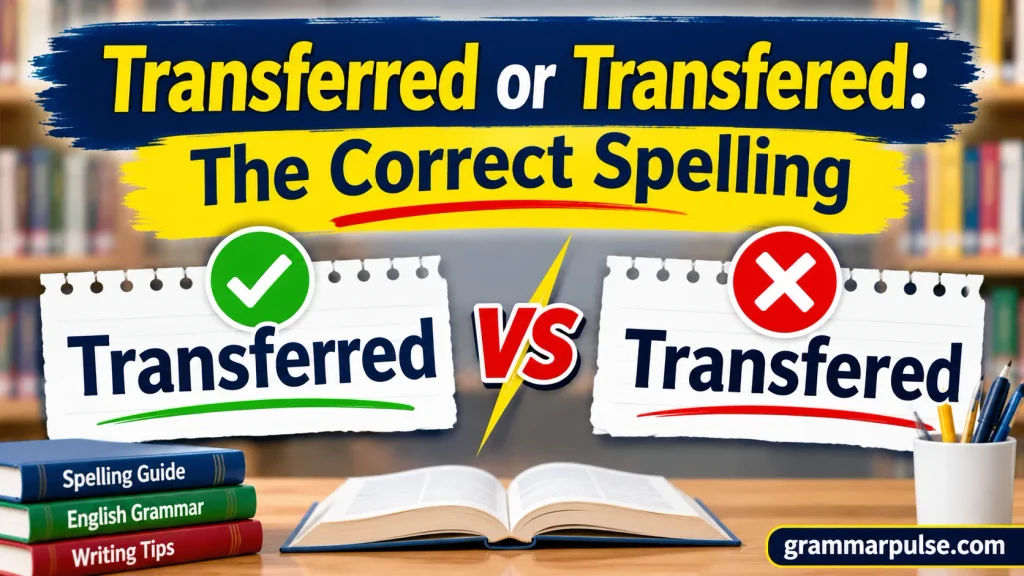
Choosing between Transferred and Transfered can be confusing, especially when you are unsure whether a word needs a double consonant before adding an ending. Both spellings may look correct at first glance, but only one follows standard English spelling rules. The correct spelling is Transferred, with two R letters in the middle. It is the past tense and past participle of the verb Transfer, which means to move something or someone from one place, person, or situation to another. Understanding this spelling difference can help you avoid common grammar mistakes and improve your everyday writing. Whether you are writing an email, preparing a business document, or completing an academic assignment, using the correct spelling makes your communication clearer and more professional.
The confusion between Transferred and Transfered happens because many English verbs simply take -ed when forming their past tense. However, the word transfer follows a particular spelling rule that requires doubling the final consonant before adding the suffix. Since transfer has a final consonant preceded by a vowel in its stressed final syllable, the last letter R is doubled, producing Transferred. The same rule applies to other words, such as preferred, referred, and occurred. Learning these examples makes it easier to recognize similar spelling patterns and remember when a consonant needs to be doubled. Once you understand this simple rule, you can confidently use Transferred without second-guessing yourself.
In this guide, we will explain the correct spelling, meaning, pronunciation, and grammatical usage of Transferred with simple examples. You will also learn why Transfered is incorrect in standard English and how to avoid making this mistake in your writing. Additionally, we will explore different sentence structures, common spelling errors, and practical tips to help you remember the correct form. Whether you are a student, professional, blogger, or someone improving their English skills, understanding this difference can strengthen your vocabulary. By the end, you will know exactly when and how to use Transferred in everyday conversations and formal writing.
Transferred or Transfered: Which Spelling Is Correct?
Let’s get straight to the point.
The correct spelling is:
Transferred ✅
The spelling “transfered” is incorrect ❌ in modern English.
Quick comparison table
| Incorrect spelling | Correct spelling | Status |
| transfered | transferred | ❌ Wrong |
| transffered | transferred | ❌ Wrong |
| transferred | transferred | ✅ Correct |
The correct version uses double “r” and double “e” in the past tense.
Why “Transferred” Is Spelled With Double Letters
To understand this spelling, you need to look at how English handles verbs ending in -fer.
The base verb is:
transfer
It means to move something from one place, person, or situation to another.
Examples:
- Transfer money from one bank account to another.
- Transfer a student to a new school.
- Transfer data from a phone to a computer.
The Grammar Rule Behind “Transferred”
Here’s the rule that matters most:
🔑 Rule: Doubling the final consonant in stressed syllables
When a verb:
- Ends in a consonant-vowel-consonant pattern (like -fer)
- Has stress on the final syllable
- And you add a suffix like -ed
You double the final consonant.
So:
- transfer → transferred
Why does English do this?
Because it preserves pronunciation and keeps spelling consistent.
If we wrote “transfered,” people might misread or mispronounce it as:
trans-FEER-ed (with a softer sound)
But “transferred” keeps the strong “fer” sound intact.
Breaking Down the Word “Transfer”
Let’s break it into parts so it becomes easier to remember:
| Part | Meaning |
| trans- | across, beyond |
| -fer | to carry or bear |
So “transfer” literally means:
to carry across
That applies whether you’re moving money, people, data, or ownership.
What “Transferred” Actually Means in Real Life
The word appears everywhere in real-world communication. Let’s look at how it works in different contexts.
Financial usage
- The bank transferred funds to your account.
- She transferred $500 to her savings.
Education
- He transferred to another university.
- Credits were transferred automatically.
Technology
- Files were transferred via Bluetooth.
- Data got transferred to the cloud server.
Employment
- The employee was transferred to the marketing department.
- She requested to be transferred to a new branch.
Why People Write “Transfered” by Mistake
This mistake is extremely common. Here’s why:
1. English pronunciation confusion
The word sounds like it could be spelled with one “r” because we don’t clearly pronounce the double consonant.
2. Overgeneralization of “-ed” rule
Most verbs just add “-ed”:
- play → played
- open → opened
So people assume:
transfer → transfered
3. Lack of exposure in writing
People hear “transfered” in casual writing online and assume it’s correct.
Simple Trick to Remember the Correct Spelling
Here’s an easy memory trick:
“FER gets a double R before ED.”
Or even simpler:
If the word ends in FER, double the R when adding ED.
Think of it like this:
- transfer → transferred
- prefer → preferred
- refer → referred
Once you notice the pattern, it becomes automatic.
Similar Words That Follow the Same Rule
This rule doesn’t apply only to “transfer.” Many verbs behave the same way.
Common examples
| Base word | Correct past tense |
| prefer | preferred |
| refer | referred |
| defer | deferred |
| infer | inferred |
| transfer | transferred |
What they all share
- End in -fer
- Stress on the last syllable
- Double the final consonant before adding suffix
Read More: Cheer vs Chear: Meaning, Differences, Correct Usage
Common Mistakes People Make With “Transferred”
Even when people know the correct spelling, they still slip up.
Mistake 1: Missing one “r”
❌ transfered
✔ transferred
Mistake 2: Mixing verb forms
❌ The files was transferred
✔ The files were transferred
Mistake 3: Wrong tense usage
❌ I have transfered the money
✔ I have transferred the money
Present, Past, and Perfect Forms of Transfer
Let’s make this crystal clear.
| Tense | Form |
| Present | transfer |
| Past | transferred |
| Past participle | transferred |
| Present participle | transferring |
Notice another pattern:
- transferring also doubles the “r”
Why Spelling Accuracy Matters More Than You Think
Spelling isn’t just about grammar rules. It affects how people perceive your writing.
- Search engines rely on correct spelling for indexing.
- Misspellings can affect SEO performance.
Real-World Case Study: Email Miscommunication
Let’s look at a simple but realistic example.
Scenario:
An employee writes:
“The documents have been transfered to the client.”
What happens next:
- The client notices the spelling mistake.
- They question the professionalism of the sender.
- The message still gets across, but trust weakens slightly.
Correct version:
“The documents have been transferred to the client.”
Small correction. Big difference in perception.
How Native Speakers Actually Learn This Rule
Native English speakers don’t usually memorize grammar rules directly. Instead, they:
- Read the correct spelling repeatedly
- See patterns in similar words
- Internalize spelling through exposure
That’s why reading matters so much.
The more you see “transferred” in real writing, the more natural it feels.
Quick Reference Cheat Sheet
Here’s a fast reminder you can bookmark mentally:
✔ Always correct:
- transferred
- transferring
- transfer
❌ Always wrong:
- transfered
- transffered
- transfrred
Why English Doubles Letters Like This
English keeps these patterns for one main reason:
To protect pronunciation consistency
Without doubling:
- words could lose clarity
- stress could shift incorrectly
- meaning might become harder to recognize quickly
So while it looks messy, it actually helps readability.
Other Confusing Spelling Pairs Like This
If “transferred” confuses you, these probably do too:
| Word | Common mistake |
| occurred | occured ❌ |
| referred | refered ❌ |
| beginning | begining ❌ |
| committed | commited ❌ |
Notice a pattern? English loves doubling consonants in specific cases.
Practical Tips to Never Misspell “Transferred” Again
Here’s how you can lock it in permanently:
Tip 1: Say it out loud
Break it into syllables:
trans-fer-red
Tip 2: Visual memory
Picture two “r” letters standing side by side.
Tip 3: Repetition practice
Write five sentences using “transferred” correctly.
Example:
- I transferred money yesterday.
- She transferred schools last year.
- The data transferred successfully.
- He transferred departments at work.
- Files transferred in seconds.
Conclusion:
The correct spelling is Transferred, not Transfered. It contains a double R because the final consonant of the verb transfer is doubled before adding the suffix -ed. This spelling follows a common English grammar rule that also applies to words such as preferred, referred, and occurred. Using the correct form helps make your writing more accurate and professional.
Whether you are writing emails, academic assignments, or everyday messages, always use Transferred when referring to something that has been moved from one place, person, or situation to another. Remembering this simple spelling rule will help you avoid common mistakes and improve your English writing skills.
FAQs:
1. Which spelling is correct: Transferred or Transfered?
Transferred is the correct spelling. It contains two R letters, while Transfered is an incorrect spelling in standard English.
2. Why does Transferred have two R letters?
The final consonant R is doubled before adding -ed because of the English consonant-doubling spelling rule.
3. What is the meaning of Transferred?
Transferred means moved something or someone from one place, person, or situation to another. It is the past tense and past participle of transfer.
4. Is Transferred the past tense of Transfer?
Yes, Transferred is both the past tense and past participle of the verb transfer.
Example: She transferred the money to my bank account.
5. What are some examples of Transferred in sentences?
Here are three simple examples. The employee was transferred to another department. She transferred the money yesterday.





2 Responses