
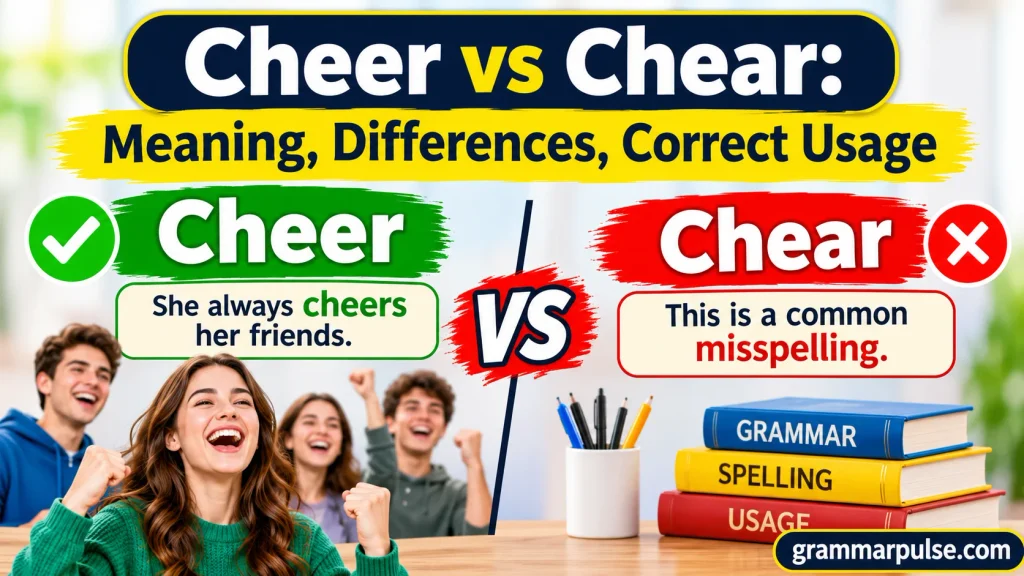
When comparing Cheer vs Chear, you might wonder which spelling is correct and how to use each word in everyday English. Although these two words look very similar, only one is recognized as the correct English spelling. The word cheer is commonly used to express happiness, encouragement, excitement, or support for someone. You may hear it at sporting events, celebrations, or during conversations when people want to motivate others. On the other hand, chear is generally considered a misspelling of cheer and does not have an accepted meaning in standard modern English. Understanding this spelling difference can help you avoid mistakes in your writing, communication, and everyday messages.
The word cheer has several meanings depending on the context in which it appears. It can describe a feeling of happiness and positivity, a loud expression of approval, or an action that encourages someone during a difficult situation. For example, fans may cheer for their favorite team, friends may cheer someone up after a bad day, and people may share cheers during a special celebration. These examples show how cheer works as both a noun and a verb. However, writing chear instead of cheer can make your sentence look incorrect and may confuse readers. That is why learning the correct spelling, meaning, and usage is important for anyone who wants to improve their English skills.
In this guide, we will explain the meaning of cheer, why chear is considered incorrect, and the key differences between these two spellings. You will also discover simple examples, common mistakes, and practical tips to remember the correct form. Whether you are writing a school assignment, preparing a professional email, or chatting with friends, using the right spelling makes your message clearer and more effective. By the end, you will understand when and how to use cheer correctly without second-guessing yourself. So, let’s explore the definitions, spelling rules, and real-life examples to make this common English spelling confusion easier to understand.
Cheer vs Chear: Why This Confusion Happens
Let’s start with something relatable.
You type quickly. Your fingers move faster than your brain. You hear the word “cheer” in your head, but your keyboard sometimes produces “chear.” Or worse, autocorrect doesn’t fix it because it assumes both might be valid.
That’s where the confusion grows.
Here’s what usually causes the mix-up:
- Phonetic spelling (it sounds like “chear” to some learners)
- Old English influence still floating around online
- Typing errors on mobile keyboards
- Misreading older texts or comments
- Lack of exposure to correct spelling in context
The result? A small spelling mistake that can make writing look less polished than intended.
What Does “Cheer” Mean in English?
The word “cheer” plays multiple roles in English. It works as both a verb and a noun, and each use carries slightly different meaning.
Cheer as a Verb (Action Word)
As a verb, cheer means to express encouragement, joy, or support.
You’ll often see it in sports, celebrations, or emotional support situations.
Examples:
- The crowd cheered loudly after the final goal.
- Fans cheer for their favorite team every weekend.
- She tried to cheer him up after a long day.
In this form, “cheer” usually involves energy, sound, or emotional uplift.
Cheer as a Noun (Feeling or Mood)
As a noun, cheer refers to a feeling of happiness or positivity.
It describes emotional brightness or a sense of uplift.
Examples:
- Her voice carried unexpected cheer despite the situation.
- The holiday season brings cheer to many people.
- He spoke with cheer and confidence.
Think of it as emotional sunshine. Not loud. Not physical. Just a mood.
Common Expressions with Cheer
English uses “cheer” in many everyday phrases:
- Cheer up → become happier
- “Cheer up, things will get better.”
- Cheers → toast or casual goodbye
- “Cheers to your success!”
- Cheerful → happy or bright personality
- “She has a cheerful personality.”
- Cheer on → support someone actively
- “We cheer on our team every match.”
These expressions show how flexible the word is in real communication.
Read More: Pentoxide vs Pentaoxide: The Correct Chemistry Term
Is “Chear” a Real Word?
Now we get to the interesting part of cheer vs chear.
Yes, “chear” did exist historically, but it no longer functions as a valid modern English spelling.
Historical Background of “Chear”
If you look at older English texts from the 1500s to early 1700s, you may find “chear” used instead of “cheer.”
During that time:
- English spelling was not standardized
- Writers spelled words based on pronunciation
- Variations were common and accepted
So “chear” wasn’t wrong back then. It was just one of several spellings.
Modern English Status
Today, things are different.
Modern dictionaries clearly recognize:
- Cheer → Correct
- Chear → Incorrect / archaic
If you check reputable sources like:
You’ll see “chear” listed as outdated or historical, not standard usage.
Why You Still See “Chear” Online
Even though it’s outdated, “chear” still appears in:
- Old book scans
- Rewritten historical documents
- Typing mistakes in forums
- Non-native English learner errors
- Auto-generated content from incorrect sources
But in professional or academic writing, it signals a spelling error.
Cheer vs Chear: Key Differences Explained
Let’s break the difference down clearly.
| Feature | Cheer | Chear |
| Modern usage | Yes | No |
| Dictionary accepted | Yes | No |
| Grammar correctness | Correct | Incorrect |
| Historical usage | Rare | Old spelling variant |
| Writing recommendation | Always use | Avoid completely |
| Clarity for readers | Clear | Confusing |
This table makes one thing obvious: only “cheer” belongs in modern writing.
Simple Memory Tricks to Never Confuse Cheer vs Chear
If spelling trips you up, use these tricks.
1. The Double E Rule
“Cheer” has two E’s, just like:
- Energy
- Excitement
- Emotion
If you feel positive energy, you use “cheer.”
2. The “A” Doesn’t Belong Trick
Think of it this way:
- “A” in chear stands alone
- But English doesn’t accept it anymore
No modern usage = no “A”
3. Link It to Action
You cheer someone on.
You give them energy.
Action words in English often stay simple and modern.
Common Mistakes with Cheer vs Chear
Even fluent writers slip up sometimes.
Here are the most common mistakes:
Mistake: Using “Chear” in Formal Writing
❌ “We chear for the team.”
✔ “We cheer for the team.”
Mistake: Mixing It with Similar Words
People often confuse:
- Cheer vs chair
- Cheer vs clear
- Cheer vs cheer (misspelling variants)
Mistake: Overusing “Cheers” Incorrectly
“Cheers” doesn’t always mean celebration.
It can also mean:
- Goodbye (informal UK English)
- Thanks (casual tone)
- Toast (social drinking context)
Using it wrong can confuse readers.
Real-World Case Study: The Student Essay Error
A common classroom mistake shows how this confusion happens in real life.
A student once wrote:
“The audience cheared loudly during the performance.”
The teacher marked it incorrect and explained:
- “Cheared” is not a word
- The correct form is “cheered”
After correction, the student remembered it by linking it to “cheer = energy.”
This small fix improved their writing clarity instantly.
It’s a simple example, but it shows how spelling shapes credibility.
“Cheer” vs “Cheers”: When to Use Each
These two often get mixed up in cheer vs chear discussions, but they serve different purposes.
Use “Cheer” when:
- Talking about encouragement
- Describing happiness or emotion
- Referring to group support
Use “Cheers” when:
- Making a toast
- Ending informal messages
- Saying goodbye casually
Example:
- “Cheers to your success!” (toast)
- “Thanks for your help. Cheers!” (casual sign-off)
Keyword Breakdown: Cheer vs Chear Explained
If you’re searching this topic, you might also use:
- cheer vs chear meaning
- is chear a word
- correct spelling of cheer
- difference between cheer and chear
- how to spell cheer correctly
All of them point to the same answer:
👉 “Cheer” is correct. “Chear” is outdated.
Why Correct Spelling Matters More Than You Think
Spelling isn’t just grammar. It shapes how people perceive your writing.
Using correct spelling:
- Improves credibility
- Makes writing easier to read
- Helps communication feel professional
- Reduces misunderstanding
A small mistake like “chear” might seem harmless, but it can distract readers from your message.
Think of spelling like clean handwriting. Even a great idea loses impact if it looks messy.
Quick Summary Table
| Question | Answer |
| Is “cheer” correct? | Yes |
| Is “chear” correct? | No |
| Is “chear” used today? | Only in historical texts |
| Should you use “chear”? | Never in modern writing |
| Best replacement | Always use “cheer” |
Conclusion:
Understanding Cheer vs Chear is simple once you know the correct spelling and meaning of each word. Cheer is the correct English spelling and can express happiness, excitement, encouragement, or support. In contrast, chear is generally considered a spelling mistake and should be avoided in standard English writing. Using the correct form helps make your sentences more clear, professional, and easy to understand.
Whenever you want to express happiness, support, or encouragement, choose the word cheer. Remembering this simple spelling rule will help you avoid common mistakes in everyday conversations, emails, and written content.
FAQs:
1. Is cheer or chear the correct spelling?
Cheer is the correct spelling in standard English. Chear is generally considered a misspelling and should not be used in formal or everyday writing.
2. What does the word cheer mean?
Cheer means to express happiness, excitement, or encouragement. It can also describe a positive feeling or a loud expression of support for someone.
3. Is chear a real English word?
Chear is not a recognized standard modern English spelling. It is usually a spelling mistake made when someone intends to write cheer.
4. How do you use cheer in a sentence?
You can use cheer as a noun or a verb. For example: “The fans cheer for their favorite team” or “Her kind words brought good cheer.”
5. What is the difference between cheer and chear?
The main difference is spelling and correctness. Cheer is the accepted English word, while chear is generally an incorrect spelling. Always use cheer in standard English writing.



One Response