
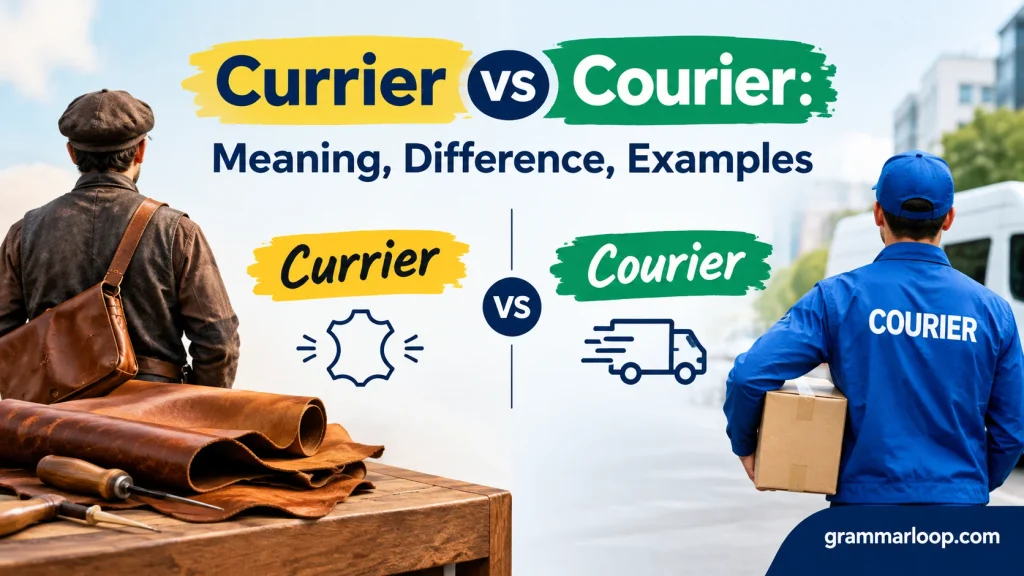
The words Currier vs Courier may look similar, but they have different spellings, meanings, and uses in English. Many people confuse these words because they sound alike and differ by only a few letters. However, understanding their meanings can help you avoid common spelling mistakes in writing, emails, and everyday conversations. The word courier is commonly used for someone who delivers letters, packages, and important documents from one place to another. In contrast, currier is a less common word that refers to a person who treats and prepares leather after it has been tanned. Learning this difference will make your writing more accurate and professional.
Understanding the difference between currier and courier is especially useful when writing about delivery services, leather production, or professional jobs. For example, if you order a package online, a courier service may deliver it directly to your home. You might also hear the word courier when discussing business documents, urgent shipments, or international deliveries. On the other hand, a currier works with leather, using specialized methods to make it suitable for different purposes. Although both words refer to people who perform specific jobs, their roles are completely different. Using the correct word helps readers understand your message without confusion and improves your overall English vocabulary and spelling skills.
In this guide, we will explore the meaning of currier, the definition of courier, and the key differences between these two words. You will also learn how to use each term correctly through simple example sentences and practical explanations. Whether you are a student, a writer, or someone improving their English grammar, these examples will help you remember the distinction. We will explain when to use courier for deliveries and when to use currier for leather-related work. By the end of this article, you will understand their correct spelling, pronunciation, and usage. This knowledge will help you choose the right word confidently in everyday and professional writing.
Currier vs Courier: Why This Confusion Happens in the First Place
Before diving into definitions, it helps to understand the real problem.
People confuse currier and courier because:
- They sound almost identical in spoken English
- One letter changes everything
- Context often disappears in fast writing or speech
- Auto-correct sometimes guesses wrong
- Many people only know one of the two words
Here is the key idea:
Pronunciation hides the meaning difference, but spelling reveals it.
When you hear someone say “courier,” your brain may also accept “currier” without noticing the change. That is where mistakes begin.
Now let’s break them apart clearly.
What “Courier” Means in Modern English (Currier vs Courier Explained)
The word courier is the one you see every day in real life.
Courier Definition
A courier is a person or service that delivers messages, documents, or packages from one place to another.
Couriers focus on:
- Speed
- Security
- Direct delivery
- Time-sensitive transport
You interact with couriers more often than you realize.
Where You See Couriers Today
Couriers work everywhere in modern life:
- Package delivery companies like DHL, FedEx, and UPS
- Local delivery riders for small businesses
- Food delivery platforms
- Legal document delivery services
- Medical sample transport services
Even when you order food online and a rider shows up at your door, you are interacting with a courier system.
Real-Life Example
Imagine you order an important document from another city.
- The company assigns a courier
- The courier picks up your envelope
- They transport it directly to your address
- You receive it within hours or days depending on service speed
That entire process depends on courier logistics.
Key Traits of a Courier
Couriers share a few defining characteristics:
- Fast delivery timelines
- Point-to-point transport
- Tracking systems for accountability
- Commercial or personal service usage
A courier is not just a person. It can also refer to a company or service network.
What “Currier” Means (Currier vs Courier Explained Clearly)
Now let’s shift into the less familiar word: currier.
Currier Definition
A currier is a person who works with leather after it has been tanned. Their job involves finishing and treating leather to make it smooth, flexible, and usable.
Unlike couriers, curriers do not deal with transportation. They deal with craftsmanship.
What a Currier Actually Does
A currier performs detailed finishing work such as:
- Scraping and cleaning leather surfaces
- Applying oils or waxes
- Softening and smoothing hides
- Preparing leather for final use in products
This work traditionally comes after tanning in the leather production process.
Historical Context of Curriers
Curriers were much more common in older economies where leather goods were handmade.
They worked closely with:
- Tanners (who process raw hides)
- Shoemakers
- Saddle makers
- Leather artisans
Today, the profession still exists but on a much smaller scale. Modern industrial production has reduced the need for manual curriers.
Where You Still See “Currier” Today
Even though the role is rare, it still appears in:
- Leathercraft workshops
- Historical references
- Museums and trade history books
- Artisan leather goods production
If you ever visit a traditional leather workshop, you might still hear the term used.
Currier vs Courier: Core Differences You Should Remember
The clearest way to understand these two words is to compare them side by side.
Simple Breakdown
- Courier = delivery and transport
- Currier = leather finishing and craftsmanship
Comparison Table
| Feature | Courier | Currier |
| Industry | Logistics and transportation | Leatherworking and craftsmanship |
| Main Function | Delivers packages or messages | Finishes and treats leather |
| Modern Usage | Very common | Rare |
| Work Environment | Roads, cities, delivery networks | Workshops, artisan studios |
| Output | Delivered items | Processed leather |
| Example Job | Delivery driver | Leather craftsman |
This table alone removes most confusion.
Why Currier vs Courier Gets Mixed Up So Often
Even native English speakers mix these words up. Here is why.
Similar Sound Structure
Both words:
- Start with a “cur/cour” sound
- End with a soft “-ier”
- Have nearly identical pronunciation in casual speech
So when spoken quickly, they blur together.
Spelling Trap
One letter makes a huge difference:
- Courier → relates to carrying and delivery
- Currier → relates to curing and treating leather
That single vowel change carries the entire meaning shift.
Context Gets Lost in Fast Communication
In texting, emails, or quick speech, people often rely on memory instead of spelling accuracy. That leads to mistakes like:
- “We hired a currier for the documents” ❌
- “The courier treated leather goods” ❌
Both are wrong, but they happen more often than you think.
Read More: Other Ways to Say “Keep Up the Good Work”
Real Examples of Currier vs Courier in Sentences
Examples make the difference stick.
Courier in Action
- The courier delivered the passport within two hours.
- I tracked the courier until the package arrived at my door.
- The courier service handled international shipping for the company.
Currier in Action
- The currier treated the leather to make it soft and durable.
- Historical records mention the currier’s role in medieval trade guilds.
- The currier prepared the hide before it became a finished saddle.
Notice how different the worlds are. One is modern and fast. The other is traditional and craft-based.
Common Mistakes with Currier vs Courier in Real Life
People misuse these words more often than they realize.
Job Listings and Resumes
A surprisingly common mistake happens in professional writing:
- “Courier specialist in leather finishing” ❌
- “Currier for logistics delivery” ❌
These errors can confuse employers and hurt credibility.
Auto-Correct Problems
Phones and writing tools sometimes replace:
- courier → currier
- currier → courier
This happens because both words exist in dictionaries.
Content Writing Confusion
Writers sometimes target the wrong keyword. For example:
- Writing “currier services near me” when they mean delivery services
- Optimizing logistics content with the wrong spelling
This can completely distort search results.
Easy Mental Hook
Couriers carry things. Curriers cure leather.
Related Words That Often Get Confused
Currier vs courier is not the only confusing pair. English has many similar traps.
Courier vs Carrier
- Courier = delivers items
- Carrier = transports goods or passengers
Example:
- A courier delivers your package
- A carrier moves cargo across regions
Curator vs Currier
- Curator = manages collections or museums
- Currier = leather worker
Career vs Courier
These sound similar in fast speech but differ completely:
- Career = profession or job path
- Courier = delivery role
Case Study: A Real-World Confusion in Business Writing
A small logistics startup once published a service page titled:
“Professional Currier Delivery Services”
At first glance, nothing seemed wrong internally. But the mistake caused issues:
What Went Wrong
- Customers searched for “courier services”
- Search engines misclassified the page
- Traffic dropped because keywords did not match intent
- Users assumed it was about leatherwork due to spelling mismatch
Result
After correcting the spelling to “courier,” the company saw:
- Improved search visibility
- Better user trust
- Higher booking conversions
This shows how one letter can impact real business performance.
Linguistic Insight: Why English Keeps These Confusions Alive
English borrows heavily from older languages like French and Latin. That creates words that:
- Sound similar
- Differ in spelling only slightly
- Carry completely unrelated meanings
“Courier” comes from historical terms linked to running messages.
“Currier” comes from leather processing traditions.
Even though they evolved separately, modern English kept both.
That is why confusion persists today.
Conclusion
In conclusion, currier vs courier is a simple but important spelling distinction to understand. Although these words look and sound similar, they have different meanings and uses. A courier is a person or service that delivers packages, letters, and documents, while a currier is someone who treats and prepares leather after tanning. Knowing the difference helps you avoid spelling mistakes and communicate more clearly in everyday and professional writing.
Remember, use courier when discussing deliveries, shipping, or transportation of documents and parcels. Use currier when referring to someone who works with leather. By learning these definitions and practicing the example sentences, you can use both words correctly and improve your English vocabulary and writing skills.
FAQs
1. What is the difference between currier and courier?
Currier refers to a person who treats and prepares leather, while courier refers to a person or service that delivers packages, letters, and documents.
2. Is courier the correct spelling for a delivery person?
Yes, courier is the correct spelling when referring to someone who delivers packages, documents, or other items from one place to another.
3. What does currier mean?
A currier is a person who processes and finishes leather after it has been tanned, making it suitable for various uses.
4. How do you use courier in a sentence?
Example: “The courier delivered my package to my house this morning.”
5. How do you use currier in a sentence?
Example: “The currier carefully treated the leather to make it softer and more durable.”






One Response