
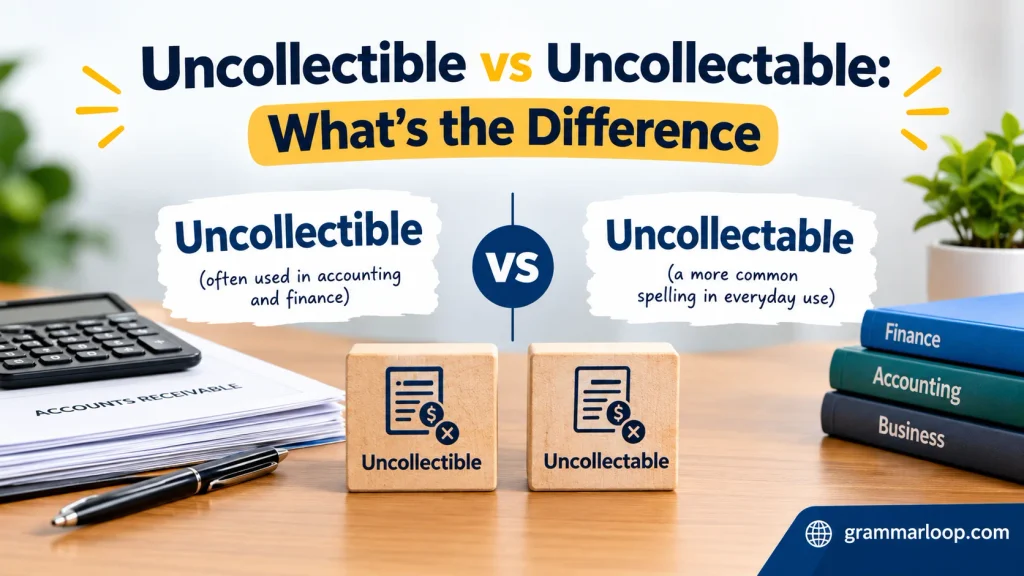
The words uncollectible and uncollectable look almost identical, and both are used to describe something that cannot be collected. However, choosing the correct spelling can sometimes be confusing, especially when you are writing about unpaid debts, financial records, or everyday situations. If you have ever wondered whether to use uncollectible or uncollectable in your writing, you are not alone. Both spellings are considered correct in English, but their usage may depend on regional preferences and the context of your sentence.
The word uncollectible is more commonly used in American English, particularly in financial and accounting contexts. For example, a business might describe an unpaid invoice as an uncollectible debt when there is little chance of recovering the money. This spelling frequently appears in accounting reports, financial documents, and professional discussions about outstanding payments. On the other hand, uncollectable is also a valid spelling and carries the same basic meaning. It may be preferred by some writers, particularly in British English or other varieties of English, although usage can vary depending on the publication and industry.
Understanding the difference between uncollectible vs uncollectable can help you improve your spelling accuracy, communicate clearly, and write more confidently. The good news is that you do not need to memorize two different definitions because both words describe something that cannot be gathered, recovered, or obtained. The main distinction is their spelling preference, rather than their meaning. In this guide, you will learn how both words are used, explore practical examples, and discover which spelling is best for your audience. By the end, you will be able to choose the right word for your writing style and use it naturally in everyday or professional communication.
Uncollectible vs. Uncollectable: The Short Answer
Here’s the quick comparison.
| Feature | Uncollectible | Uncollectable |
| Correct spelling | ✅ Yes | ✅ Yes |
| Meaning | Unable to be collected | Unable to be collected |
| Part of speech | Adjective | Adjective |
| Common in accounting | Yes | Occasionally |
| More common today | Yes | Less common |
| Accepted by major dictionaries | Yes | Yes |
Key takeaway: There is no difference in meaning between uncollectible and uncollectable. The difference lies almost entirely in preference and frequency of use.
What Does “Uncollectible” Mean?
The adjective uncollectible describes something that cannot reasonably be collected, recovered, or obtained.
Most people encounter the term in financial settings where it refers to money that a business is unlikely to receive from a customer.
For example:
- An unpaid customer invoice
- A defaulted loan
- Outstanding rent
- Credit card balances
- Medical bills
- Delinquent accounts receivable
Businesses generally classify these amounts as uncollectible only after making reasonable efforts to collect payment.
Simple definition
Uncollectible: Something that cannot be collected because recovery is unlikely or impossible.
Examples
- The company determined the invoice was uncollectible after repeated collection attempts.
- Several customer accounts became uncollectible during the economic downturn.
- The lender wrote off thousands of dollars in uncollectible debt.
Although the word often relates to finance, it can describe anything that cannot realistically be collected.
For example:
- Taxes
- Membership dues
- Fees
- Loans
- Judgments
- Royalties
What Does “Uncollectable” Mean?
Uncollectable carries the same definition.
It also describes money, property, or obligations that cannot be collected.
For example:
- The debt became uncollectable after the debtor declared bankruptcy.
- Several invoices proved uncollectable because the customers had permanently closed their businesses.
There is no hidden legal distinction between the two spellings. Neither spelling changes the meaning of the sentence.
Instead, uncollectable simply represents an alternative spelling that has become less common in modern business communication.
Is There Any Difference Between Uncollectible and Uncollectable?
This question causes the most confusion.
The answer is remarkably straightforward.
Meaning
There is no difference.
Both words mean:
- Impossible to collect
- Not likely to be recovered
- Unable to obtain payment
Neither carries a broader or narrower definition.
Grammar
Both are adjectives.
Examples:
- Uncollectible account
- Uncollectable debt
Neither changes the sentence structure.
Context
Both words appear in:
- Accounting
- Finance
- Banking
- Insurance
- Legal writing
- Government records
- Tax documents
Modern usage
This is where the real difference appears.
Today’s business publications overwhelmingly favor uncollectible.
That preference isn’t based on grammar. Instead, it reflects modern editorial practice and industry convention.
Why Is “Uncollectible” More Common Today?
Language changes gradually. Words that once appeared equally often often develop clear favorites over time.
That’s exactly what happened here.
Several factors contributed to the rise of uncollectible.
Accounting standards
Accounting professionals routinely describe unpaid receivables as uncollectible accounts or uncollectible receivables.
Because accounting textbooks, university courses, and professional publications consistently use this spelling, businesses naturally adopted it.
Business writing
Companies value consistency.
Large organizations typically publish internal style guides that recommend one preferred spelling for recurring terminology.
Over time, uncollectible became the standard choice across many industries.
Search behavior
Modern readers search online using the phrase uncollectible debt far more often than uncollectable debt.
Content creators and publishers naturally optimize for the wording readers expect.
Editorial preferences
Editors generally prefer the spelling that appears most often in respected publications.
As a result, uncollectible continues gaining ground while uncollectable becomes less frequent.
Read more: Courtesy vs Curtesy: Meaning, Differences, Usage
Which Spelling Do Major Dictionaries Accept?
Fortunately, you don’t have to choose between “correct” and “incorrect.”
Major dictionaries recognize both spellings.
| Dictionary | Uncollectible | Uncollectable | Notes |
| Merriam-Webster | ✅ | ✅ | Both accepted |
| Cambridge Dictionary | ✅ | ✅ | Both recognized |
| Collins Dictionary | ✅ | ✅ | Similar definitions |
| Dictionary.com | ✅ | ✅ | Both listed |
Although dictionary entries vary slightly in wording, they all define the two terms similarly.
That means using either spelling won’t make your writing grammatically incorrect.
How Businesses Use “Uncollectible”
Outside grammar discussions, the word appears most often in finance.
Here are the industries where you’ll encounter it most frequently.
Accounting
Accounting departments constantly evaluate unpaid invoices.
If collection becomes unlikely, companies classify those balances as uncollectible accounts.
Doing so helps produce more accurate financial statements.
Common accounting terms include:
- Uncollectible accounts
- Uncollectible receivables
- Allowance for doubtful accounts
- Bad debt expense
- Write-off
Banking
Banks assess whether loans remain collectible.
When borrowers default and recovery appears unlikely, financial institutions may classify loans as uncollectible before writing them off.
Healthcare
Hospitals and medical practices deal with unpaid patient balances every day.
Accounts may become uncollectible because:
- Insurance disputes remain unresolved.
- Patients relocate.
- Bankruptcy proceedings begin.
- Collection efforts fail.
Insurance
Insurance companies sometimes identify premiums, reimbursements, or recoveries as uncollectible after exhausting reasonable collection procedures.
Government Agencies
Tax authorities occasionally classify taxes as effectively uncollectible when collection costs exceed potential recovery or when legal limitations prevent further action.
Understanding Uncollectible Accounts
One of the most common phrases in accounting is uncollectible accounts.
An uncollectible account refers to money a company expected to receive but now believes it probably won’t.
Imagine this scenario.
| Step | Event |
| Customer purchases goods | $5,000 invoice issued |
| Payment due in 30 days | Invoice remains unpaid |
| Reminder notices sent | No response |
| Collection agency hired | Collection unsuccessful |
| Customer files bankruptcy | Balance becomes uncollectible |
Rather than keeping unrealistic assets on the balance sheet, accountants adjust financial records to reflect expected losses.
This creates a more accurate picture of the company’s financial health.
Uncollectible Debt vs. Bad Debt
These phrases often appear together, although they aren’t interchangeable.
| Uncollectible Debt | Bad Debt |
| Describes debt that cannot realistically be collected | Accounting expense recognized after determining collection is unlikely |
| Refers to the condition of the debt | Refers to the accounting treatment |
| Usually an adjective | Usually a noun phrase |
Example
A customer fails to pay.
After months of unsuccessful collection attempts, the company concludes the balance is uncollectible.
The accounting department then records bad debt expense and removes the receivable from its books.
In other words:
Uncollectible describes the debt.
Bad debt describes how accountants report the loss.
How Companies Determine Whether a Debt Is Uncollectible
Businesses don’t label unpaid balances as uncollectible immediately.
Instead, they usually follow a structured process.
Typical evaluation process
- Review payment history.
- Contact the customer.
- Send reminder notices.
- Offer payment arrangements.
- Escalate to collections.
- Evaluate bankruptcy filings.
- Consider legal action.
- Estimate recovery likelihood.
Only after these steps fail does management usually classify the balance as uncollectible.
This process protects financial reporting accuracy and prevents premature write-offs.
Real-World Example
Consider a wholesale supplier that sells inventory to retailers.
A retailer purchases $18,500 worth of products on credit with payment due in 45 days.
The invoice remains unpaid.
Over the next eight months, the supplier:
- Sends multiple payment reminders.
- Calls the customer.
- Negotiates repayment options.
- Refers the account to a collection agency.
Eventually, the retailer files for bankruptcy protection.
At that point, the supplier concludes the outstanding balance is uncollectible.
Accounting records are updated to recognize the expected loss rather than continuing to report the amount as a collectible asset.
This approach aligns financial statements with economic reality.
Common Phrases You’ll See
These combinations appear frequently in accounting literature and business communication.
| Phrase | Common Usage |
| Uncollectible debt | Very common |
| Uncollectible accounts | Very common |
| Uncollectible receivables | Very common |
| Uncollectible invoices | Common |
| Uncollectible loans | Common |
| Uncollectible balances | Common |
| Uncollectable debt | Less common |
| Uncollectable account | Less common |
If you’re writing for a business audience, these phrases will feel familiar and professional.
Examples of “Uncollectible” in Sentences
Here are several natural examples.
- The finance department reviewed every uncollectible account before year-end.
- Several invoices became uncollectible after the customer entered bankruptcy.
- Management increased its estimate for uncollectible receivables.
- Rising inflation contributed to more uncollectible debt among small businesses.
- The lender eventually wrote off the uncollectible loan.
These examples reflect the language commonly used in accounting reports and financial news.
Examples of “Uncollectable” in Sentences
Although less common, this spelling remains perfectly acceptable.
Examples include:
- The court ruled the remaining balance was uncollectable.
- Some historical accounting records describe debts as uncollectable.
- The unpaid judgment eventually became uncollectable.
Readers will understand either spelling without difficulty.
Common Mistakes People Make
Small spelling differences often create unnecessary confusion.
Here are the mistakes to avoid.
Assuming one spelling is wrong
This is the biggest misconception.
Both spellings are correct.
Thinking they have different meanings
They don’t.
No major dictionary distinguishes their definitions.
Mixing spellings
Consistency matters more than preference.
Choose one spelling for the entire document.
For example, avoid writing:
- Uncollectible debt
- Uncollectable accounts
- Uncollectible receivables
Switching back and forth distracts readers.
Ignoring your organization’s style guide
Many businesses specify preferred terminology.
Following those guidelines creates consistency across reports, emails, and published content.
Which Spelling Should You Use?
Although either choice works, one option usually makes more sense depending on your audience.
Business writing
Choose uncollectible.
It’s the spelling readers expect.
Accounting
Use uncollectible unless company policy specifies otherwise.
Accounting standards, textbooks, and professional publications overwhelmingly favor this form.
Academic writing
Follow your instructor’s style guide or institutional requirements.
If no preference exists, uncollectible remains the safer option because of its broader acceptance in contemporary publications.
General writing
Either spelling is acceptable.
The important rule is simple.
Stay consistent.
Quick Reference Guide
| Situation | Recommended Spelling |
| Accounting reports | Uncollectible |
| Business communication | Uncollectible |
| Financial statements | Uncollectible |
| Legal documents | Either |
| Historical quotations | Match original spelling |
| Personal writing | Either |
Conclusion
Both uncollectible and uncollectable are correct English spellings, and they share the same meaning: something that cannot be collected or recovered. The main difference is their spelling preference, which may vary depending on the writer, region, or context. Uncollectible is especially common in American English and financial writing, while uncollectable is also accepted and used by many English speakers.
When choosing between these two words, consider your target audience and maintain consistency throughout your writing. If you are writing for an American audience or preparing an accounting document, uncollectible is generally the safer choice. However, you can use uncollectable when it matches your preferred spelling style or your publication’s guidelines. Remember, both words communicate the same idea, so choosing the appropriate spelling will help make your writing clear, accurate, and professional.
FAQs:
1. What is the difference between uncollectible and uncollectable?
Uncollectible and uncollectable have the same meaning: something that cannot be collected or recovered. The difference is mainly in spelling preference and usage.
2. Is uncollectible a correct word?
Yes, uncollectible is a correct English word. It is widely used in American English, especially in accounting, business, and financial documents.
3. Is uncollectable also correct?
Yes, uncollectable is also a correct spelling. It has the same meaning as uncollectible and can be used in general or professional writing.
4. Which spelling should I use in American English?
In American English, uncollectible is generally the preferred spelling, particularly when discussing unpaid invoices, outstanding debts, or financial losses.
5. What is an example of uncollectible in a sentence?
Here is an example: “The company classified the unpaid invoice as an uncollectible debt because the customer could not be reached.” This sentence describes money the company does not expect to recover.





One Response