
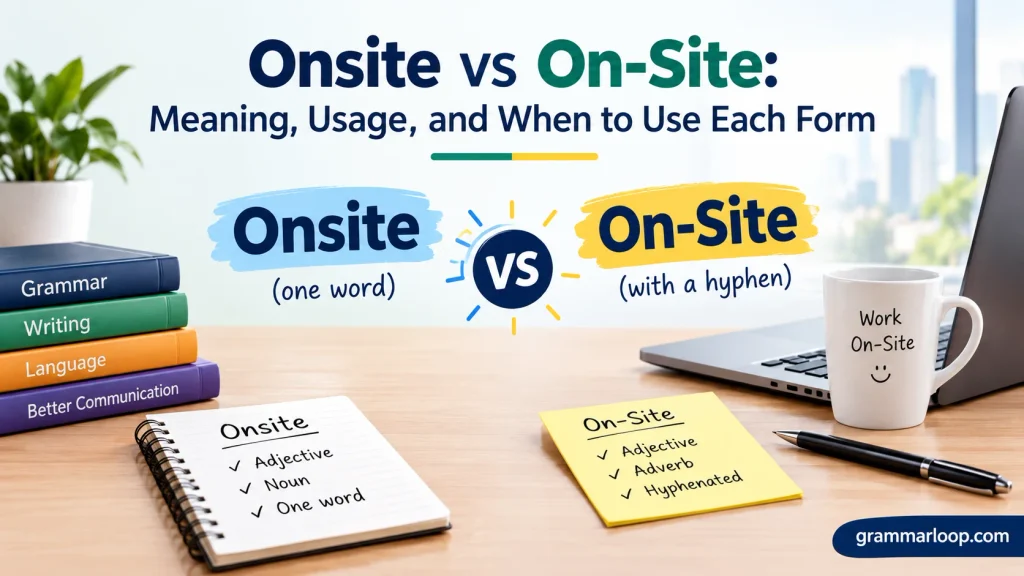
The terms onsite and on-site may look almost identical, but their spelling, meaning, and usage can sometimes confuse writers. Both forms generally describe something that happens at a particular location, especially in workplaces, schools, offices, and business settings. However, choosing the correct form depends on the writing style, context, and grammar rules you follow. Understanding this small difference can help you write more clearly, professionally, and confidently in everyday communication.
The word onsite is commonly used as a single word, particularly in modern business writing, job descriptions, and workplace policies. For example, a company might offer onsite training, onsite support, or onsite services to employees and customers. On the other hand, on-site uses a hyphen to connect the words “on” and “site.” This version is also widely accepted, especially in formal writing, technical documents, and publications that follow specific style guides. Both forms can communicate the same basic idea, so it is important to consider consistency and the preferences of your audience.
In this guide, you will discover the meaning, differences, and practical uses of onsite vs on-site through simple explanations and helpful examples. We will explore when to use each spelling in professional emails, workplace documents, job advertisements, and everyday sentences. You will also learn how dictionary preferences, style guides, and writing conventions can influence your choice. By the end, you will understand how to select the most suitable form for your writing needs and avoid common spelling mistakes. Whether you are writing a business report, updating a résumé, or creating website content, this guide will help you make the right choice.
Quick Answer:
If you only need the essential takeaway:
- On-site = the traditional, hyphenated form used in formal writing
- Onsite = the modern, closed compound form used in digital and informal contexts
- Both mean the same thing: at a physical location
Here’s the key idea:
The difference is not meaning. The difference is style.
Think of it like “email” vs “e-mail.” Both work, but one feels more modern and streamlined.
Onsite vs On-Site Meaning Explained Clearly
Let’s break down both forms so you actually understand how they behave in sentences.
What “On-Site” Means
The hyphenated form “on-site” acts as both:
- An adjective
- An adverb
It describes something happening at the actual location instead of remotely.
Examples:
- On-site inspection of the building revealed structural issues.
- The company provides on-site technical support.
- Engineers worked on-site during the system installation.
The hyphen connects the words so the reader treats them as one unit.
Without it, confusion can creep in. For example, “on site inspection” can look like a prepositional phrase instead of a compound modifier.
What “Onsite” Means
“Onsite” removes the hyphen and turns the phrase into a single word compound.
It carries the same meaning:
- At the physical location
- In person
- Not remote
Examples:
- The candidate completed an onsite interview.
- The company offers onsite childcare.
- Teams provide onsite support during deployment.
This version feels more modern and is widely used in tech, startups, and internal communication.
Onsite vs On-Site: Real Difference You Actually Need to Know
Let’s be blunt:
👉 There is no difference in meaning
👉 There is a difference in style, tone, and context
Here’s a simple breakdown:
- “On-site” signals formal writing
- “Onsite” signals modern or internal writing
- Editors, industries, and style guides decide which one you use
It’s less about grammar rules and more about consistency and audience expectations.
Onsite vs On-Site Comparison Table
| Feature | On-Site | Onsite |
| Structure | Hyphenated phrase | Closed compound word |
| Meaning | At a physical location | At a physical location |
| Tone | Formal, traditional | Modern, streamlined |
| Common usage | Academic, journalism, construction reports | Tech, startups, HR systems |
| Readability | Slightly more explicit | More compact |
| Style preference | AP Style often prefers it | UX writing, internal docs prefer it |
| Flexibility | Less flexible | More flexible in branding |
This table shows the truth clearly: style, not meaning, drives the choice.
Style Guide Rules Behind Onsite vs On-Site
Different writing systems influence which version you should use.
Formal Writing Standards Favor “On-Site”
Traditional editorial systems often prefer hyphenation when two words act as a single modifier.
Why?
Because hyphens reduce ambiguity.
For example:
- “on-site manager” clearly modifies “manager”
- “onsite manager” can still work, but some editors see it as less precise
You’ll often see “on-site” in:
- Academic papers
- Government documents
- Engineering reports
- Construction documentation
In these environments, clarity matters more than speed.
Modern Digital Writing Prefers “Onsite”
Digital-first companies often remove hyphens for simplicity.
Why?
Because modern writing prioritizes:
- Speed
- Clean UI text
- Minimal punctuation
- Mobile readability
You’ll see “onsite” in:
- Tech job listings
- SaaS platforms
- HR onboarding portals
- Internal dashboards
For example, a job post might say:
- “Onsite interview required at headquarters”
Instead of:
- “On-site interview required at headquarters”
Both work. One just feels more modern and efficient.
Read More: Ways to Say It Means a Lot: Powerful Alternatives
When to Use “On-Site” (Best Use Cases)
Use the hyphenated version when clarity and formality matter.
Best contexts include:
- Legal documents
- Academic writing
- Engineering reports
- Construction and safety documentation
- Journalism articles with strict editing rules
Practical examples:
- On-site safety inspection
- On-site environmental assessment
- On-site quality control audit
Why it works better here:
Formal writing often involves dense information. The hyphen reduces misreading and keeps meaning tight.
Think of it like traffic signs. You want zero confusion.
When to Use “Onsite” (Modern Usage Contexts)
Use the closed form when writing for modern, fast-moving environments.
Best contexts include:
- Tech companies
- Startup communication
- HR systems and job portals
- Internal company documentation
- UX writing and product interfaces
Examples:
- Onsite interview process
- Onsite onboarding session
- Onsite support engineer
- Onsite team collaboration
Why it works here:
Modern writing values speed and simplicity. The hyphen feels unnecessary overhead.
It’s like removing friction from a user interface.
Case Study: How Tech Companies Use “Onsite”
Let’s look at a real-world pattern.
In most tech hiring pipelines, companies use:
- “Phone screen”
- “Virtual interview”
- “Onsite interview”
They rarely write “on-site interview” anymore.
Why?
Because recruitment systems, dashboards, and calendars prefer short labels. The word “onsite” fits neatly into UI fields without spacing or formatting issues.
A recruiter might see:
Status: Onsite Interview Scheduled
Not:
Status: On-site Interview Scheduled
The meaning stays identical. The user experience improves slightly with the shorter form.
Case Study: Construction Industry and “On-Site” Preference
Now shift industries.
Construction, engineering, and safety documentation still prefer:
- “On-site inspection”
- “On-site hazard assessment”
- “On-site compliance check”
Why?
Because these environments demand precision.
A safety officer reading a report should never misinterpret meaning. The hyphen removes any ambiguity in complex sentences.
For example:
The on-site structural evaluation revealed corrosion in support beams.
Here, clarity matters more than modern styling.
Common Mistakes in Onsite vs On-Site Usage
Even experienced writers slip up. Here are the most common errors.
Mixing both forms in one document
Bad example:
- Onsite interview scheduled for Monday
- On-site preparation required beforehand
This inconsistency weakens professionalism.
Using no hyphen in formal writing systems that require it
Some writers default to “onsite” everywhere. That creates problems in academic or editorial contexts.
Overthinking the difference
Many writers waste time debating the form instead of focusing on clarity and flow.
The truth is simple:
Consistency beats perfection every time.
Regional and Industry Differences in Usage
The difference between “onsite” and “on-site” doesn’t depend heavily on geography. It depends more on industry.
Industries favoring “on-site”:
- Construction
- Engineering
- Academia
- Journalism
- Healthcare documentation
Industries favoring “onsite”:
- Software development
- IT services
- Startups
- HR platforms
- SaaS companies
Regional note:
Both forms appear in US and UK English. The difference comes from style guides, not country rules.
Implications of Onsite vs On-Site
If you write content online, this part matters more than most people think.
Search engines treat both as the same intent
Google understands that:
- “onsite support”
- “on-site support”
point to the same concept.
What actually matters for :
- Consistency across your content
- Natural keyword usage
- Avoiding duplication in phrasing
- Matching user search behavior
Best practice:
Pick one version per page or brand system.
For example:
- Blog uses “on-site” consistently
- Product pages use “onsite” consistently
Mixing both can dilute clarity for readers, even if search engines understand it.
Quick Decision Guide: Which One Should You Use?
Here’s a simple rule set you can actually apply:
Use “on-site” when:
- You write formal content
- Your audience expects editorial standards
- You work in engineering, academia, or compliance
- You want maximum clarity
Use “onsite” when:
- You write for tech or startup environments
- You create internal documentation
- You design UI text or product labels
- You prefer modern, minimal style
Golden rule:
Choose one form and stick with it across your entire document or system.
Conclusion
Choosing between Onsite and On-Site is mostly about style, consistency, and the writing context rather than a difference in meaning. Both forms refer to something that happens at a specific location, but onsite is becoming more common in modern business writing, while on-site remains widely accepted in formal documents and style-guide-based writing. The best approach is to follow one spelling throughout your article, email, or workplace document. If your company or publication follows a particular style guide, use its preferred form consistently. By understanding this simple spelling difference, you can write more professionally, avoid unnecessary mistakes, and make your communication clearer.
FAQs
1. Is “onsite” or “on-site” correct?
Both are correct. Onsite is the modern closed-word spelling, while on-site is the traditional hyphenated form used in many formal writing styles.
2. What does “onsite” mean?
Onsite means something happens at a particular physical location, such as an office, construction site, school, or workplace.
3. Should I use “on-site” in professional writing?
Yes. On-site is widely accepted in professional, technical, and formal writing, especially if your organization follows a style guide that prefers hyphenation.
4. Is “onsite training” grammatically correct?
Yes. Onsite training is grammatically correct and is commonly used in job postings, company websites, and workplace communication.
5. Which spelling should I use for SEO content?
For content, onsite is often the better choice because it matches modern search behavior. However, including on-site naturally in your article can help cover both keyword variations.






One Response